
What is the primary role of dense word embeddings such as those produced by Word2Vec or GloVe in natural language processing pipelines?
Select an answer to reveal the explanation.
Short Explanation and Infographic
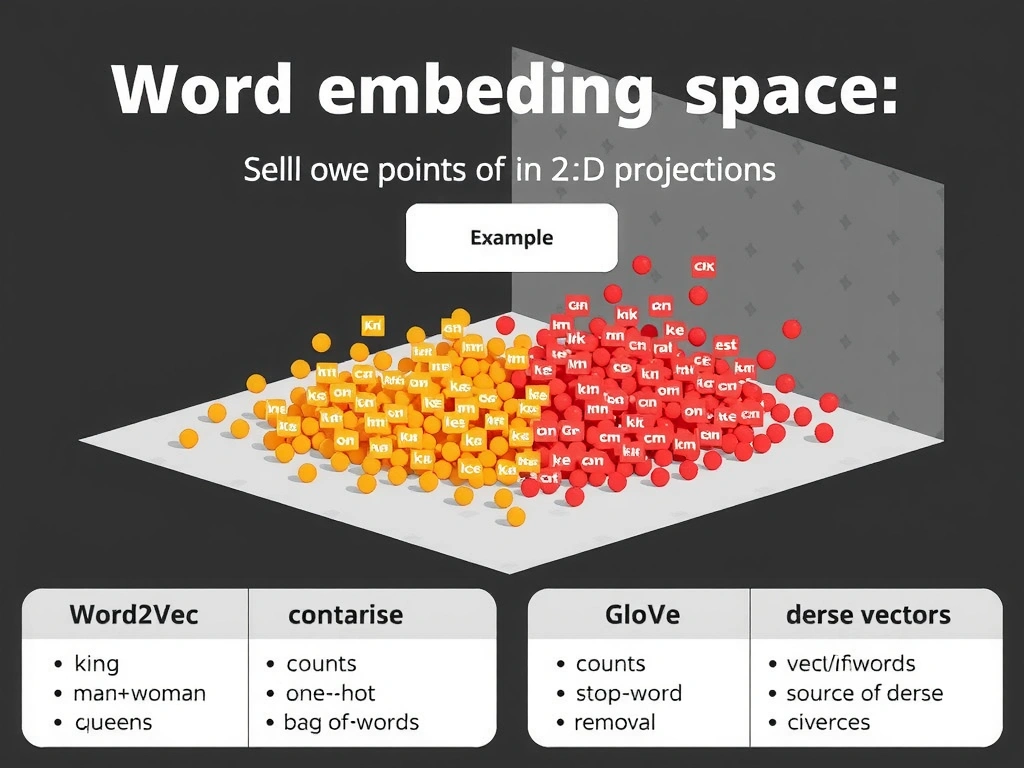
Check this out. Words aren't just strings to a model—they need numbers that carry meaning. Word embeddings squash each word into a dense vector so "king" and "queen" sit nearer each other than "king" and "carburetor." Word2Vec and GloVe learn those spaces from co-occurrence patterns. Think of it like seating people at a huge party: related concepts end up at the same table. Exam trap: folks confuse embeddings with bag-of-words counts, stop-word removal, or document topic IDs. Those are different tools. Land it: embeddings = dense vectors that encode semantic and syntactic relationships. You've got this—keep going.
Full explanation below image
Full Explanation
Word embeddings convert discrete vocabulary tokens into fixed-length dense real-valued vectors. Methods such as Word2Vec (skip-gram or continuous bag-of-words) and GloVe (global co-occurrence factorization) learn these vectors so that geometric relationships mirror linguistic relationships: synonyms and words used in similar contexts lie close in cosine or Euclidean distance, and certain algebraic regularities capture analogies. Downstream models then consume sequences or averages of these vectors instead of opaque string identifiers, which improves generalization compared with sparse one-hot or pure count features when data is limited.
The correct answer states this primary purpose: dense continuous representations that encode semantic and syntactic structure. Embeddings can be static (one vector per word type) or contextual (different vectors per occurrence, as in transformer hidden states). Static embeddings remain useful baselines, for feature bootstrapping, and for educational clarity. Practical considerations include vocabulary coverage, out-of-vocabulary handling, dimensionality choice, and domain adaptation when the pre-training corpus differs from the application domain.
Distractors describe other NLP operations. Assigning a document a single topic label is closer to topic modeling or document classification outputs, not word embedding construction. Removing punctuation or expanding contractions is text normalization, which may precede embedding lookup but is not the embedding’s purpose. Bag-of-words or term-frequency tables record how often tokens appear; they are high-dimensional and sparse and do not place words in a shared continuous geometry of meaning. A durable exam memory aid is “embeddings place words on a map of meaning; counts only tally visits.” When a question mentions Word2Vec or GloVe and asks for the main purpose, select dense vectors that capture relationships among words—not cleaning steps, not raw counts, and not document-level topic IDs alone.