
Within an AI project lifecycle, what is the MLOps stage mainly responsible for?
Select an answer to reveal the explanation.
Short Explanation and Infographic
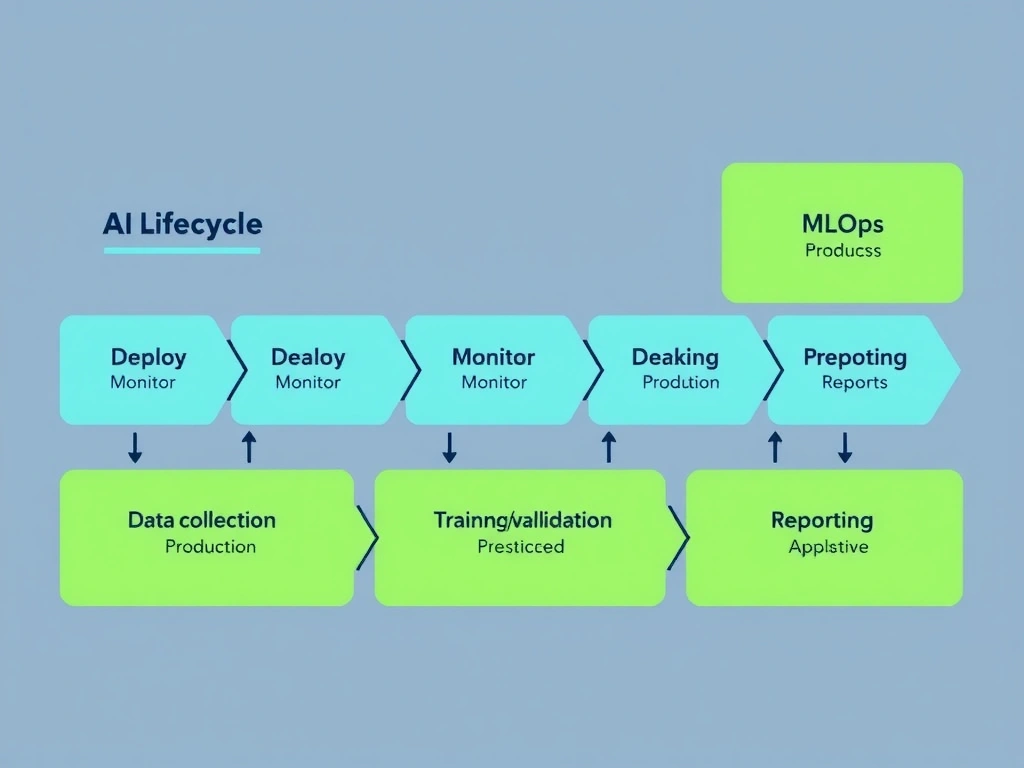
Let's keep this straight. ML development gets you a model; MLOps keeps that model alive in the real system. Deploy it, watch the metrics, retrain when drift shows up, fix broken pipelines—that's the job. I remember when teams treated "done" as the moment training finished… then production ate them alive. Exam trap: training/validation alone, writing reports, or collecting raw data can all sit near MLOps in a diagram, but they aren't the main MLOps responsibility. When you see deploy + monitor + maintain in production, you've got MLOps. Land it: operations for machine learning systems after (and around) the handoff to production. You're stacking the odds in your favor by thinking lifecycle, not one-off science projects.
Full explanation below image
Full Explanation
In lifecycle framing, MLOps is the set of practices and platform capabilities that operationalize machine learning. While model training and validation produce candidate artifacts and quality estimates, the MLOps stage is primarily concerned with what happens when those artifacts must run reliably as software services or batch jobs: deploying models safely, monitoring their technical and statistical health, and maintaining them through updates, retraining, rollbacks, and incident response when something breaks in the live path.
This includes CI/CD (or CT—continuous training) pipelines, model registries, environment promotion, feature serving consistency between train and serve, observability for latency and errors, drift detection, access control, and compliance logging. MLOps does not replace data science; it connects experimental work to durable production outcomes and feedback loops so that insights from the field return to the next training cycle. Without that operational layer, even strong offline models tend to decay or fail silently after release.
Training and offline validation remain essential but are incomplete as a definition of the MLOps stage because they can occur entirely outside production operations. Generating final reports aids communication and audit but is not the core operational mandate. Collecting and initially cleaning data establishes the foundation of the project and usually precedes modeling; it is not synonymous with MLOps even though data pipelines are later monitored and versioned under operational practices once systems are live.
Organizations mature by standardizing deployment patterns, defining ownership for production models, and treating models as long-lived products with clear SLAs. For exam questions that ask what the MLOps stage is "primarily about," prioritize deployment, monitoring, and maintenance of machine learning models in production environments over isolated research, documentation-only, or early data-ingestion tasks. A compact memory aid is deploy, watch, and care for the model after it leaves the lab.