
In prompt engineering for large language models, what is the Chain-of-Thought technique meant to accomplish?
Select an answer to reveal the explanation.
Short Explanation and Infographic
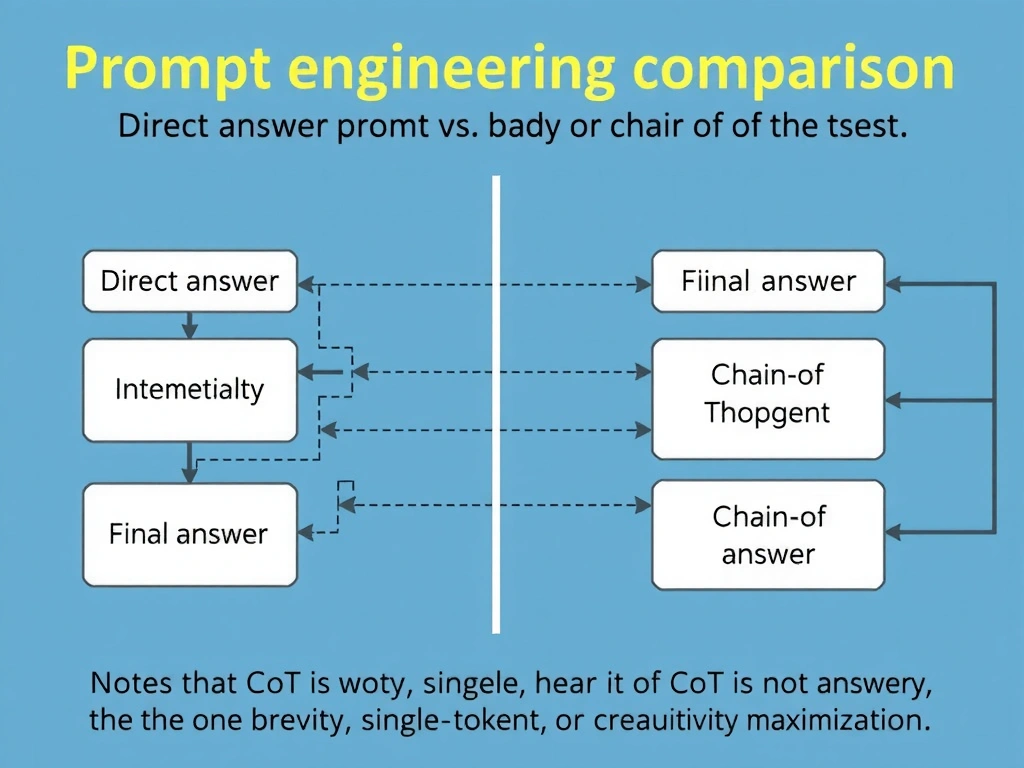
Here's the deal with Chain-of-Thought: you're not asking the model to blurt out an answer like a magic eight ball. You're nudging it to show its work—step one, step two, step three—then land the conclusion. Think of it like making a junior engineer walk through the troubleshooting path instead of guessing. For multi-hop math, logic, or planning questions, that decomposition is gold. Exam trap: CoT is not "make it shorter," not "one final answer only," and not "be more creative." Those are different prompt goals. If the option says guide intermediate steps on a complex problem, that's CoT. Pay close attention—you'll see this paired with few-shot examples that include sample reasoning. Practice writing a CoT prompt yourself; it sticks better hands-on.
Full explanation below image
Full Explanation
Chain-of-Thought (CoT) prompting is a prompt-engineering technique that improves large language model performance on tasks requiring multi-step reasoning. Instead of requesting only a final answer, the prompt encourages the model to generate intermediate reasoning steps—an explicit decomposition of the problem—before concluding. This can be elicited with phrases such as "think step by step," or more reliably with few-shot exemplars that demonstrate worked reasoning traces leading to answers that the model can imitate in structure.
The underlying intuition is that intermediate tokens allow the model to allocate computation across a sequence of simpler subproblems, reducing errors that occur when many logical leaps are compressed into a single generation. CoT has been shown especially helpful for arithmetic word problems, symbolic manipulation, and certain commonsense multi-hop questions where a single leap is fragile. Variants include zero-shot CoT, few-shot CoT, and self-consistency methods that sample multiple reasoning paths and aggregate answers to improve robustness. In production prompt design, teams often reserve CoT for harder items and keep simple factual lookups on direct prompts to control latency and cost.
CoT is not designed to minimize answer length; shorter answers without working often hurt hard reasoning tasks. It is the opposite of forbidding intermediate reasoning or demanding only a final token. It is also distinct from creativity-maximizing prompts that prioritize stylistic diversity over correctness. Practitioners should still validate outputs, because fluent reasoning traces can be wrong, and sensitive applications may need constrained decoding, external tools, calculators, or human review before acting on a conclusion.
Best practice is to match CoT to tasks that benefit from decomposition, provide clear formatting for steps, and separate reasoning from the final answer when post-processing is needed. For exams, associate Chain-of-Thought with guiding models to solve complex problems via intermediate steps—not with brevity, single-token finality, or pure creative generation. If a choice mentions decomposing a complex problem into intermediate steps, that is the Chain-of-Thought signal you want.