
In an NLP text-preprocessing pipeline, what does stemming do?
Select an answer to reveal the explanation.
Short Explanation and Infographic
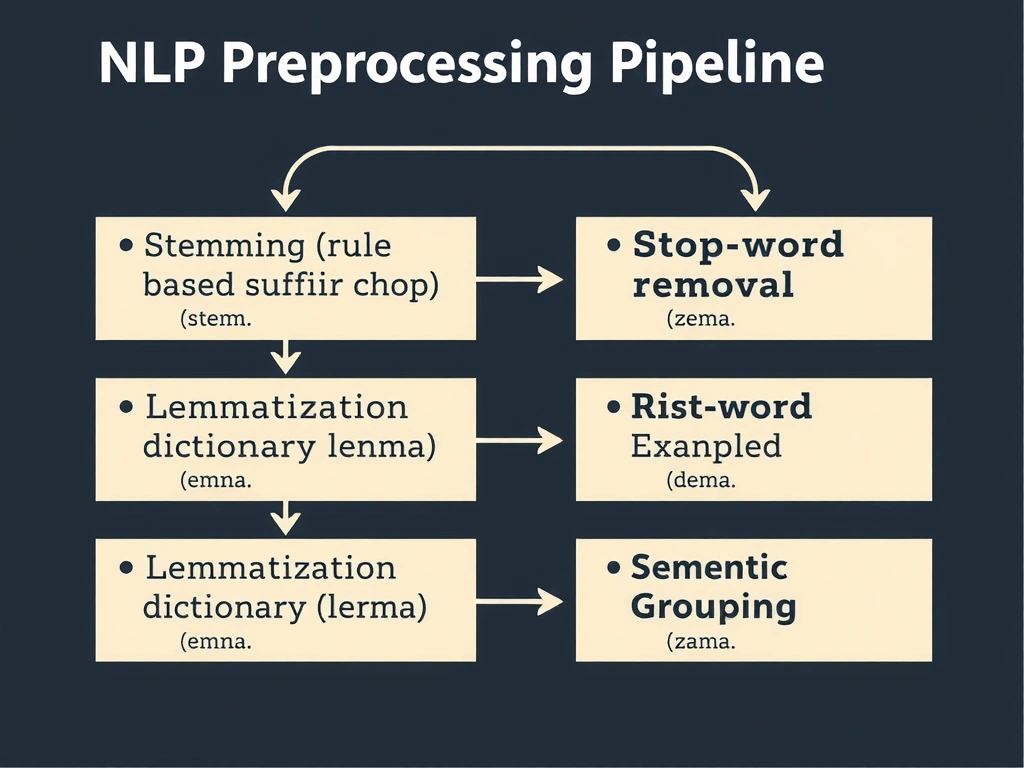
Okay, quick NLP trap time. Stemming is the rough, rule-based chop job: "running," "runs," "ran" might all get whacked down toward a common stem so bag-of-words models don't treat every surface form as a stranger. Think of it like hacking branches off a word tree with garden shears—not always pretty, but fast. Don't confuse it with stop-word removal (kicking out "the" and "a") or with grouping synonyms by meaning. And here's the exam classic: stemming versus lemmatization. Lemmatization wants a real dictionary word—a lemma—using linguistics. Stemming just applies heuristics and might leave weird non-words. If the option says simple heuristic root/stem from chopping endings, that's stemming. Got it? Sweet—don't mix those four steps on test day.
Full explanation below image
Full Explanation
Natural language preprocessing often converts raw text into tokens suitable for classical or hybrid ML pipelines. Stemming is a lightweight normalization technique that reduces inflected or derived word forms to a common stem by applying deterministic, language-specific heuristic rules—commonly suffix stripping as in the Porter or Snowball stemmers. The goal is to collapse morphological variants so that features based on counts or presence treat related forms more similarly, improving generalization when training data is limited and reducing vocabulary size.
Stemming is intentionally crude: it does not require a full morphological analyzer and may produce stems that are not valid dictionary words (for example, "studies" and "studying" may map to truncated forms). That speed and simplicity made stemming popular in information retrieval and traditional NLP. Lemmatization, by contrast, maps tokens to a canonical lemma using vocabulary knowledge and part-of-speech context, usually yielding real words ("better" → "good" in some analyzers). Stop-word removal eliminates high-frequency closed-class words that often add little discriminative signal for certain tasks. Semantic grouping or synonymy handling is a different concern involving thesauri, wordnets, or embedding similarity—not suffix heuristics.
Choosing stemming versus lemmatization depends on language, task, and pipeline. Stemming can over-conflate distinct meanings or under-conflate irregular forms; lemmatization is often more precise but costlier and language-resource dependent. Modern deep NLP models with subword tokenizers may rely less on stemming, yet the concept remains exam-relevant for classical pipelines and for distinguishing adjacent preprocessing steps.
For test questions, remember: stemming = heuristic ending truncation to a stem; lemmatization = dictionary/morphological base form; stop words = remove common function words; semantic clustering = meaning-based grouping. Matching the definition to the right step avoids the most common multiple-choice mix-ups.