
What is the main purpose of the model validation phase in an AI project?
Select an answer to reveal the explanation.
Short Explanation and Infographic
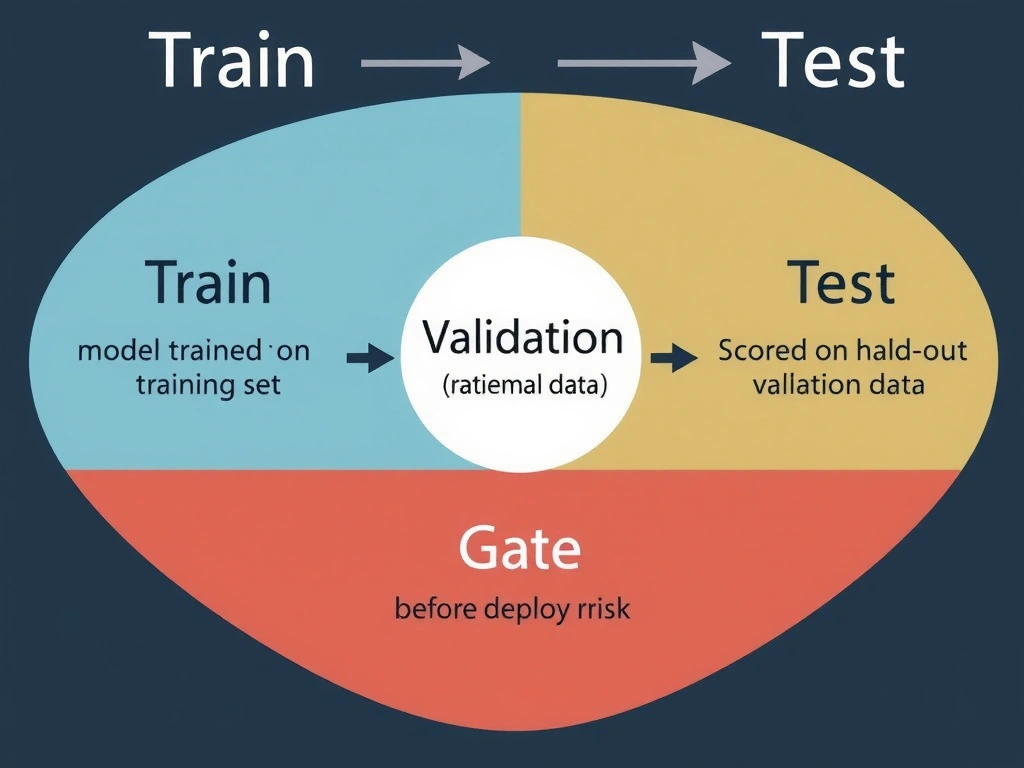
Here's where it gets interesting for you. Training accuracy can look amazing because the model basically memorized the homework. Validation asks a tougher question: does it still work on problems it hasn't seen? You hold out data—or use cross-validation—and score the model there so you know if it generalizes. Boss walks in: "Are we ready to deploy?" If you only quote training metrics, you're guessing. Exam trap: feature selection, training on everything, and deployment are different lifecycle beats. Validation is the honest check on unseen data before you bet the business on the model. Remember: unseen data, generalization, not "train harder" or "go live." Stick with that and you'll nail these lifecycle questions.
Full explanation below image
Full Explanation
Model validation exists to estimate how a trained model will behave on new data drawn from the same problem distribution. During training, models can overfit—capturing noise and idiosyncrasies of the training set—so high training performance can be misleading. By evaluating on a validation set, through cross-validation, or via a carefully isolated test set, teams measure generalization: the ability to perform well on examples the optimizer never used to update parameters.
Validation informs model selection (which architecture or hyperparameters to keep), early stopping, threshold calibration, and go/no-go decisions before deployment. Metrics should match the business problem—accuracy, precision/recall, ROC-AUC, calibration error, fairness slices, and domain-specific costs of false positives versus false negatives. Leakage must be avoided: information from the holdout must not contaminate training through improper preprocessing or target leakage.
Selecting features is an earlier or parallel modeling activity; it prepares the representation the model learns from, but it is not the defining objective of validation. Training on all available data without a holdout may be done after final selection for a production retrain, yet that step is training—not validation—and still requires a previously defined evaluation strategy. Deployment makes the model available to users and is a later lifecycle stage that should be gated by successful validation.
Sound practice separates training, validation, and final test evaluation; documents metrics and acceptance criteria; and revalidates after major data or pipeline changes. For certification items, map "model validation" to evaluating performance on data the model has not seen in order to ensure it generalizes—not to feature engineering, pure training, or production release.