
A predictive maintenance model is already live on the factory floor. Why should the team keep monitoring it continuously after release?
Select an answer to reveal the explanation.
Short Explanation and Infographic
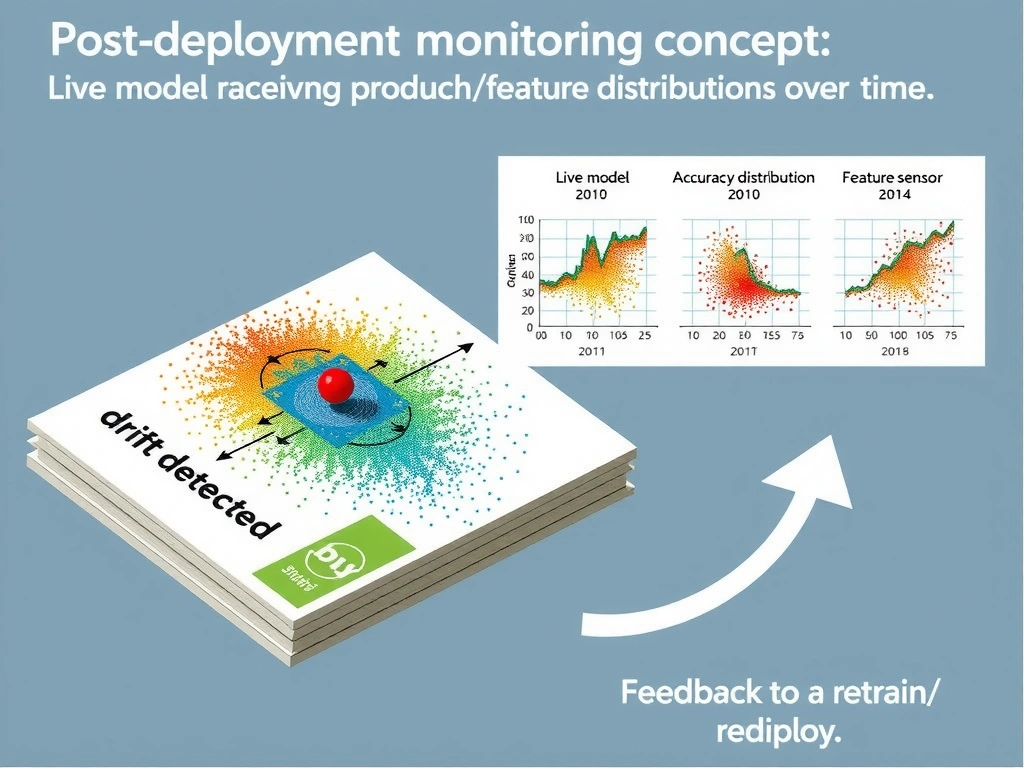
Let me show you how this works in the real world. You deploy a failure-prediction model on day one and everyone high-fives. Then the plant swaps suppliers, sensors age, and operators change shift patterns—and boom, the data the model sees isn't the data it trained on. That's drift, and it's why continuous monitoring exists. You track metrics, look at input distributions, and get alerts when things go sideways—before a silent accuracy drop costs real downtime. Exam trap: nobody monitors to make training slower, force fewer features, or promise 100% forever. That's fantasy. The real reason: detect model drift and performance decay as the world moves. Trust me on this—production is where models grow old. Monitor them like you'd monitor a critical link.
Full explanation below image
Full Explanation
Once a machine learning model is deployed, its training-time performance is no longer a fixed property of the system. Real-world data evolves: equipment is replaced, sensors recalibrated, operating procedures change, seasonal patterns appear, and the relationship between inputs and failure outcomes can shift. These phenomena are commonly discussed as data drift (input distribution changes) and concept drift (the mapping from features to labels changes). Continuous monitoring is the primary operational defense against silent degradation.
Effective monitoring tracks prediction quality when labels eventually arrive (for example, actual failures), proxy signals when labels lag, input feature statistics, prediction score distributions, latency and error rates of the serving stack, and business KPIs tied to the use case. Alerting thresholds and dashboards enable teams to retrain, recalibrate, roll back, or investigate data pipeline bugs before failures cascade into costly downtime or safety issues.
Lengthening training time is not a goal of monitoring; training duration is a resource and pipeline design concern. Reducing the number of features may be a deliberate modeling decision during development or redesign, but it is not the primary purpose of production monitoring. Guaranteeing 100% accuracy is neither realistic nor a monitoring objective; models are statistical systems with residual error, and operations aim for stable, acceptable performance under defined SLAs.
Best practices include establishing baseline metrics at launch, monitoring both technical and business outcomes, versioning models so regressions are attributable, and defining playbooks for drift response (investigate, retrain, redeploy). In factory predictive maintenance, missing drift can mean missed failures or excessive false alarms that erode operator trust. For exams, connect continuous monitoring after deployment primarily to detecting model drift and performance decline as data distributions change.