
In an AI project lifecycle, what is the primary goal of the deployment phase?
Select an answer to reveal the explanation.
Short Explanation and Infographic
Check this out: training builds the model; deployment puts it to work. Think of it like baking a cake versus serving it in the restaurant. You can have a perfect model sitting in a notebook, and customers never see it—until you deploy. Deployment means packaging the model, wiring APIs or batch jobs, handling auth and scaling, and making predictions available to apps and people. Pay close attention: the exam loves to mix lifecycle stages. Cleaning data? Earlier. Choosing algorithms? Still earlier. Training? That's fitting weights, not going live. When the question says deployment, look for language about availability to end users or other services. Land the takeaway: deploy = make the trained model usable in production. Nice and clean.
Full explanation below image
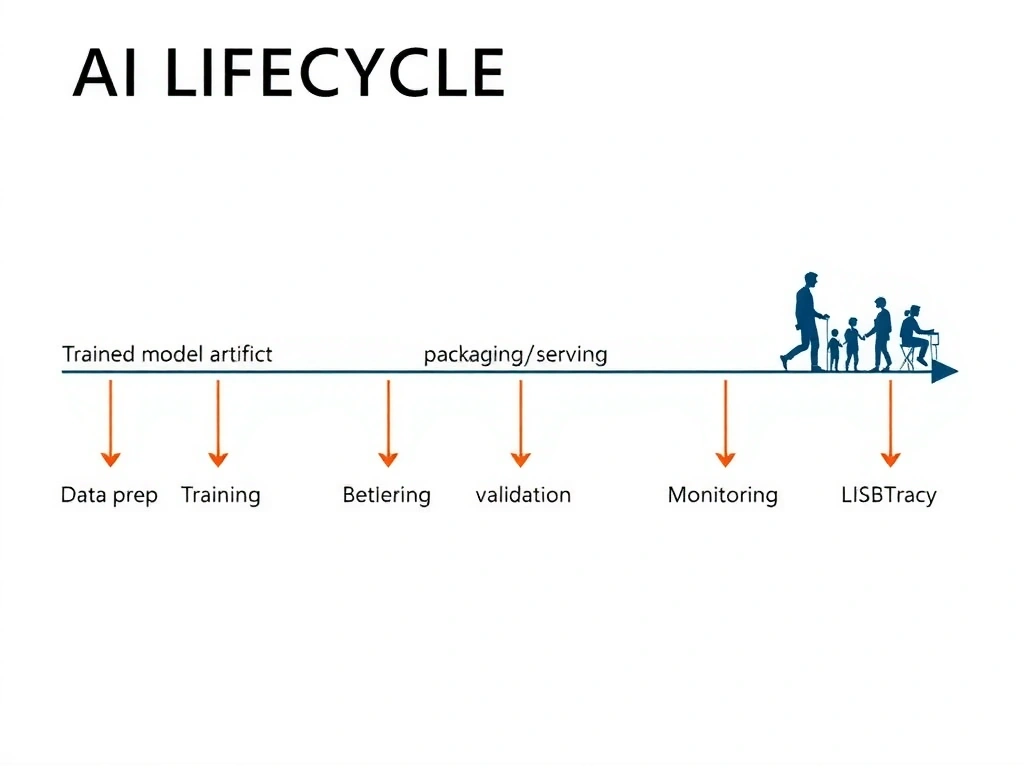
Full Explanation
An AI project lifecycle typically progresses through problem framing, data collection and preparation, model development and training, validation or testing, deployment, and ongoing monitoring and maintenance. The deployment phase is the transition from a model that has been trained and evaluated in a controlled environment to a model that is operationally available. Its main objective is to make that model accessible so end users, product interfaces, or downstream services can request predictions or batch scores under production constraints.
Deployment activities often include packaging (containers, model registries), inference service design (online API versus batch scoring), integration with feature stores or input pipelines, configuration of resources and autoscaling, security controls, canary or blue-green rollout strategies, and logging for observability. Success is measured not only by technical readiness but by safe, reliable access for real workloads.
Data cleaning and preprocessing are foundational and usually precede training; they prepare inputs but do not by themselves put a model in front of users. Selecting algorithms is part of experimentation and model selection. Training optimizes parameters on training data and produces candidate artifacts; without a deployment step those artifacts remain offline. Conflating training with deployment is a common exam mistake because both are "model-related," yet they answer different questions: "Can the model learn well?" versus "Can consumers use the model now?"
In mature MLOps, deployment is gated by validation metrics, approval workflows, and rollback plans. Teams document model cards, resource limits, and ownership. Remember the lifecycle order: prepare data → train/select → validate → deploy → monitor. The correct focus for deployment is operational availability of a trained model for real use—not earlier research or data tasks.