
Clinicians will only adopt a hospital diagnostic model if they can understand why it flagged a case. Which concept is most critical for building that trust?
Select an answer to reveal the explanation.
Short Explanation and Infographic
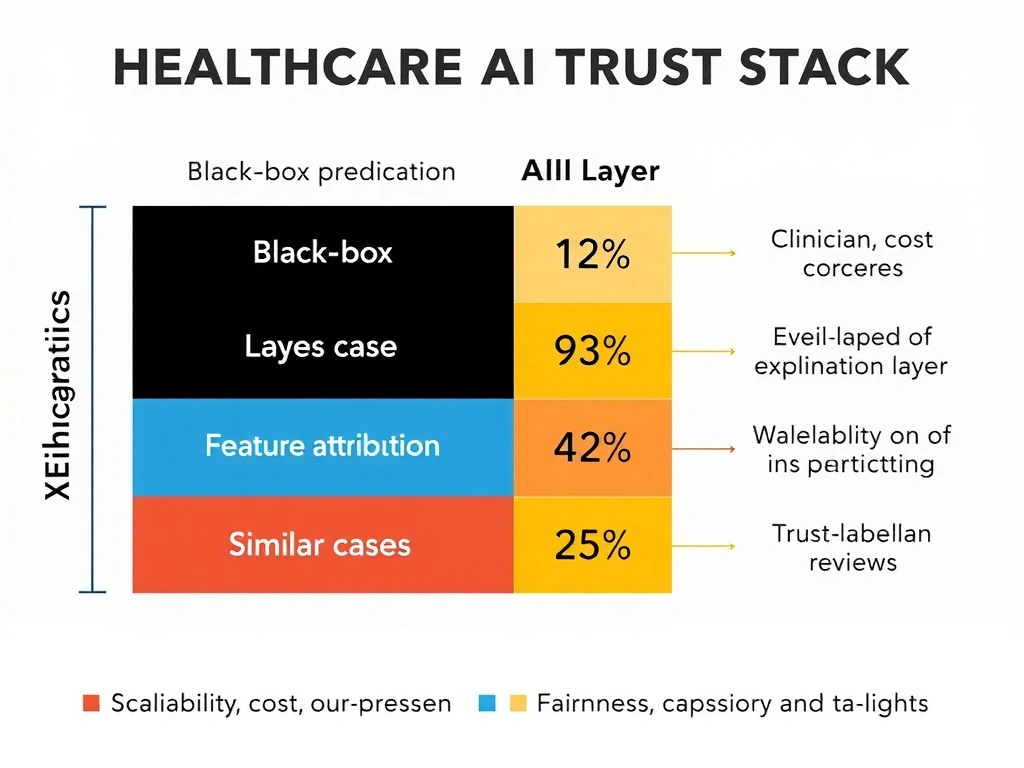
Okay, let's dive in. Doctors aren't going to rubber-stamp a black-box score on a patient chart. Imagine your boss walks in: "The model says high risk—why?" If all you've got is a silent probability, trust dies on the spot. That's where Explainable AI comes in. XAI is about making the why visible—feature contributions, similar cases, rule-style summaries—so a clinician can sanity-check the output against their expertise. Exam trap: don't grab "scalability" or "IT efficiency" just because they sound enterprise-y. Those keep the lights on; they don't explain a diagnosis. Bias matters hugely in medicine, but this question is laser-focused on understandability. Land this: when the ask is trust through understanding, the answer is XAI. You've got this.
Full explanation below image
Full Explanation
In high-stakes domains such as clinical diagnosis, model accuracy alone is insufficient for adoption. Practitioners need enough insight into a prediction to reconcile it with medical knowledge, catch obvious errors, document decisions, and meet regulatory and ethical expectations. Explainable AI (XAI) refers to methods and design practices that make model behavior understandable to humans—ranging from intrinsically interpretable models (for example, sparse linear models or decision rules) to post-hoc techniques such as feature attribution, saliency maps, counterfactual examples, and case-based explanations.
In a diagnostic workflow, XAI supports trust by showing which symptoms, lab values, or imaging patterns most influenced the score, or by presenting analogous historical cases. That transparency does not replace clinical judgment; it complements it. Governance frameworks increasingly expect documentation of model limitations and human oversight pathways, both of which are easier when explanations are available.
Model scalability is about serving more requests or larger models efficiently. It may be necessary for hospital-wide deployment but does not answer "why this patient?" IT efficiency optimizes resource usage and cost; it is orthogonal to interpretability. Algorithmic bias and fairness analysis are critical companion concerns—especially to avoid disparate harm across populations—but the scenario specifically prioritizes understandability for physicians. Choosing bias as the "most important" concept would misalign with the stated requirement, even though a responsible program should address both explainability and fairness.
Best practice is to select explanation methods appropriate to the model class and clinical users, validate that explanations are faithful (they truly reflect model behavior) and useful (clinicians can act on them), and combine XAI with monitoring, audit trails, and clear escalation paths. For exam readiness, map "users must understand predictions to trust them" directly to Explainable AI, not to infrastructure or pure performance metrics.