
An enterprise wants its machine learning work to stay reliable after launch—not just when models are first trained. Which description best captures the MLOps workflow?
Select an answer to reveal the explanation.
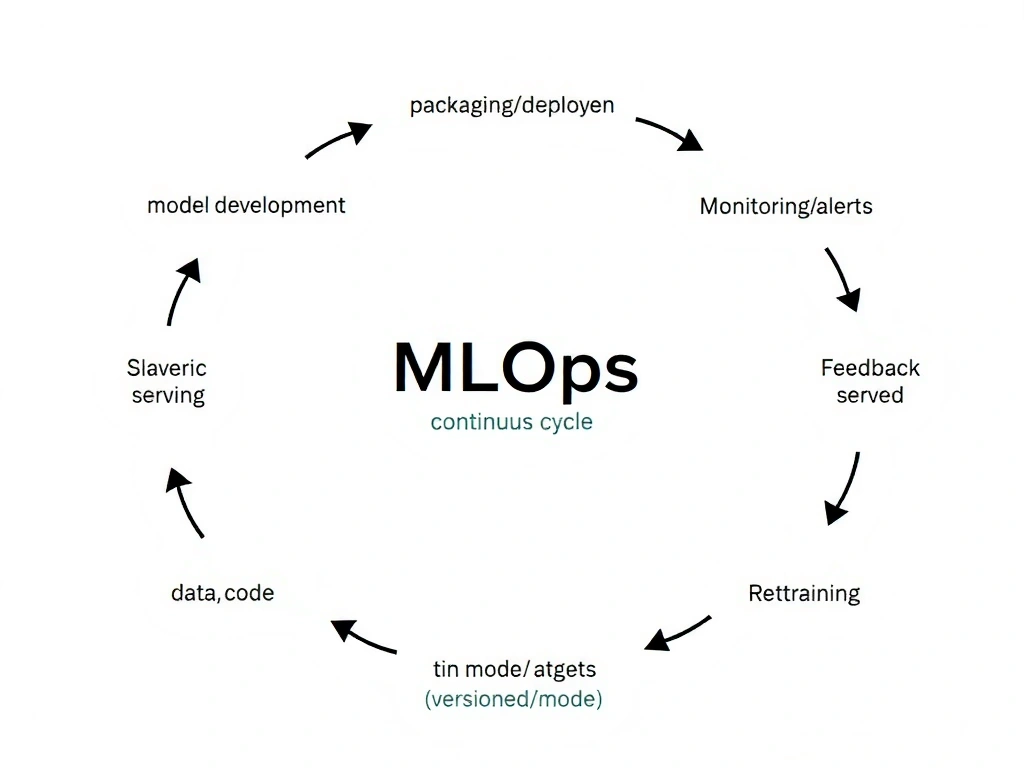
Short Explanation and Infographic
Here's the deal: MLOps isn't "train a model and go home." Think of it like keeping a live network healthy—you don't configure a router once and never look at it again. You build, ship, watch, and fix. Same idea with models. Your boss might say the fraud model is live by Friday—great—but Friday is day one, not graduation. Data shifts, users change, and last month's accuracy can quietly fall off a cliff. MLOps is the continuous cycle of development, deployment, and monitoring so you catch that before customers do. Exam trap: don't pick answers that make MLOps sound like a single script or only the data scientist's job. Remember: continuous loop, multi-role, production-aware. Got it? Sweet—keep that mental model.
Full explanation below image
Full Explanation
MLOps (Machine Learning Operations) adapts DevOps principles to the unique needs of machine learning systems. Unlike traditional software that often behaves the same way once code is fixed, models depend on data distributions, feature pipelines, and environmental assumptions that can change after release. Therefore the MLOps workflow is best understood as a continuous cycle rather than a linear project plan: teams develop and train models, package and deploy them into serving environments, monitor performance and data quality in production, and feed insights back into the next development iteration.
This cycle typically includes versioning of data, code, and models; automated or semi-automated training and evaluation pipelines; controlled promotion from staging to production; logging of predictions and metrics; and processes for retraining or rollback when quality declines. Collaboration across data scientists, ML engineers, platform teams, and business stakeholders is essential because failures can arise from model quality, pipeline bugs, infrastructure issues, or changing business rules.
The continuous-loop characterization is correct because it explicitly covers development, deployment, and monitoring as an integrated workflow. A one-time train-and-release view is incorrect because it ignores post-deployment reality—drift, latency regressions, and concept changes. Treating MLOps as only a data scientist activity is wrong; production reliability requires engineering practices such as CI/CD for models, observability, access control, and incident response. Reducing MLOps to a single training script misses reproducibility, testing, staged rollout, and feedback loops.
In practice, mature MLOps programs define SLAs for model quality, automate promotion criteria, maintain lineage for auditability, and close the loop with scheduled or triggered retraining. For certification purposes, associate MLOps with the operational lifecycle of ML systems—not with isolated research notebooks—and prefer answers that emphasize continuity, production monitoring, and cross-team ownership over one-off experiments.