
A security system must locate human faces within live camera frames so operators can review those regions. Which computer vision task family best matches this requirement?
Select an answer to reveal the explanation.
Short Explanation and Infographic
Security cam, find the faces, highlight where they are—that's detection. Object detection (face detection is the specialized version) draws the boxes so a human or downstream system knows where to look. Classification only tags the whole image: 'this frame has a person' without coordinates. Generation invents new images—you don't need a deepfake engine to watch a lobby. Semantic segmentation paints every pixel; powerful, but for 'show me the faces' the classic fit is detection. Exam trap: people pick segmentation because it sounds more precise, or classification because it's familiar. Ask: do we need locations of instances? Yes → detection. Boss wants face crops for the guard UI by end of day? Ship a face detector, not a text-to-image model. Simple question, clean mapping—don't overthink it.
Full explanation below image
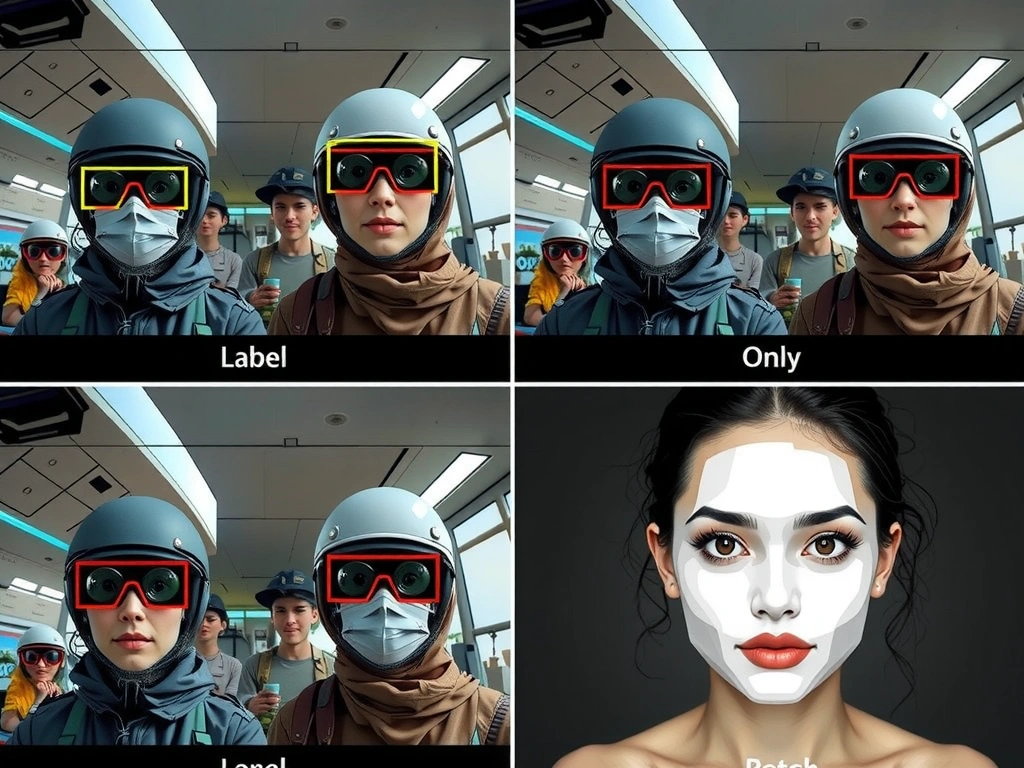
Full Explanation
Computer vision tasks differ by the structure of their outputs. Image classification maps an entire image to one or more global labels without spatial localization. Object detection finds and categorizes instances, usually as bounding boxes with class scores—and face detection is a specialized detector whose class of interest is faces (sometimes with landmarks). Semantic segmentation assigns a class to every pixel, producing dense masks. Image generation synthesizes new pixels rather than analyzing an existing frame for operational review.
The security footage requirement is to detect faces so operators can review those regions. That implies spatial localization of face instances in each frame (and across time in video). Face or general object detection is therefore the most appropriate task family: models propose candidate boxes or keypoints, non-maximum suppression filters duplicates, and crops can be passed to recognition, blur-for-privacy, or human review queues. Real-time systems pair lightweight detectors with tracking to maintain identities across frames, but the core perceptual task remains detection.
Classification is insufficient because a frame-level label cannot highlight where faces appear or handle multiple faces with positions. Image generation is orthogonal; creating synthetic imagery does not locate faces in live CCTV. Semantic segmentation can mark face pixels and is used in matting or AR, yet for security review workflows the standard, efficient, and exam-expected answer is detection: boxes (or landmarks) rather than full-scene dense labeling. Segmentation also typically costs more to annotate and run when instance boxes already meet the product need.
Related distinctions worth remembering: face recognition identifies who someone is after detection; detection only answers where and whether a face is present. Multi-object tracking associates detections over time. When exam stems describe 'find/locate X in images or video,' prefer detection; when they say 'label every pixel,' prefer segmentation; when they say 'what is this image of,' prefer classification; when they say 'create a new image,' prefer generation. Applying that map here yields face/object detection as the best match for locating faces in security footage, aligning technical vocabulary with a concrete operational goal.