
After a fraud-detection model is live, the team implements continuous checks so prediction quality does not silently degrade. Which phase of the AI project lifecycle does this activity primarily belong to?
Select an answer to reveal the explanation.
Short Explanation and Infographic
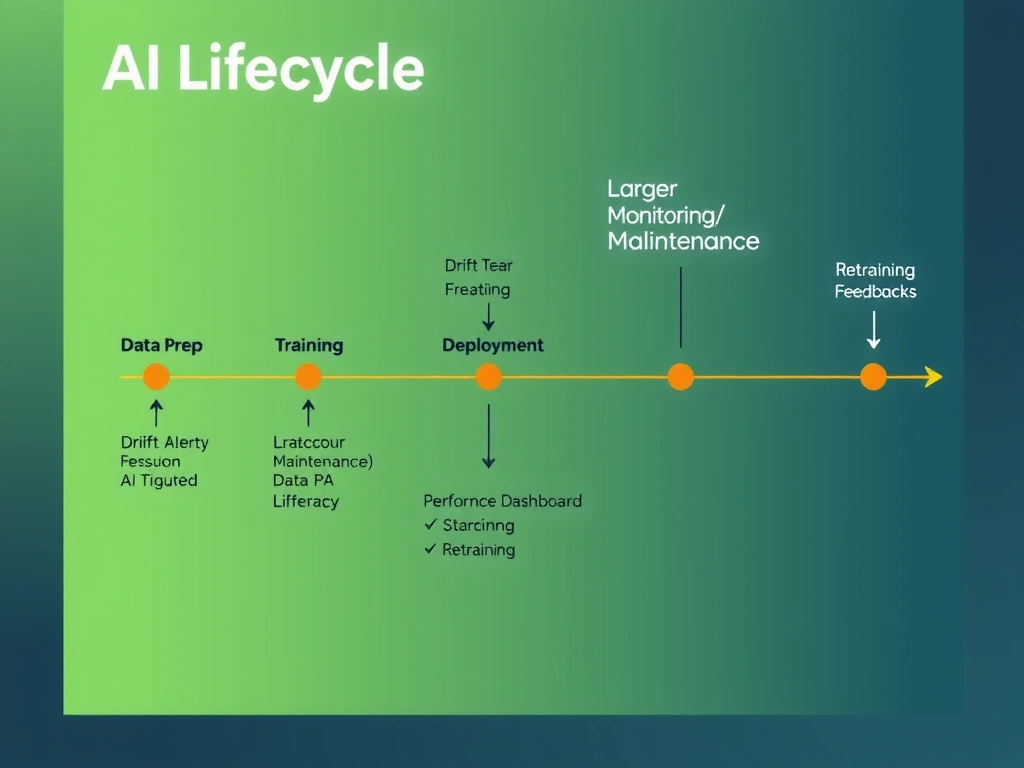
You shipped the fraud model—congrats—but the story isn't over. Fraudsters change tactics, seasonality shifts, data pipelines break. If nobody watches live metrics, accuracy rots and the business finds out the hard way. That ongoing watch-and-fix loop is monitoring and maintenance, not data prep, not 'we deployed it once,' not training. Think of deployment as opening the store; monitoring is noticing when the shelves go empty. Boss walks in: 'Why did false positives spike this week?' You want dashboards, drift alerts, and a retraining plan—not a shrug. Exam trap: picking deployment because the model is in production. Deployment gets it live; monitoring keeps it healthy. Land that split and MLOps questions get easier. Trust me on this—production is a process, not a finish line.
Full explanation below image
Full Explanation
AI project lifecycles typically progress through problem framing, data preparation, model training and validation, deployment to a serving environment, and then ongoing monitoring and maintenance. The scenario describes a model that is already deployed for fraud detection and a team that must ensure accuracy remains consistent over time. That responsibility maps squarely to monitoring and maintenance: tracking predictive performance (when labels arrive with delay), watching input and prediction distributions for drift, detecting upstream data quality breaks, managing challenger models, and triggering retraining or rollback when service levels fail.
Fraud detection is a canonical setting where this phase is non-negotiable. Adversaries adapt, customer behavior shifts, and feature schemas evolve. A model that looked excellent on a static offline test set can degrade weeks later without any code change. Monitoring systems therefore combine technical signals (latency, null rates, feature ranges) with business signals (precision at operational thresholds, dollars saved versus analyst load). Maintenance includes scheduled refreshes, human-in-the-loop review sampling, and governance documentation for regulated environments.
Why other phases are wrong: data preparation covers cleaning, labeling, and feature engineering before or between training cycles, but the question’s emphasis is continuous assurance after go-live. Deployment is the transition of a validated artifact into production infrastructure—critical, yet instantaneous relative to the long tail of operations. Model training is the offline (or pipeline) optimization of parameters on historical data; it creates the artifact being watched, but it is not the watching itself.
Best-practice framing for exams and jobs: treat production ML as a living system. Define SLIs/SLOs for model quality, close the loop from production errors back to datasets, version models and data, and separate deploy events from operate processes. Memory aid: deployment = release; monitoring/maintenance = keep it right. When a stem says 'remains consistent over time' after the model is live, choose monitoring and maintenance every time. That lifecycle literacy is as important as algorithm knowledge for real-world AI delivery.