
In classical computer vision, what is the main role of a HOG (Histogram of Oriented Gradients) descriptor?
Select an answer to reveal the explanation.
Short Explanation and Infographic
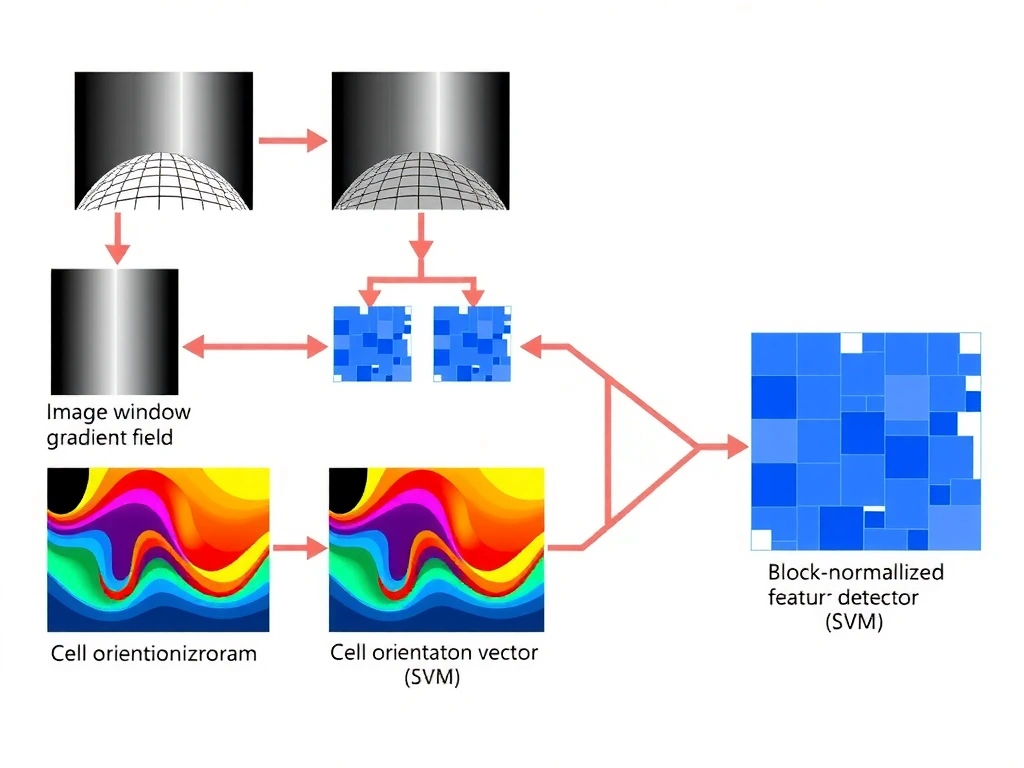
HOG is old-school computer vision—and it still shows up on exams—so let's make it stick. Histogram of Oriented Gradients builds a feature vector from how edges point inside little cells of the image. Strong vertical edges in a torso region? That pattern helped classic pedestrian detectors (HOG + SVM) work before ConvNets took over. It's not an activation, not a loss, not 'a neural net.' Those are the traps. Think of HOG like a careful sketch of edge directions you hand to a classifier. Boss asks why the legacy detector still flags people in warehouse cams? Hand-crafted gradient histograms, not magic. Deep learning largely superseded HOG for many tasks, but knowing what it is—a feature descriptor for detection—keeps you from mixing it up with ReLU or cross-entropy on test day.
Full explanation below image
Full Explanation
Histogram of Oriented Gradients (HOG) is a hand-crafted feature descriptor widely used in pre-deep-learning and classical object detection systems. The algorithm divides an image region into cells, computes image gradients, quantizes gradient orientations into histogram bins weighted by gradient magnitude, and often normalizes histograms across overlapping blocks to improve invariance to illumination and contrast changes. The concatenated histograms form a feature vector that describes local shape through edge structure rather than raw pixel intensities.
Historically, HOG features combined with linear SVMs powered influential detectors such as pedestrian detection. The intuition is that object categories often share characteristic arrangements of edge orientations—upright human bodies produce distinctive vertical and diagonal gradient patterns—while block normalization reduces sensitivity to lighting. Sliding-window search applied the descriptor across scales and positions, scoring each window with a trained classifier.
The correct characterization is therefore: HOG is a feature descriptor used for object detection (and related recognition tasks). It is not an activation function; activations transform neuron pre-activations inside learned networks. It is not a loss function; losses quantify prediction error during optimization. It is not itself a neural network architecture, though neural nets can learn features that supersede HOG. Confusing HOG with those categories usually comes from lumping every 'vision jargon term' into deep learning scaffolding.
Modern practice often replaces HOG with convolutional backbones that learn hierarchical features from data, offering better accuracy on complex benchmarks. Nonetheless, HOG remains pedagogically important: it illustrates gradient-based shape encoding, the value of local normalization, and the classical detect-by-window pipeline. Understanding HOG also clarifies what deep models automate—feature construction—when exam questions contrast engineered descriptors with end-to-end learning. For quick recall: HOG = histograms of edge directions → feature vector → feed a classifier for detection. If an option calls HOG a ReLU-like activation, a training loss, or a full neural net, discard it. That single mapping is enough to secure the point and to connect classical CV with today’s learned detectors.