
At its core, what is prompt engineering primarily concerned with?
Select an answer to reveal the explanation.
Short Explanation and Infographic
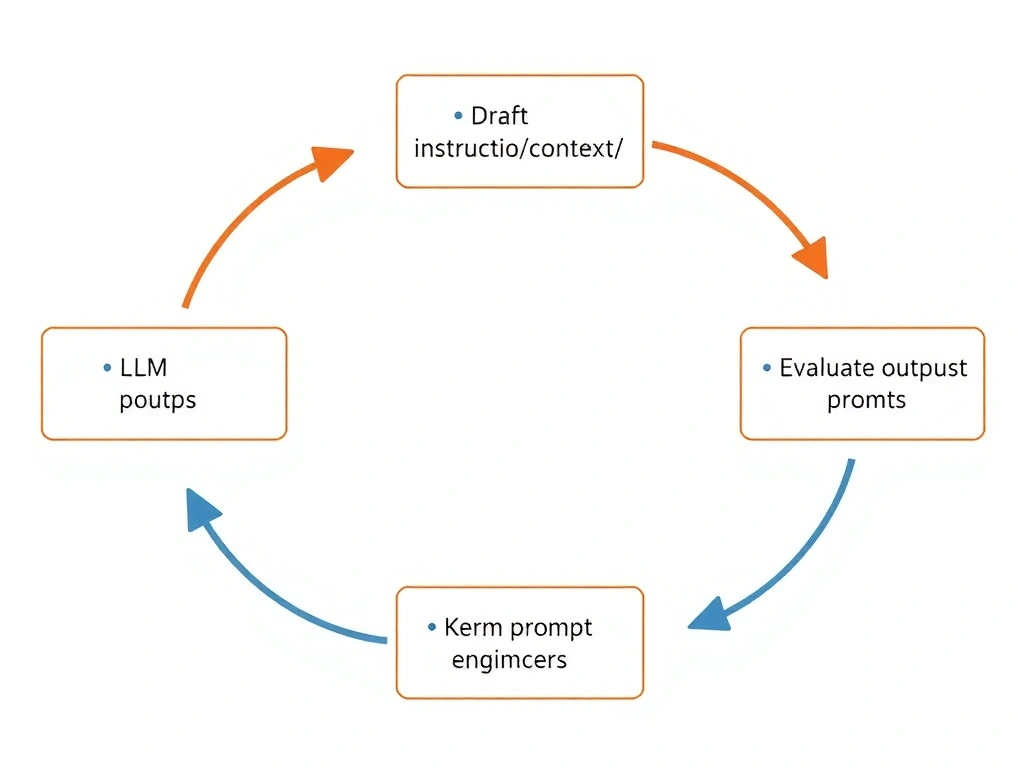
Prompt engineering is exactly what it sounds like: you design the message that goes into the LLM so the thing that comes out is useful. Wording, structure, role, examples, output format—you tweak those instead of retraining a 70B model every time marketing changes the tone. Think of it like this: the model is a brilliant intern with fuzzy instructions; prompt engineering is writing the brief so clearly they stop improvising the wrong stuff. Exam trap: confusing it with writing CUDA, training from scratch, or running a classic sklearn metric report. Related skills, different jobs. Boss wants JSON that always validates? That's a prompt (and maybe a parser) problem first. Get hands-on: change one constraint at a time and watch behavior shift. That's the muscle the exam is testing.
Full explanation below image
Full Explanation
Prompt engineering is the disciplined practice of constructing, testing, and refining the textual (and sometimes multimodal) inputs that condition a generative model—especially an LLM—so that its outputs satisfy task requirements. Practitioners choose instructions, personas, constraints, tool schemas, delimiters, and optional few-shot demonstrations; they manage context length; and they iterate based on systematic evaluation. The goal is reliable behavior from a largely frozen model: correct format, appropriate style, grounded content, and reduced unsafe or off-task completions.
This discipline sits between product requirements and model capabilities. It is not the same as implementing training infrastructure or writing kernels, though platform engineers enable the runtime that executes prompts. It is not synonymous with classical model evaluation, though good prompt work depends on evaluation harnesses, rubrics, and regression sets. It is certainly not equivalent to pretraining a new foundation model from scratch, which requires massive data pipelines, distributed training, and research investment orders of magnitude beyond editing prompt templates.
Effective prompt engineering blends clarity with constraints: specify the audience, the forbidden behaviors, the citation rules, and the exact output schema when needed. Techniques include zero-shot and few-shot designs, chain-of-thought or decomposition for hard reasoning, retrieval-augmented context for factual grounding, and defensive patterns against prompt injection in adversarial settings. Version prompts like code; A/B test; monitor production transcripts for drift.
Why exams emphasize the definition: adjacent vocabulary collides. People say 'prompt engineering' when they mean 'build an LLM,' or they reduce it to a single magic phrase. The accurate core is iterative design of model inputs toward desired results. Memory aid: if you did not update weights and you did improve task success by changing what the model reads, you were doing prompt engineering. As systems mature, prompts may be partially replaced by fine-tuning, tools, or structured decoding—but the conceptual center remains steering generation through carefully engineered inputs. That is the answer to select when options dangle coding, metric computation, or full pretraining as look-alikes.