
Why is semantic segmentation often considered especially challenging in computer vision projects?
Select an answer to reveal the explanation.
Short Explanation and Infographic
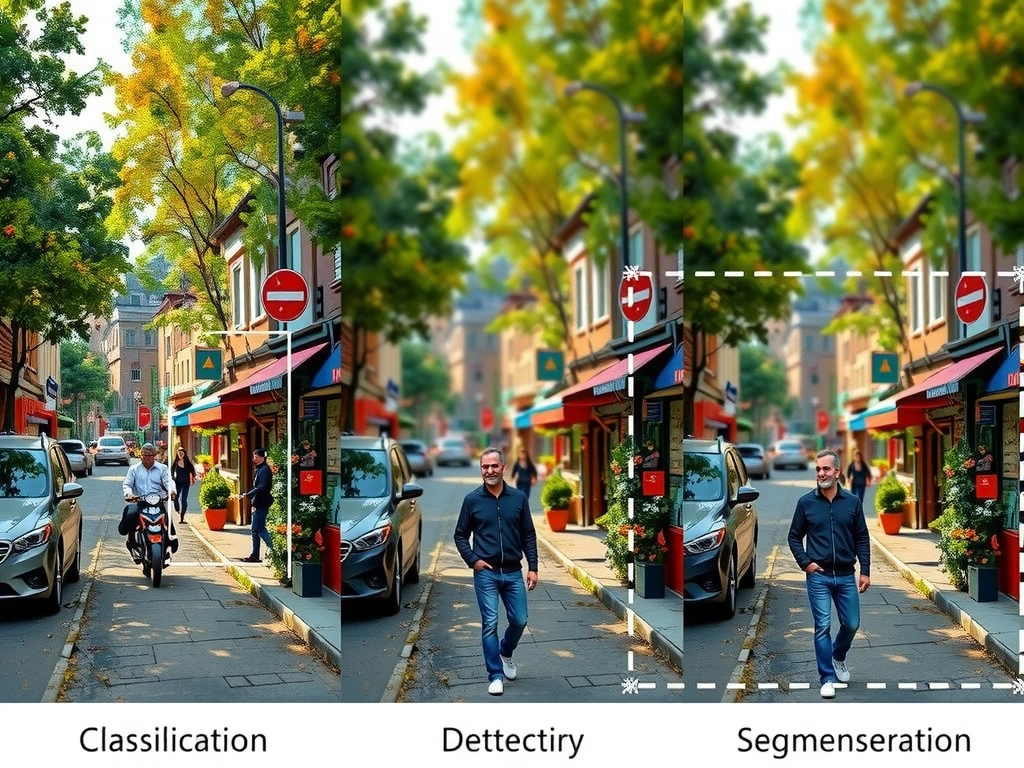
Semantic segmentation is where every pixel gets a class—road, car, person, background—the whole map. That sounds clean until you try labeling it. Somebody has to paint precise masks, not just draw a box or pick one image tag. Boundaries get messy, thin objects vanish, class imbalance is brutal. Deep models help, but they don't make annotation free or edges magically perfect. Exam trap: answers that say the task is 'too easy,' 'super interpretable,' or 'always faster to train than classification.' Don't take the bait. The real pain is pixel-level precision plus mountains of finely labeled data. If your boss wants lane markings segmented by Friday with fifty labeled frames, you'll feel that challenge immediately. Remember: dense labels, dense headaches—worth it for maps and medical masks, but never 'trivial.'
Full explanation below image
Full Explanation
Semantic segmentation assigns a class label to every pixel in an image, producing a dense categorical map rather than a single image-level tag or a sparse set of bounding boxes. That density is exactly why projects find it hard. Annotation cost scales poorly: labelers must delineate object interiors and boundaries carefully, often using specialized tools, multi-review consensus, and ontology rules for ambiguous regions (for example, where a pedestrian meets a bicycle). Quality issues at edges and thin structures heavily influence metrics such as mean Intersection-over-Union (mIoU), so small labeling inconsistencies become large performance swings.
From a modeling perspective, networks must preserve spatial detail while building semantic context. Encoder–decoder designs, skip connections, multi-scale context modules, and high-resolution feature pathways exist largely to fight the tension between downsampling for semantics and upsampling for crisp masks. Class imbalance is common—background pixels may dominate—so loss design (weighted cross-entropy, Dice-style objectives, boundary losses) becomes part of the challenge. Domain shift (lighting, sensors, geographies) can shatter boundary quality even when coarse recognition still looks acceptable.
The correct answer therefore stresses pixel-level precision and the need for large amounts of carefully labeled data. Claiming the task is too simple for deep learning ignores both the annotation burden and the active research surface around accurate boundaries. Claiming models are very easy to interpret is unsupported; dense predictors remain complex neural systems. Claiming training is always slow as a definitional issue is also a weak distractor framing—and the opposite claim that training is always easier than classification is false in many high-resolution settings where memory and compute balloon.
Practically, teams mitigate difficulty with pretrained backbones, weak or semi-supervised labels, synthetic data, active learning on uncertain regions, and hierarchical taxonomies that separate 'stuff' (sky, road) from 'things' (car, person). Still, when an exam asks for a common challenge, prioritize dense supervision and precision—not myths about triviality or automatic interpretability. Compared with classification or detection, segmentation’s supervision signal is richer and costlier; that tradeoff is the concept to remember.