
You send a zero-shot prompt asking an LLM to draft a travel itinerary. What does zero-shot mean in this situation?
Select an answer to reveal the explanation.
Short Explanation and Infographic
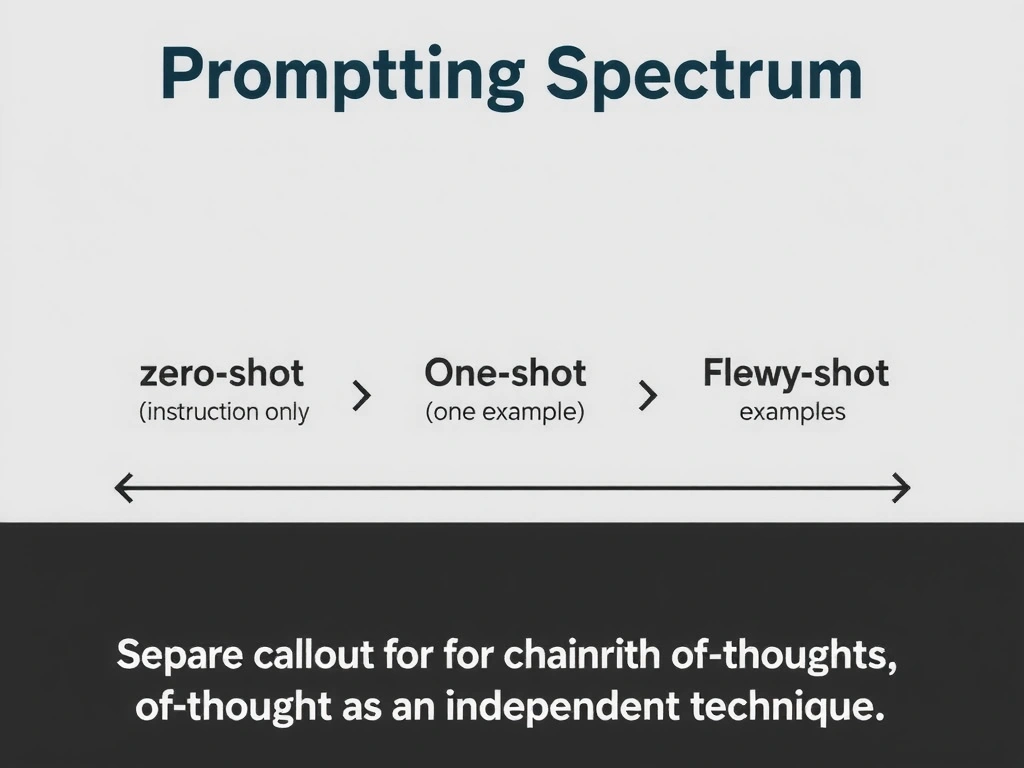
Zero-shot sounds fancy, but it's simple: you tell the model what you want without showing it examples in the prompt. 'Write a three-day Kyoto itinerary for food lovers'—that's zero-shot. If you paste two sample itineraries first and then say 'now do Osaka the same way,' you've switched to few-shot. Chain-of-thought—'think step by step'—is a different knob; you can use it with or without examples. Exam trap: equating zero-shot with CoT or with dumping every detail until the model can't use prior knowledge. Nah. Zero examples in context = zero-shot. Boss wants a quick draft and you have no template library yet? Zero-shot is your starting play. Later you add shots when format compliance gets picky. Remember that contrast and you'll nail these prompt questions.
Full explanation below image
Full Explanation
Zero-shot prompting means the model is asked to perform a task using a natural language instruction (and optional context) without any in-context input–output demonstrations of that task. The model must rely on patterns internalized during pretraining and alignment, plus whatever specification appears in the single request. In the itinerary example, a zero-shot prompt states the goal, constraints, and tone directly—destination, duration, interests—without pasting prior sample itineraries that illustrate the expected structure.
This sits on a spectrum with one-shot and few-shot prompting. One-shot includes a single worked example; few-shot includes several. Examples help when the task is format-sensitive, domain-specific, or easy to misread from instructions alone. Zero-shot is attractive for latency, token cost, and rapid prototyping, and modern instruction-tuned models are often strong zero-shot learners on common tasks. Still, zero-shot can underperform when output schemas are rigid or when the task is unusual relative to pretraining.
The correct option captures 'instructions without examples.' Chain-of-thought prompting, which encourages intermediate reasoning, is a separate technique: you can request step-by-step reasoning in zero-shot or few-shot settings. Supplying several recipe- or itinerary-style demonstrations is definitionally few-shot. Over-specifying ingredients or constraints is simply thorough instruction design; it neither defines zero-shot nor implies the model is barred from using prior knowledge—LLMs always condition on both the prompt and their parameters.
For exam strategy, lock three terms: zero-shot = no demos; few-shot = demos in the prompt; chain-of-thought = elicit reasoning traces. Also note retrieval-augmented generation adds external documents as context; that is not the same as few-shot task demonstrations, though both occupy the context window. When evaluating production prompts, measure whether adding shots improves format adherence enough to justify tokens. The durable takeaway: zero-shot is about missing in-context examples, not about magical 'no knowledge' settings or mandatory step-by-step wording.