
In a data-centric AI strategy, which focus is considered the key lever for improving model outcomes?
Select an answer to reveal the explanation.
Short Explanation and Infographic
Here's where a lot of teams get it backwards. Model-centric thinking says, 'Swap the architecture, add layers, buy a fancier paper.' Data-centric AI says, 'Hold the model steady and make the data cleaner, more consistent, and more representative.' Mislabeled fraud cases, blurry defect photos, missing rare classes—that stuff kills accuracy faster than picking ResNet over EfficientNet. Imagine your boss walks in after a bad demo: do you rewrite the network overnight, or do you fix the 8% of labels that are wrong and add the edge cases production actually sees? Data-centric says fix the data. Exam trap: answers that sound impressive—'biggest model,' 'hottest algorithm,' 'elite team only'—but miss the point. Quality and consistency of training data is the lever. Land that takeaway and you're golden.
Full explanation below image
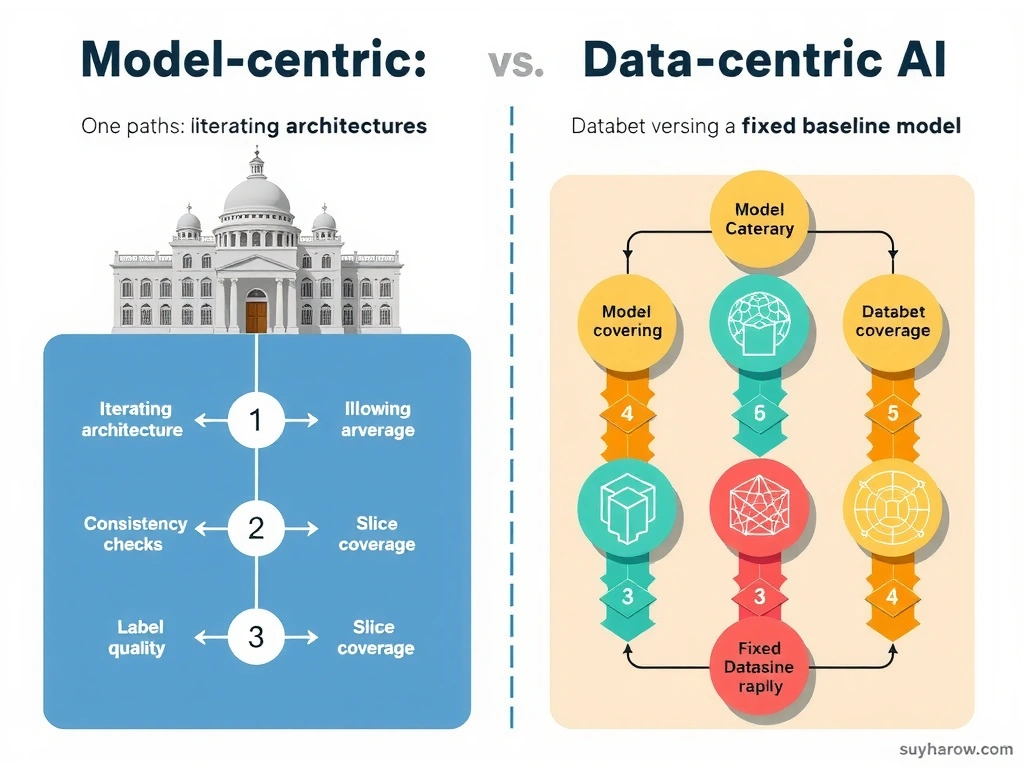
Full Explanation
Data-centric AI is a development philosophy that treats the dataset as the primary object of iterative improvement while often holding the learning algorithm relatively constant. Instead of assuming that gains must come from novel architectures, larger parameter counts, or exotic optimizers, practitioners invest in higher-quality labels, clearer labeling guidelines, removal of duplicates and leakage, better coverage of rare but critical slices, and systematic error analysis that feeds new examples back into the training set. The hypothesis is practical: many production failures stem from noisy, biased, or incomplete data rather than from an insufficiently fashionable model.
A data-centric loop typically looks like this: train a baseline model; evaluate not only global metrics but slice-level performance; inspect failure clusters; correct labels or collect targeted examples; retrain; repeat. Tools may include active learning, consensus labeling, weak supervision with careful adjudication, synthetic data for underrepresented conditions, and rigorous dataset versioning. Consistency matters as much as volume—annotators who disagree on the definition of a defect create an upper bound no architecture can fully overcome.
The correct answer therefore highlights quality, consistency, and coverage of training data. Distractors reflect model-centric or organizational misconceptions. Preferring the latest deep learning algorithm each sprint optimizes for novelty rather than for measurable data repair. Focusing on larger, more complex models can help in research settings with massive clean corpora, but size is not the defining lever of the data-centric mindset and can amplify label noise. Building a team of expert engineers is valuable, yet without processes that improve data, expertise alone does not embody the methodology.
In certification and workplace discussions, contrast data-centric with model-centric clearly. Model-centric: fix the code and architecture. Data-centric: fix what the model learns from. Hybrid programs do both, but when a question asks for a key element of data-centric AI, choose data quality and consistency. Memory aid: if your metrics move more when you correct labels than when you swap backbones, you are already living the data-centric idea. Document dataset versions the way you document model checkpoints so improvements are reproducible and auditable across the ML lifecycle.