
What is the primary purpose of transfer learning when building computer vision models?
Select an answer to reveal the explanation.
Short Explanation and Infographic
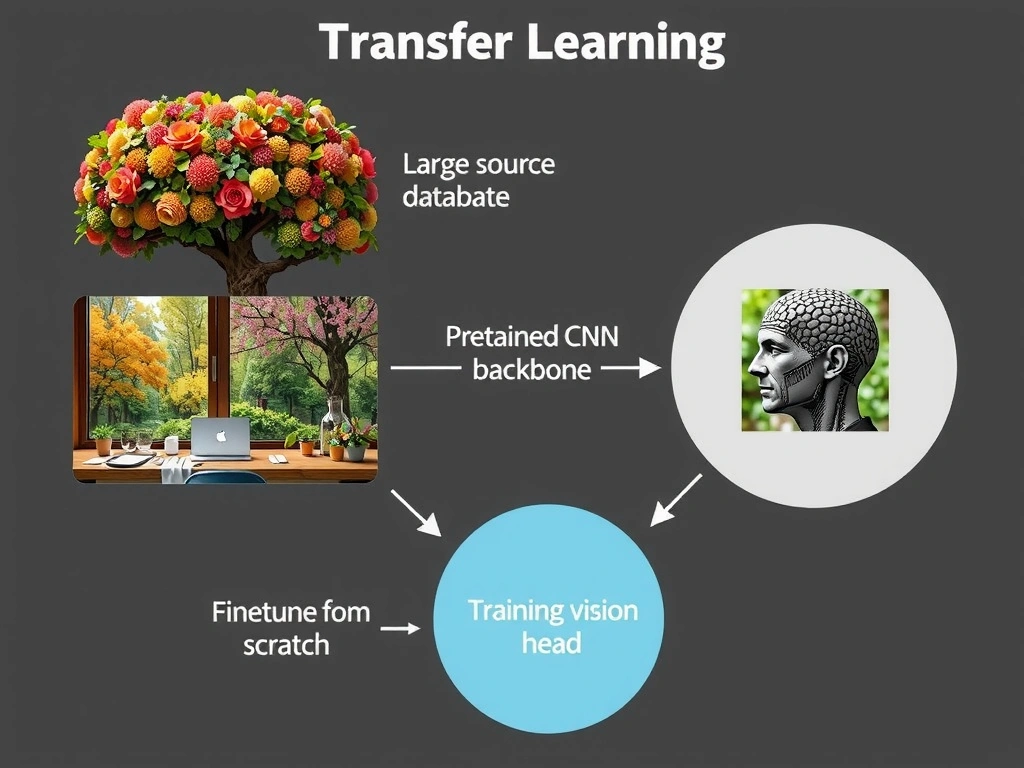
Check this out—transfer learning is how you stop reinventing the wheel every time you get a new image problem. Somebody already trained a big model on a huge dataset; those early layers learned edges, textures, shapes. You borrow that brain, maybe freeze some layers, fine-tune the rest on your smaller labeled set. Boss says you have two hundred defect photos, not two million? Transfer learning is your friend. Exam trap: thinking transfer learning means 'train from scratch bigger' or confusing it with resizing images. Nope. It's reuse + adapt for a related task. Pretty cool when it works—and on the exam, pick the answer about applying a pretrained model to a new but related problem with limited data. That's the whole game.
Full explanation below image
Full Explanation
Transfer learning in computer vision is the practice of taking a model trained on a source task—commonly large-scale image classification on datasets such as ImageNet—and adapting it to a target task that is different but related, such as medical image triage, industrial defect detection, or fine-grained product recognition. The underlying principle is that early convolutional features capture generic visual statistics (edges, color transitions, simple textures), while deeper layers become more task-specific. By initializing from pretrained weights, practitioners give the target model a strong inductive bias and usually need far fewer labeled target examples and far less compute than training from random initialization.
Typical workflows include feature extraction (freeze the backbone, train a new classifier head) and fine-tuning (unfreeze some or all layers and continue training at a modest learning rate). Choice depends on how similar the domains are and how much target data is available. When the new domain is close to natural photographs, freezing more layers often works well. When the domain shift is large (for example, X-rays versus everyday photos), more fine-tuning or domain-specific pretraining may be required, but the transfer idea remains: start from something that already understands images rather than from noise.
The correct answer emphasizes reuse across related tasks under data scarcity. Distractors fail for clear reasons. Mandating training from scratch on ever-larger corpora ignores the economic and sample-efficiency motivation for transfer. Image resizing is mere preprocessing; it does not move knowledge between tasks. Linear regression on raw pixels is a weak baseline for modern vision problems and does not describe transfer learning at all.
Operationally, transfer learning pairs with careful validation: monitor for negative transfer when the source task is a poor match, track calibration on the target distribution, and document license and dataset lineage of the pretrained checkpoint. In production MLOps, pretrained backbones are versioned assets just like code. For exam recall, compress the definition to one sentence: transfer learning applies a model trained on one task to another related task, often with a smaller dataset, by reusing and adapting learned representations. That sentence is the discriminating idea against 'train bigger from scratch,' 'shrink images,' or 'use linear regression on pixels.'