
What defines a fully connected neural network (dense multilayer network) at the connectivity level?
Select an answer to reveal the explanation.
Short Explanation and Infographic
Simple picture, big exam point. Fully connected means dense wiring: each neuron talks to every neuron in the next layer. No local stencil, no "only three neighbors." That's why parameter counts explode when you flatten a big image into a dense layer—every pixel multiplies into every unit. Convolutions are the sparse local cousins; RNNs add time loops; unsupervised is a training setup, not a connectivity rule. Imagine your boss wants a tiny MLP on engineered features—that's a classic fully connected stack: input to hidden to output, all dense. Don't say "it's an RNN" or "unsupervised only." Connectivity is the story. All-to-all between layers—that's the characteristic. Land that and you're solid.
Full explanation below image
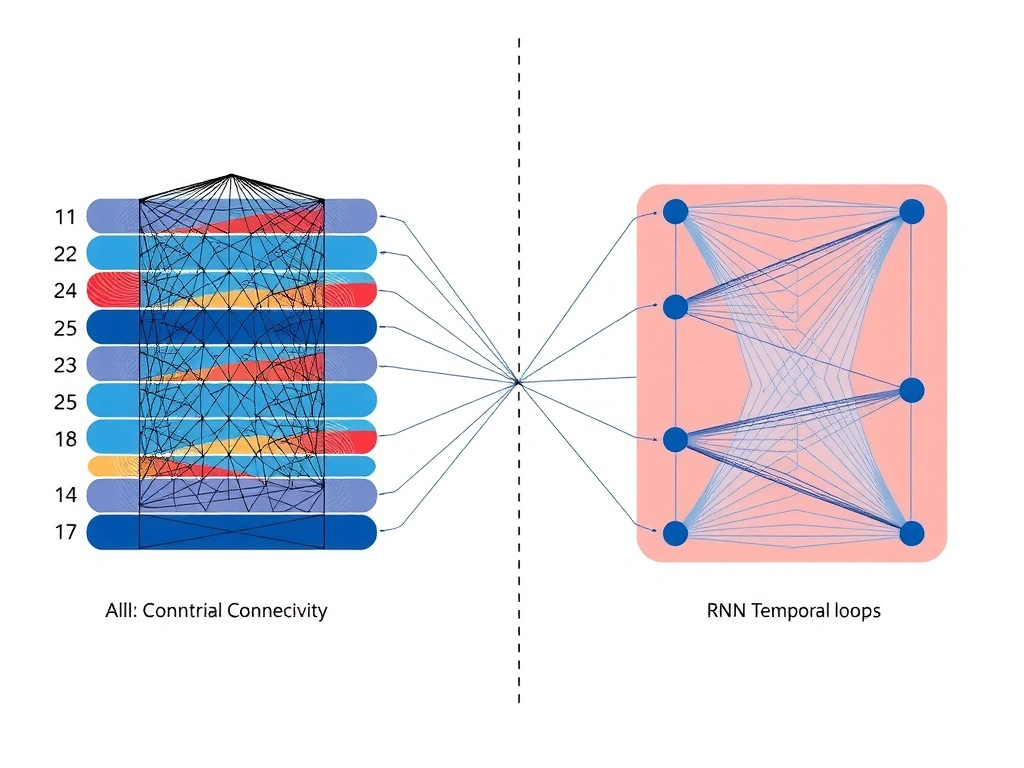
Full Explanation
A fully connected neural network—often called a multilayer perceptron when arranged as stacked dense layers—is defined by dense connectivity: each neuron in a hidden layer receives input from every neuron in the previous layer and, likewise, sends outputs to every neuron in the following layer at the network edges as appropriate. Each of those edges carries a learnable weight, so parameter count scales with the product of layer widths. Nonlinear activations between layers allow the network to approximate complex functions on vector inputs. That dense mesh is the defining characteristic examiners look for when they ask what makes a network fully connected.
This pattern contrasts with convolutional layers, where each unit sees only a local receptive field and weights are shared across positions, and with recurrent networks, where connections form cycles through time via hidden-state feedback. Fully connected layers are feedforward with respect to depth unless additional recurrent or residual structures are added. They are also paradigm-agnostic: the same dense connectivity can be trained with supervised labels, self-supervised losses, or other objectives; "unsupervised only" is not part of the definition. Mixing connectivity with learning paradigm is a classic distractor pattern on certification tests.
Practically, pure dense nets work well on moderate-dimensional feature vectors but struggle as naïve whole-image classifiers because flattening images yields enormous weight matrices and ignores spatial locality. Modern systems therefore use convolutions, attention, or other structured layers for raw perception and may still apply fully connected layers as final classifiers or small MLP blocks. In tabular MLPs, several fully connected layers with dropout or batch norm remain a strong baseline before more exotic architectures are tried.
Exam memory aid: fully connected equals every unit to every unit in the next layer. Sparse local links suggest convolution; temporal loops suggest recurrence; labeled versus unlabeled data is orthogonal. Keeping connectivity, architecture family, and learning paradigm separate prevents common multiple-choice traps and matches how practitioners describe dense layers in real codebases.