
Which task is a classic, high-impact application of a convolutional neural network (CNN)?
Select an answer to reveal the explanation.
Short Explanation and Infographic
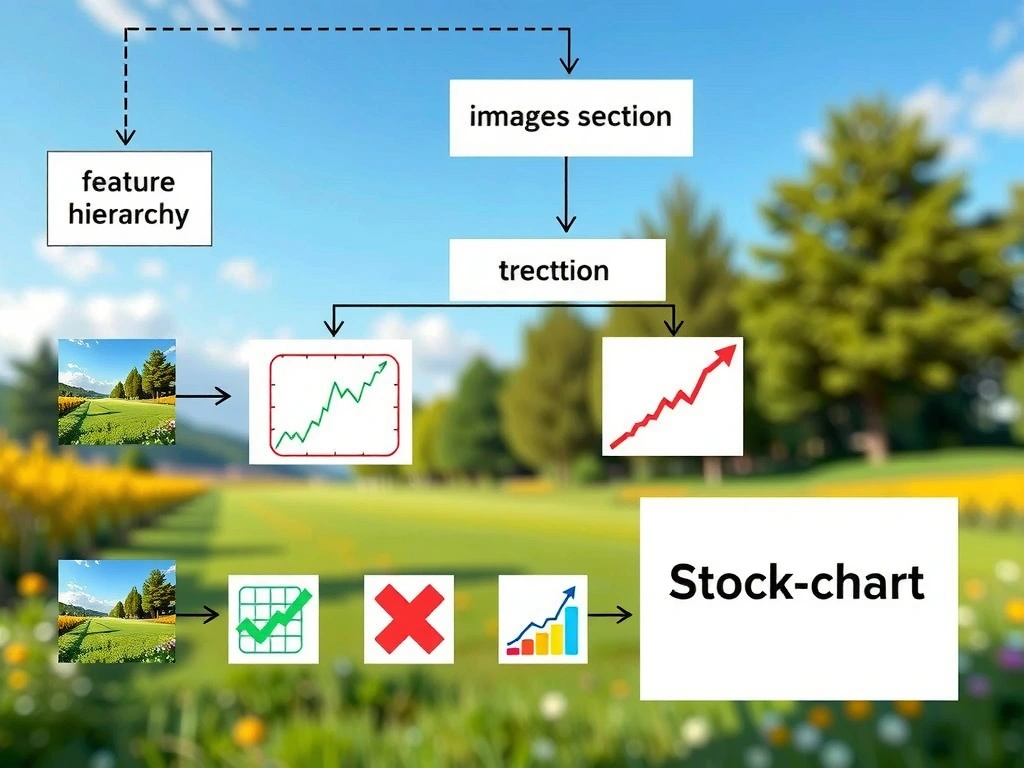
Let's keep this grounded. CNNs were built to look at grids—photos, video frames, medical scans—and learn edges, textures, and objects with those sliding filters. So object detection and image classification? That's home field. Customer segmentation from a spreadsheet? Different sport—think clustering or gradient-boosted trees. Stock charts and free-form paragraph generation aren't the classic CNN headline either (sequences and Transformers own a lot of that). Sure, 1D convs show up in odd places, but the exam wants the bread-and-butter vision use case. If your boss drops a folder of warehouse camera frames and says "find the forklifts," you're reaching for a CNN detector. Remember: CNN equals spatial vision strengths first.
Full explanation below image
Full Explanation
Convolutional neural networks dominate a wide range of computer vision applications because their inductive bias matches spatial data. Shared local filters detect patterns such as edges and textures; deeper layers compose those into object parts and whole objects. Landmark tasks include image classification, object detection, semantic segmentation, and related problems in medical imaging, autonomous driving perception, and industrial inspection. Architectures from early ConvNets through ResNets and modern detectors all exploit this local-and-hierarchical structure. In production, a single CNN backbone often feeds both a classifier head and a detection head depending on the product requirement.
Other options describe important ML problems that are not the canonical CNN showcase. Customer segmentation usually operates on tabular behavioral features with clustering or classical supervised models. Stock forecasting is primarily a time-series and sequential modeling challenge; while convolutional filters can appear in hybrid models, they are not the defining historical or exam-facing CNN application. Open-ended natural language generation is associated with recurrent and, more recently, Transformer language models rather than standard 2D CNNs. Choosing those distractors usually means the candidate recalled "popular ML tasks" instead of CNN-specific strengths.
Nuance for practitioners: 1D convolutions process sequences, and CNNs can appear in multimodal stacks, yet certification questions almost always anchor CNNs to visual recognition workloads. When comparing architectures, map CNN to grid-like spatial structure, RNN/Transformer to ordered tokens, and tree/linear models to many tabular problems. That mapping is a reliable exam heuristic and a solid first cut in system design interviews. It also prevents over-applying CNNs where attention or gradient-boosted trees would be simpler and stronger.
Takeaway: if the stem asks for a common CNN application, prefer object detection and image classification over marketing segmentation, pure financial forecasting, or open-ended text generation. Remember the spatial-filter story, and the correct application family follows naturally.