
In a natural language preprocessing pipeline, how do tokenization and stemming differ in purpose?
Select an answer to reveal the explanation.
Short Explanation and Infographic
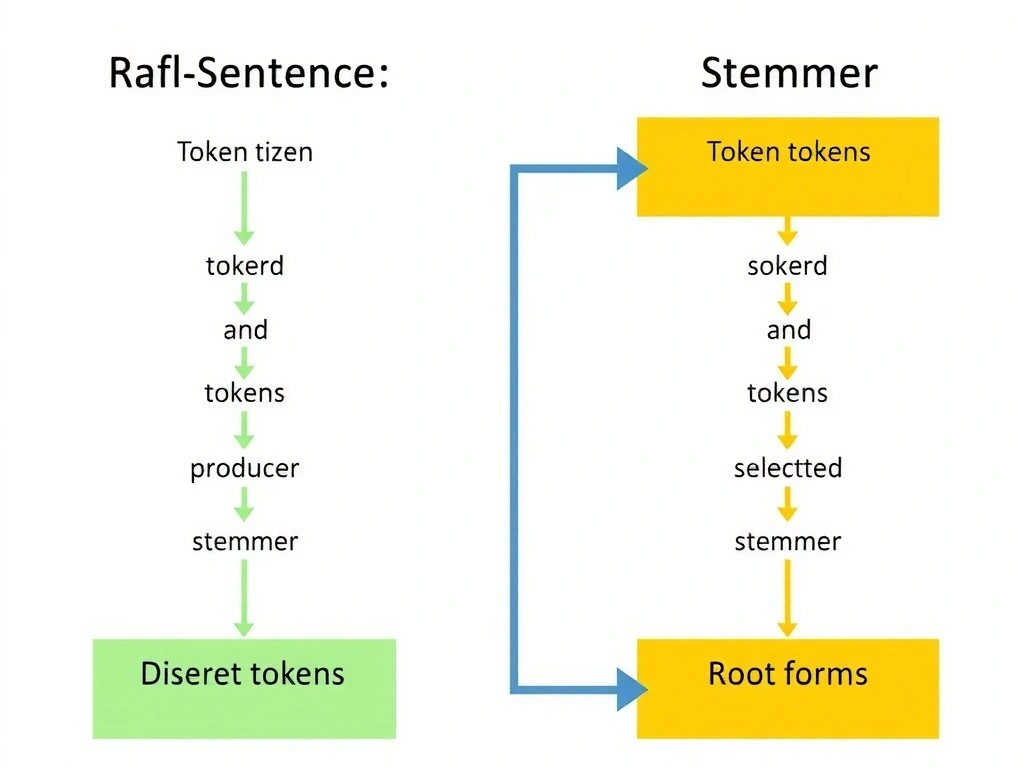
Okay, let's clear this one up fast. Think of raw text like a long sentence your pipeline has never seen. First job? Chop it into pieces you can actually count and feed forward—that's tokenization: words, maybe subwords, maybe punctuation as separate tokens. Second job? When 'running,' 'runs,' and 'ran' are clogging your vocabulary with near-duplicates, stemming smashes them toward a common root so the model (or your bag-of-words features) treats them as related. Different goals, different stages. Exam trap: people mash the words together or claim stemming replaces tokenization. Nope. You still need tokens first. Boss asks why the search index matches 'connect' to 'connected'? You point at stemming—not at the tokenizer. Got it? Sweet. Remember: tokens = units; stems = roots.
Full explanation below image
Full Explanation
Tokenization and stemming are complementary text preprocessing operations with clearly different objectives. Tokenization is the process of segmenting a raw character stream into smaller units called tokens. Depending on the system, tokens may be whitespace-delimited words, punctuation-aware word pieces, subword units such as BPE or WordPiece fragments, or even characters. The essential outcome is a sequence the rest of the pipeline can index, embed, count, or attend over. Without reliable tokenization, downstream steps have no consistent atomic inputs.
Stemming, by contrast, is a morphological normalization technique. After you already have word-like tokens, a stemmer applies rule-based truncations (for example, Porter-style suffix stripping in English) to map inflected or derived forms toward a common stem. The classic motivation is vocabulary reduction and improved recall in retrieval or classical feature pipelines: 'fishing,' 'fished,' and 'fisher' may collapse toward related stems so sparse features or inverted indexes treat them as related. Stemming is typically crude and language-specific; it does not guarantee a linguistically perfect lemma and can over-stem or under-stem.
The correct distinction, therefore, is functional: tokenization creates units; stemming reduces word forms toward roots. They are not interchangeable labels for one step. Claiming that tokenization only cares about numbers while stemming only cares about words is incorrect—tokenizers routinely process mixed text, and stemming applies to word tokens regardless of whether digits appear elsewhere in the document. Asserting that the two processes are identical erases a fundamental pipeline boundary. Suggesting that stemming is simply 'more complex' and therefore supersedes tokenization confuses computational cost with role; modern neural systems may skip traditional stemming entirely in favor of subword tokenization and contextual embeddings, yet they still depend on some form of segmentation into model inputs.
In practice, classical NLP pipelines often tokenize, optionally normalize case, then stem or lemmatize, then build features. Neural LLM pipelines usually rely on learned subword tokenizers and rarely apply Porter-style stemming. For exam purposes, keep the definitions crisp: tokens are the pieces; stems are compressed word bases. When a question contrasts the two, answer with that division of labor, not with vague claims about difficulty or exclusivity to numeric text. Understanding this split also helps when debugging search quality, bag-of-words models, or hybrid systems that still use surface-form normalization beside modern embeddings.