
In a convolutional neural network, what is the fundamental structural difference between a fully connected layer and a convolutional layer?
Select an answer to reveal the explanation.
Short Explanation and Infographic
Check this out. Think of a fully connected layer like every employee emailing every other employee—total mesh, lots of wires. A convolutional layer is more like sliding a small stencil across a photo: the same few weights look for edges or textures in every neighborhood. That local filter plus weight sharing is why CNNs crush image features without drowning you in parameters. Don't confuse FC with pooling—pooling just shrinks maps. And no, dense layers aren't "RNN-only" or "images only." On real projects, you stack convs for spatial features, then maybe a dense head for class scores. Exam trap: knowing connectivity pattern, not buzzword architecture names. Dense equals all-to-all; conv equals local shared filters. Nice and clean.
Full explanation below image
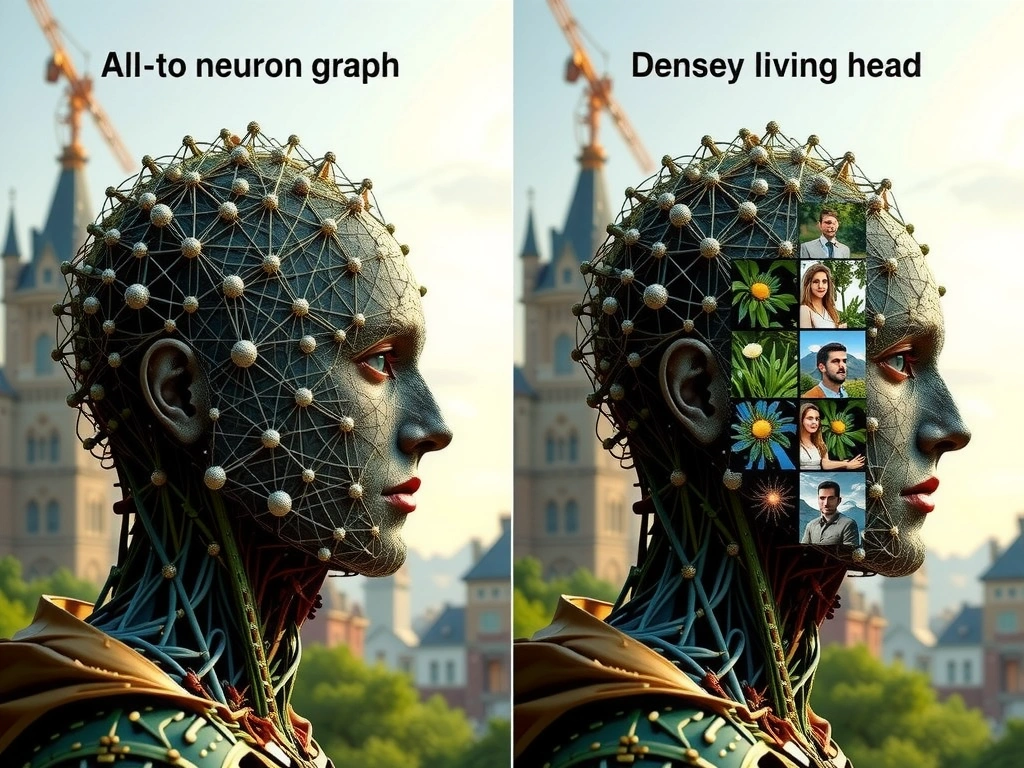
Full Explanation
Fully connected (dense) layers and convolutional layers implement different inductive biases through connectivity. In a fully connected layer, every activation in the input is multiplied by a dedicated weight for every output unit. That dense matrix can model arbitrary interactions but scales poorly with high-dimensional inputs such as images: a modest grid of pixels yields an explosion of parameters and ignores the fact that nearby pixels are more related than distant ones.
A convolutional layer instead applies small learnable kernels that operate on local receptive fields and share the same weights across spatial positions. Each filter detects a local pattern—edges, textures, motifs—and produces a feature map. Stacking convolutions builds hierarchical features while keeping parameter counts manageable through weight sharing and sparsity. In modern CNNs, early and mid stages are typically convolutional (often with pooling or striding), while fully connected layers, if present, appear near the end as classifiers—or are replaced by global pooling plus a small dense head.
The incorrect options mix neighboring ideas. Equating fully connected layers with pooling confuses dense linear transforms with spatial aggregation (max/average pooling). Claiming dense layers belong only to RNNs and convolutions only to CNNs is historically and practically false: dense layers appear in MLPs, CNN classification heads, and many hybrid models. Assigning dense layers exclusively to images and convolutions exclusively to text reverses common usage and oversimplifies both modalities (1D convolutions exist for sequences; dense layers work on any flat vector).
Memory aid: connectivity density defines the layer type—full mesh versus local shared filters—not the marketing name of the parent architecture. When designing networks, use convolutions where locality and translation equivariance help; use dense layers when global mixing of already-compact features is needed.