
What primary role does batch normalization play when inserted into a deep neural network training pipeline?
Select an answer to reveal the explanation.
Short Explanation and Infographic
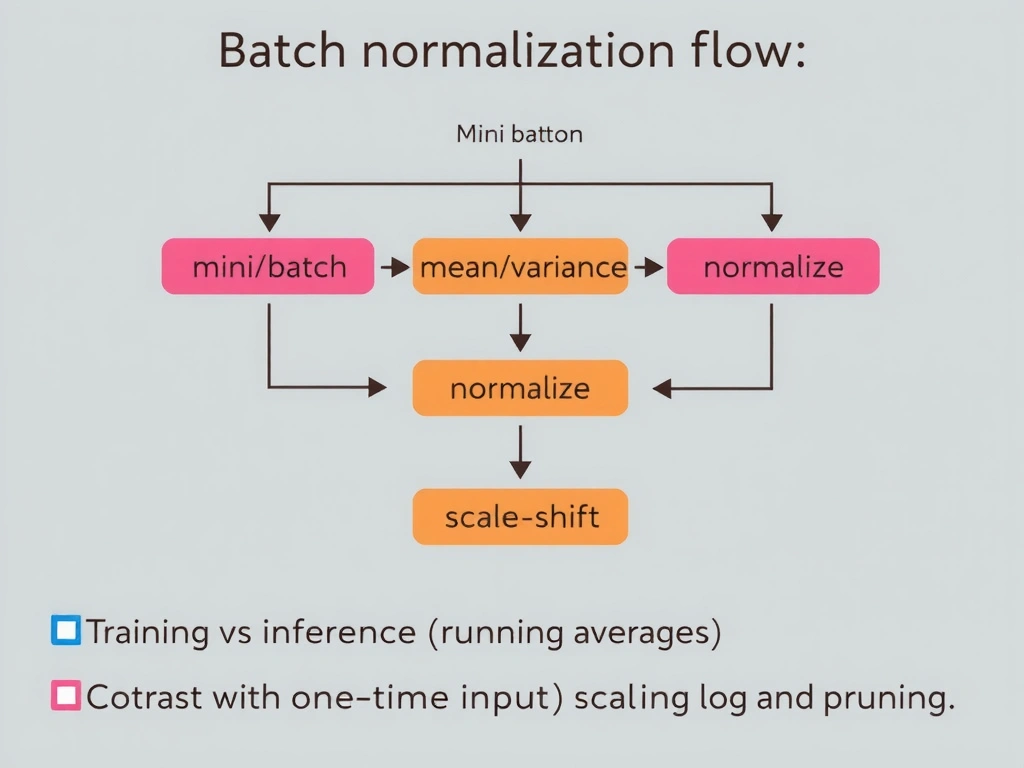
Alright, here's where batch norm saves your bacon. As layers stack, activation distributions drift—your deeper layers keep chasing a moving target. Batch normalization re-centers and re-scales activations using mini-batch mean and variance, then lets the network re-learn a scale and shift. Think of it like re-tuning the radio between stations so the next stage hears a clean signal. Boss walks in and says training is bouncing all over? Batch norm is often on the shortlist with good init and learning-rate tuning. Trap: it's not just "normalize the CSV columns once," and it doesn't prune neurons or magically add capacity. Exam answer: stabilize and speed training by normalizing activations. Keep that distinction sharp.
Full explanation below image
Full Explanation
Batch normalization (BatchNorm) operates on intermediate activations during training. For each mini-batch, it estimates mean and variance per channel (or feature), standardizes activations to zero mean and unit variance, then applies learned scale (gamma) and shift (beta) parameters so the network can recover an optimal distribution. At inference, running averages of those statistics replace batch estimates so predictions are deterministic and batch-size independent.
The practical benefits are stability and often faster convergence. By reducing large shifts in activation statistics as weights update—sometimes described as easing internal covariate shift—and by smoothing the optimization landscape, BatchNorm allows higher learning rates and less brittle deep training. It can also provide a mild regularizing effect because each sample's normalization depends on other batch members, though it is not a substitute for explicit regularizers when overfitting is severe.
Distractors confuse BatchNorm with adjacent techniques. Normalizing input features once before training is preprocessing, not BatchNorm; BatchNorm is applied repeatedly to layer outputs (or pre-activations, depending on placement) throughout training. It does not increase model capacity by adding neurons, nor does it reduce width by removing them—those are architectural or pruning decisions. Dropout and pruning address capacity and co-adaptation differently.
Implementation notes for practitioners: placement relative to activation (before or after nonlinearity) varies by family; small batch sizes can make batch statistics noisy, motivating alternatives such as LayerNorm, GroupNorm, or InstanceNorm in those regimes. Always switch to evaluation mode so running statistics are used at test time. Exam focus: BatchNorm normalizes activations with batch statistics to stabilize and accelerate training—not one-time input scaling, not neuron deletion, and not automatic capacity expansion.