
How does a long short-term memory (LSTM) network primarily differ from a simple recurrent neural network when modeling long sequences?
Select an answer to reveal the explanation.
Short Explanation and Infographic
Here's the deal: a simple RNN keeps rewriting one hidden state every step. Over a long sentence or time series, early signal dies out—vanishing gradients again. An LSTM adds a memory cell, like a protected notebook, and three gates—input, forget, output—that decide what to write, erase, or read. Pay close attention here, because people mix this up with "LSTM is cheaper." Nope—more gates means more work per step, but you gain the ability to hold context across longer spans. And LSTMs are not "image only"; that's the CNN story. Imagine your boss wants sentiment across a 500-token review: a plain RNN forgets the opening, the LSTM still has a path to it. Remember for the exam: simple RNN fights long-term dependencies; LSTM manages them with cell state and gates. You've got this.
Full explanation below image
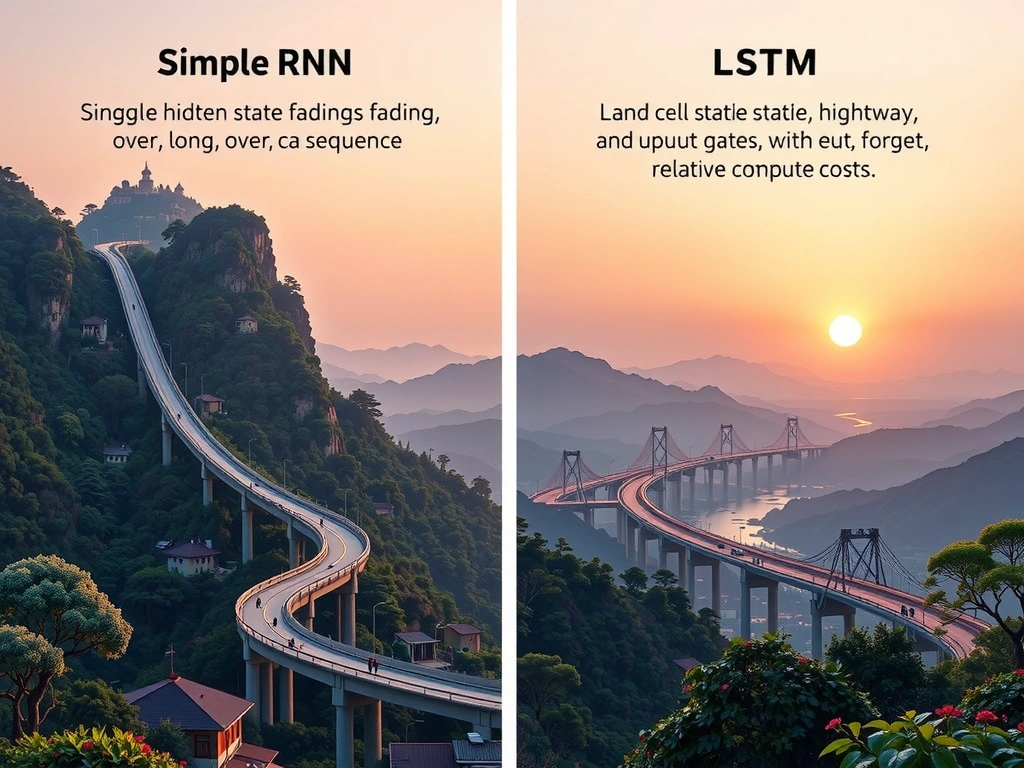
Full Explanation
The core distinction between a simple recurrent neural network and an LSTM is how each architecture handles information across many timesteps. A simple RNN updates a single hidden vector with a shared transition at every step. In theory that hidden state is a summary of the entire past; in practice, gradients shrink as they are backpropagated through many multiplications, so the network fails to learn long-term dependencies. That is why plain RNNs often work on short sequences but degrade when important cues appear far from the prediction point.
An LSTM introduces an explicit memory pathway—the cell state—along with input, forget, and output gates. The forget gate scales how much of the previous cell state is kept; the input gate controls how much of a new candidate update is written; the output gate filters the cell content into the visible hidden state. Additive updates to the cell state create a more stable gradient highway, allowing relevant signals to persist over longer horizons. This design is the historical reason LSTMs (and related gated models) replaced vanilla RNNs for many language, speech, and time-series tasks.
Distractors invert or mislabel these facts. Claiming a simple RNN handles longer sequences better contradicts the motivation for LSTMs. Asserting that LSTMs are more computationally efficient confuses capacity with cost: gating and dual state (cell and hidden) increase arithmetic per step. Restricting LSTMs to image processing confuses recurrent sequence modeling with convolutional spatial filters.
Best practice is to treat LSTM versus simple RNN as a memory-and-stability choice, not a free lunch. LSTMs still benefit from gradient clipping, careful sequence length, and modern alternatives (GRUs, attention, Transformers) when context windows grow very large. For certification-style questions, lock in this contrast: simple RNNs struggle with long-term dependencies; LSTMs manage them via a gated memory cell—and they are sequence models, not vision-only components.