
In a convolutional neural network, what does stride refer to?
Select an answer to reveal the explanation.
Short Explanation and Infographic
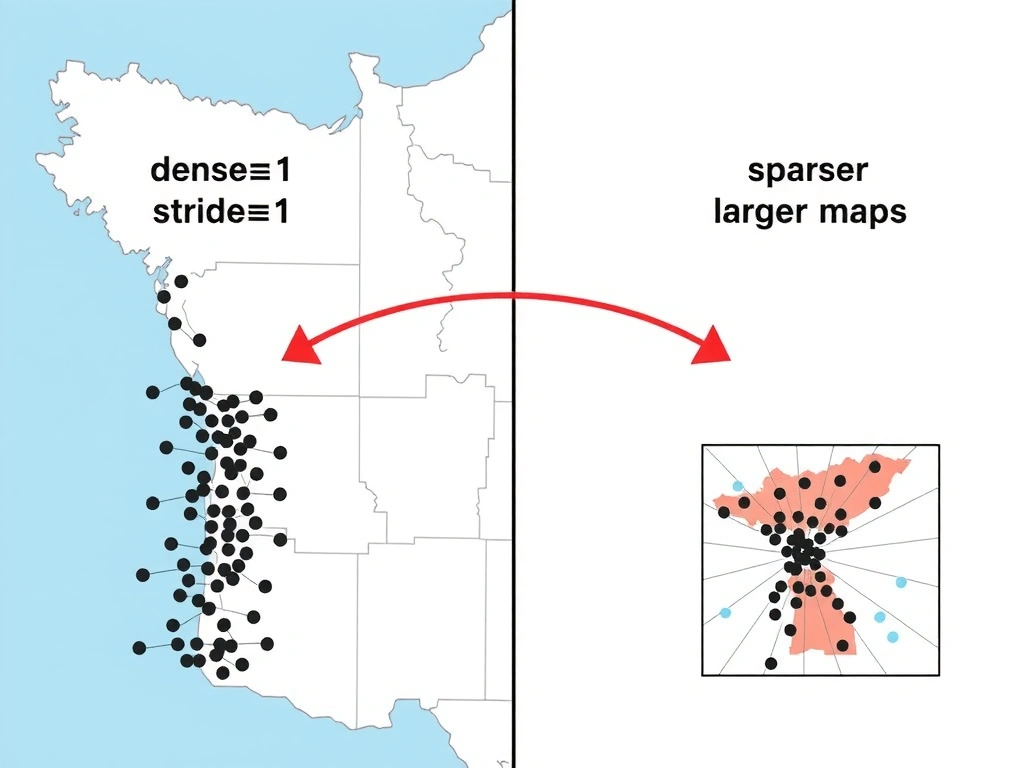
Stride is literally the step size of your filter as it walks across an image. Kernel is the little window; stride is how far it hops. Stride 1 checks almost everywhere—high resolution feature maps. Stride 2 skips every other position—maps get smaller, compute drops. Think of mowing a lawn: stride is how wide each pass overlaps or jumps. Exam trap: mixing stride with pooling window size, learning rate, or "how many layers." Different knobs. If your boss wants cheaper, coarser features early in the net, increasing stride (or using strided convs) is a classic move. Remember: stride = kernel step size on the input grid.
Full explanation below image
Full Explanation
In convolutional layers, a learnable kernel slides over the spatial dimensions of an input tensor (for images, height and width, and sometimes time in 1D). The stride hyperparameter specifies how far the kernel moves after each application. With stride 1, the kernel visits essentially every valid location (subject to padding rules). With stride 2, it skips positions, producing a coarser output grid roughly half the spatial size when dimensions divide evenly. Thus stride directly influences output resolution, receptive field growth across the network, and computational cost. Changing stride is one of the simplest ways to trade spatial detail for speed and memory without rewriting the entire architecture.
Stride should not be confused with the pooling window size. Max or average pooling uses its own kernel size and often its own stride to aggregate local regions; those are pooling parameters, not the definition of convolution stride—although both affect downsampling. Learning rate governs optimizer step size in parameter space and has no geometric meaning on the image lattice. Network depth counts layers and does not describe intra-layer filter motion. Exam distractors frequently swap these labels, so name each knob carefully when you study diagrams or code.
Designers choose strides (and alternatives such as pooling or strided convolutions versus dilated convolutions) to balance detail preservation against efficiency. Aggressive early striding can lose fine spatial information important for detection or segmentation; mild striding keeps maps larger at higher memory cost. Output spatial size formulas in frameworks combine input size, kernel size, padding, dilation, and stride—so mis-setting stride is a common source of shape mismatches when you stack conv blocks or attach detection heads.
For assessments, define stride as the step size of the sliding filter on the input. Link it to downsampling behavior. Reject options that redefine it as pooling window extent, learning rate, or layer count. That precise vocabulary is essential when reading architecture diagrams and configuring Conv2D layers in practice. A quick memory cue: kernel is what you apply, stride is how far you step, depth is how many layers you stack.