
In multi-class classification, what does a final softmax layer produce?
Select an answer to reveal the explanation.
Short Explanation and Infographic
Softmax is your multi-class probability machine. You feed it a vector of raw scores—logits—and it squishes them into numbers between 0 and 1 that add up to 1. Think of splitting a pizza so every class gets a slice and the whole pie is accounted for. That's perfect when exactly one label is correct. Exam trap: people think softmax is the predicted class ID. Nope—that's usually argmax after softmax. And it's not a lonely true/false bit; that's more binary territory (sigmoid on one logit). Got it? Softmax → probability vector over classes. When your boss asks "how sure are we on each category?" you're reading those softmax outputs.
Full explanation below image
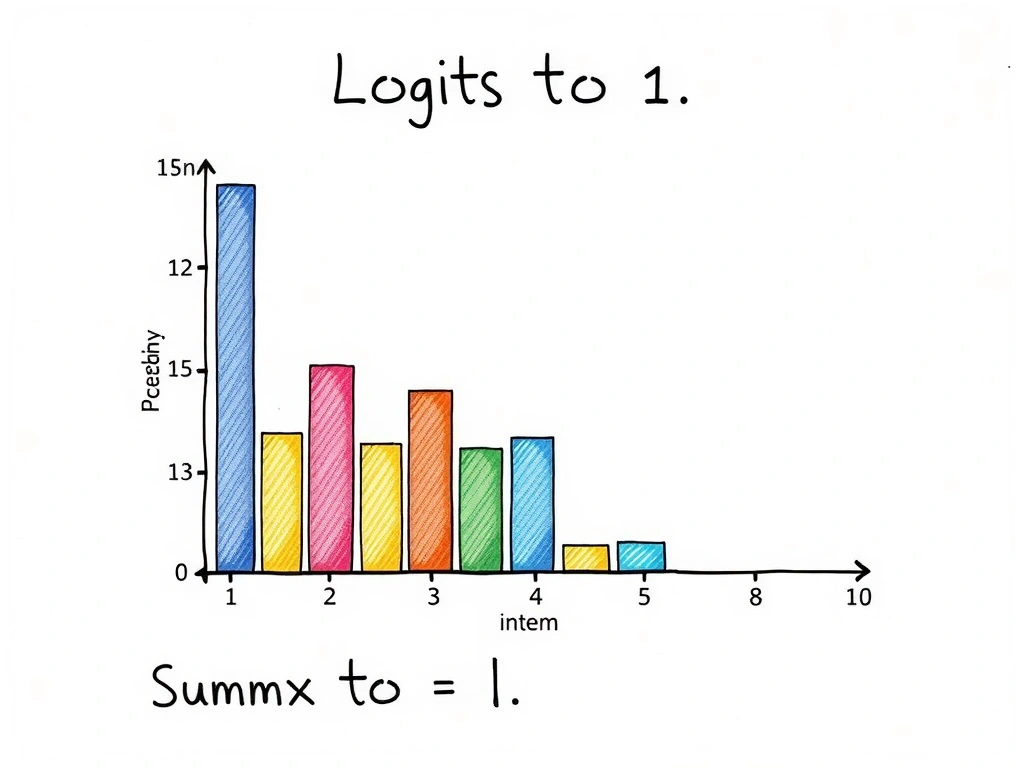
Full Explanation
Softmax converts a vector of real-valued logits into a discrete probability distribution over K mutually exclusive classes. For each class i, the softmax value is proportional to exp(logit_i), normalized by the sum of exp(logit_j) across all classes. The outputs are therefore nonnegative and sum to one, which makes them valid categorical probabilities under a multinomial (single-label) interpretation. Training often pairs softmax with categorical cross-entropy loss, which compares the predicted distribution to a one-hot (or smoothed) target. That pairing is the standard multi-class head in textbooks and production image or text classifiers when exactly one label applies.
This is different from emitting only a Boolean confidence flag. Binary problems may use a sigmoid on a single logit to estimate P(class = 1), but multi-class softmax yields an entire distribution. It is also different from directly outputting a lone integer class index: practitioners commonly take argmax of the softmax vector to choose a hard label, yet the layer’s mathematical output is the probability vector itself, which supports calibration checks, rejection thresholds, and richer evaluation. Softmax does not return raw integer counts from the batch; those would be data statistics, not normalized model scores. Keeping these distinctions clear prevents mixing post-processing choices with the layer definition.
Numerically, implementations use log-sum-exp tricks for stability because large logits can overflow when exponentiated. Temperature scaling can sharpen or flatten the distribution for distillation or calibration. Softmax assumes classes compete; for multi-label settings where several classes may be true simultaneously, independent sigmoids are often preferred instead. Those design choices matter in real systems, but the exam still centers on the core multi-class probability-vector behavior.
Exam takeaway: associate softmax with a K-dimensional probability simplex output for multi-class heads. Correct answers emphasize probabilities per class summing to one. Incorrect options typically describe Booleans, hard labels only, or integer count vectors—none of which match the softmax transformation from logits to a normalized distribution. If a stem asks what the softmax layer produces, answer with the probability vector, then mention argmax only if asked how you pick a single class.