
A team needs a model that can synthesize realistic human face images. Which neural architecture is the most appropriate primary choice among the following?
Select an answer to reveal the explanation.
Short Explanation and Infographic
If the job is making new faces, you need a generative model—not a classifier that only sorts photos you already have. GANs pair a generator that paints fakes with a discriminator that tries to spot them. They duke it out until the fakes look real. Think of a forger versus an art detective improving together. Exam trap: CNNs are great for vision, but a vanilla classification CNN isn't generating pixels from noise. Fully connected nets and RNNs are the wrong primary tools for this ask. Modern shops also use diffusion models, but among these options GAN is the clear fit. Boss says "generate faces by Friday"—you're reaching for a generative architecture like a GAN.
Full explanation below image
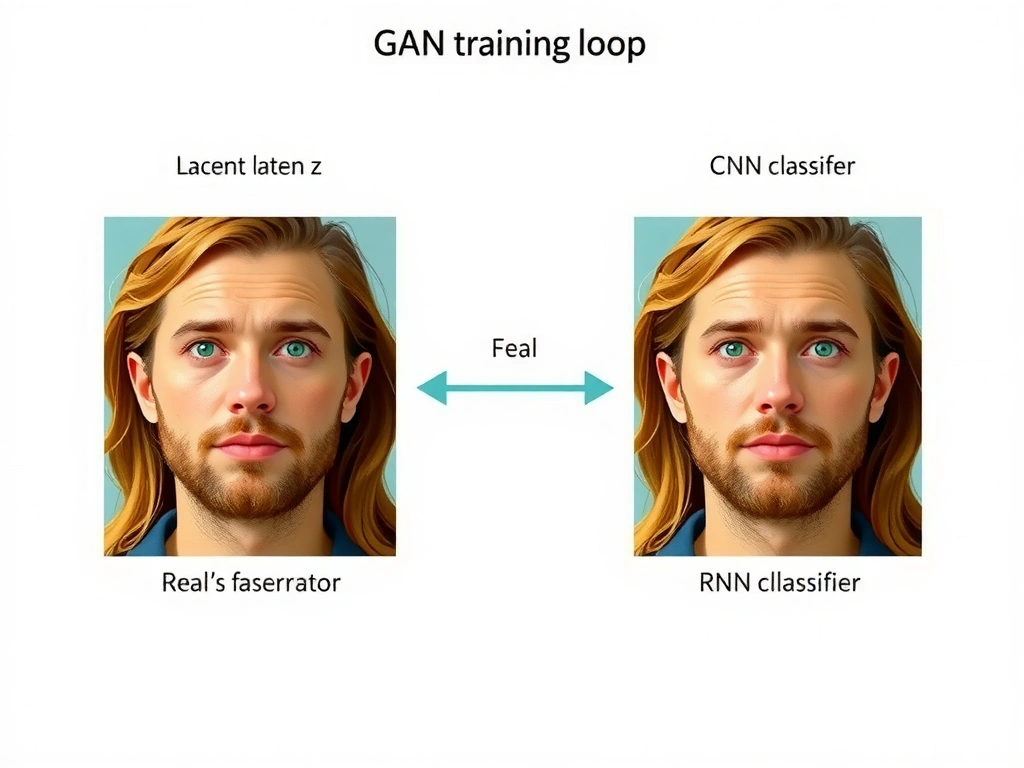
Full Explanation
Generating realistic human faces is a generative modeling problem: the system must sample from a complex distribution over high-dimensional pixel space so that outputs look like plausible faces, not merely assign labels to existing images. Generative adversarial networks address this by pitting a generator network, which maps latent noise (and optionally conditions) to images, against a discriminator network that distinguishes real training photos from generated ones. Adversarial training pushes the generator toward the data manifold, historically producing sharp, realistic faces (for example, progressive and style-based GAN families). The two-player setup is the conceptual signature you should recall when a question asks for a network that creates new samples rather than scores old ones.
A convolutional neural network used only for classification learns decision boundaries among categories such as identity or attributes. While CNN building blocks appear inside GAN generators and discriminators, a standalone classifier does not synthesize novel faces. Fully connected networks that map tabular inputs to class labels similarly solve discriminative tasks and lack an image-generation objective. Recurrent networks model sequential structure in text, audio, or time series; they are not the standard primary architecture for unconditional or class-conditional face image synthesis, even though sequential models can appear in other generative settings. Those three alternatives are strong distractors because each is a real neural tool—just the wrong tool for synthesis.
Contemporary alternatives include variational autoencoders and especially diffusion models, which now dominate many image generation benchmarks. Within the given multiple-choice set, however, the GAN is the architecture explicitly built for adversarial generative sampling and is the appropriate selection. Evaluation for face generation may involve FID, precision/recall for distributions, and human preference studies rather than classification accuracy alone. Production systems may also add identity preservation losses, latent editing controls, or safety filters, but the architectural starting point remains generative.
Exam strategy: match the verb in the stem—generate, synthesize, create—to generative families (GAN, VAE, diffusion). Match classify, detect, or recognize to discriminative CNNs and related models. That verb check quickly eliminates RNNs and pure classifiers when the requirement is realistic face image generation, leaving the GAN as the correct choice among the listed options. When in doubt, ask whether the model must invent new pixels from a latent code; if yes, think generative first.