
Within a Transformer, what is the primary role of the attention mechanism?
Select an answer to reveal the explanation.
Short Explanation and Infographic
Attention is the heart of the transformer—don't let the math scare you. Here's the plain English: when the model processes a word, attention asks, "Which other words matter right now?" and builds a weighted blend of their information. Think of reading a sentence and glancing back at the subject when you hit the verb—attention formalizes that glance with scores. Exam trap: people mix attention with dropout (random neuron kill) or with one-time feature selection. Different tools. Boss wants long-range context without a pure RNN crawl? Attention is how each token listens to the rest. Remember: dynamic relevance weighting across the sequence—that's the job.
Full explanation below image
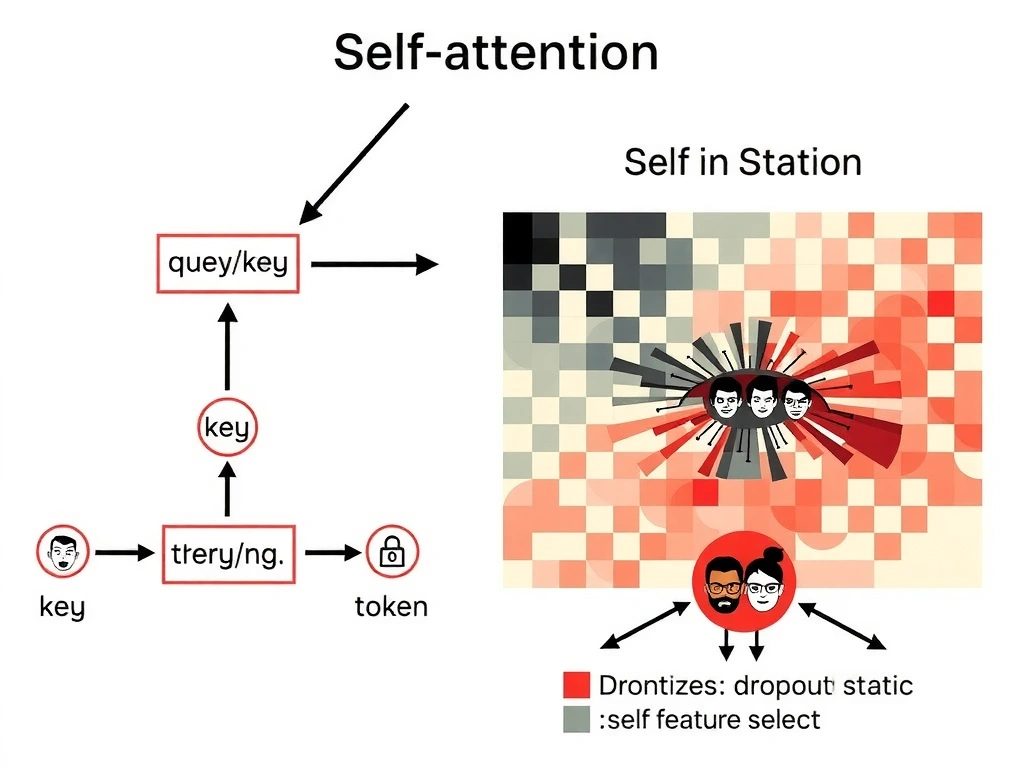
Full Explanation
In Transformer models, attention computes interactions among elements of a sequence (or between sequences in cross-attention). Each position produces queries, keys, and values through learned projections. Compatibility scores between queries and keys—often scaled dot products—are normalized (commonly with softmax) into attention weights. Those weights form a convex combination of value vectors, so the output at a position is a context-aware mixture emphasizing the most relevant tokens for that position. Multi-head attention runs this process in parallel subspaces so the model can track different relationship types simultaneously—syntax, coreference, positional patterns, and more.
This mechanism is dynamic and input-dependent. Unlike a static feature-selection mask fixed before training, attention reassigns importance for every example and every layer. Unlike layer-pruning schemes, it does not remove depth; it enriches representations inside the existing stack. Unlike dropout, its purpose is not random capacity reduction for regularization, although dropout is frequently applied to attention weights or residual branches as a separate regularizer.
Attention enables modeling long-range dependencies without stepping solely through a recurrent chain, which is central to transformer efficiency and quality on language tasks. Masked variants enforce causality for autoregressive decoding; encoder self-attention may be bidirectional; cross-attention links decoder states to encoder memory in sequence-to-sequence models. Efficient attention approximations exist for long contexts, but the conceptual role remains weighted contextual aggregation.
For exam clarity: state that attention weighs how much each token should influence another when building representations. Reject distractors that redefine it as offline feature picking, automatic depth reduction, or dropout-style neuron silencing. Pairing this understanding with positional encodings and residual pathways completes the standard transformer mental model used in modern NLP and generative AI systems.