
In deep learning optimization, what does the learning rate control?
Select an answer to reveal the explanation.
Short Explanation and Infographic
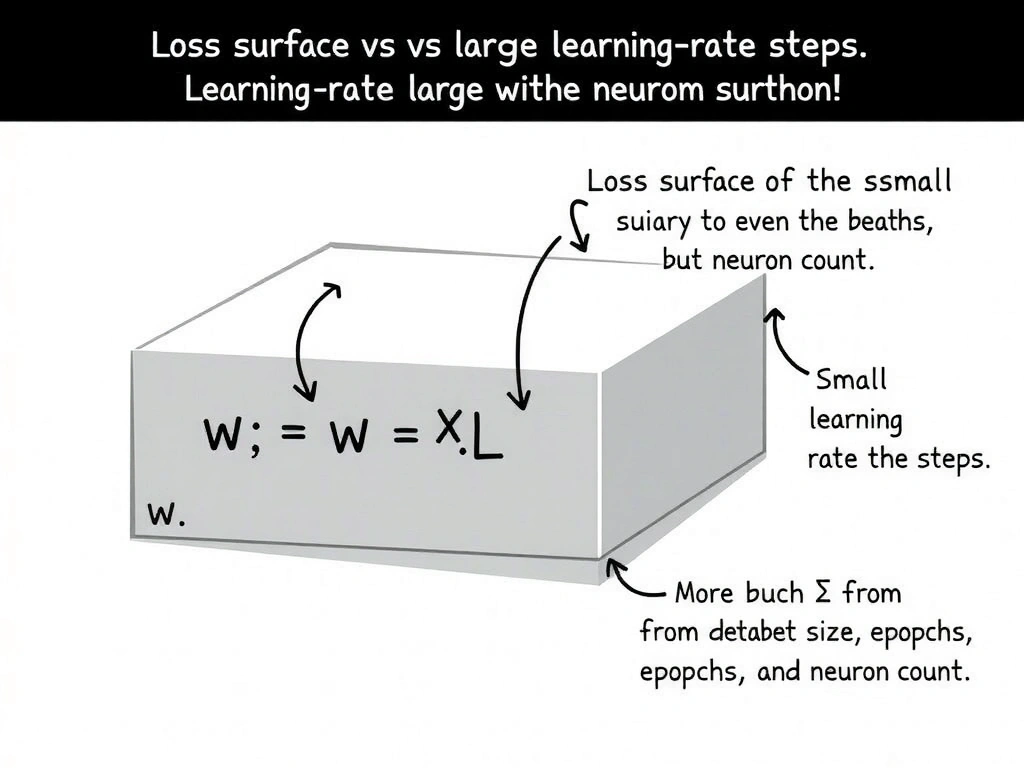
Okay, learning rate—this one shows up constantly, so let's nail it. When your optimizer takes a step downhill on the loss surface, the learning rate is basically the size of your boots. Too big and you leap past the valley and bounce around. Too small and you crawl forever. Think of it like adjusting the gas pedal, not counting how many miles of road (dataset size), how many laps (epochs), or how many lanes you built (neurons). Boss walks in: "Training is unstable"—check the learning rate first. Schedules, warmups, and adaptive methods like Adam tweak effective steps, but the concept is still step size on the gradient update. Land the takeaway: learning rate = how hard you push the weights each update.
Full explanation below image
Full Explanation
The learning rate is a fundamental optimization hyperparameter that scales the magnitude of parameter updates. In a basic gradient descent step, weights move opposite the gradient of the loss: new parameters equal old parameters minus learning_rate times gradient (with possible momentum or adaptive scaling). A larger learning rate yields bigger jumps along the estimated descent direction; a smaller rate yields more conservative moves. Choosing an appropriate value balances progress against stability: excessively large rates can diverge or oscillate, while tiny rates slow convergence and may stall in poor regions of the loss landscape.
Modern trainers rarely keep a fixed rate forever. Schedules decay the rate over time, cyclic policies oscillate it, and warmup phases start small then increase to stabilize early training of large models. Adaptive optimizers such as Adam maintain per-parameter statistics that modulate effective step sizes, yet practitioners still set a base learning rate that strongly influences outcomes. Learning rate therefore remains one of the first knobs tuned when training fails to converge or generalizes poorly.
Distractors mix learning rate with unrelated quantities. The number of training examples describes data volume. Epochs measure how many times the learner traverses the dataset. Neuron counts define capacity and architecture. None of those replace the role of step-size control in the update rule. Confusing these terms leads to misconfigured experiments—for example, adding data when the real issue is an oversized step, or widening layers when the optimizer is simply too aggressive.
A practical memory aid is: architecture decides what function family you search; data and epochs decide how much evidence and how long you search; learning rate decides how boldly each gradient step moves inside that search. For certification-style questions, state clearly that the learning rate governs update magnitude relative to the loss gradient, and reject options that redefine it as dataset size, epoch count, or layer width.