
An analytics team scores social-media comments as positive, negative, or neutral for brand monitoring. Which NLP problem is this, and which recurrent architectures are well suited for the sequential text?
Select an answer to reveal the explanation.
Short Explanation and Infographic
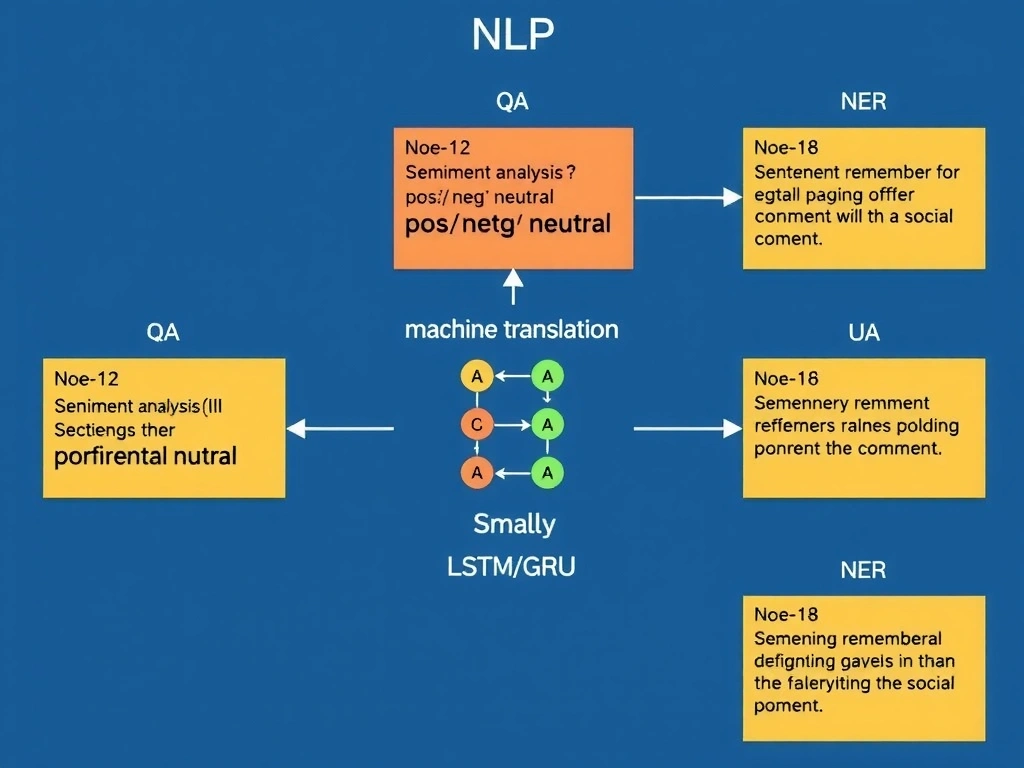
Here's the deal: when you read a tweet and decide happy, angry, or meh—that's sentiment analysis. Words come in order, so sequence models matter. Think of it like reading a customer review out loud; "not" early on can flip the whole meaning later. LSTM and GRU gates help the network remember that long-enough context. Boss walks in: "Tag every comment positive, negative, or neutral by Friday." You're not translating, answering trivia, or highlighting company names—you're classifying vibe. Exam trap: NER and MT both involve text, so they look tempting. Land the takeaway: polarity labels + sequential text → sentiment, and LSTM/GRU (or stronger modern seq models) are the classic fit. You've got this.
Full explanation below image
Full Explanation
Classifying text as positive, negative, or neutral is the standard definition of sentiment analysis, also called polarity classification, in natural language processing. The output is a discrete label for a document, sentence, or short social post rather than a free-form answer, a translated sentence, or a sequence of entity tags. Because natural language is ordered, models that respect sequence structure historically include recurrent neural networks. Simple recurrent cells often fail on longer posts because gradients vanish across many time steps, which weakens learning of distant negation and context cues. Long short-term memory and gated recurrent unit cells introduce gating mechanisms that better preserve useful information across tokens, making them classic architectural choices for sentiment models before transformers became ubiquitous in production stacks.
Distractors map cleanly to different NLP tasks and should be rejected for that reason. Question answering systems take a query and often a context passage, then return an answer span or a generated response. Machine translation is a sequence-to-sequence problem that emits another language's token stream rather than a three-way polarity decision. Named entity recognition assigns labels such as person, location, or organization to individual tokens; it does not summarize overall emotional tone of a post. A vanilla RNN without gates is also a weaker match when posts are long, even if the task were sequential tagging.
In modern production systems, teams may use bag-of-words baselines, convolutional text models, or transformer classifiers such as fine-tuned bidirectional encoders. The exam point remains task identification plus the recurrent lineage that handles sequential dependencies with gates. Best practices include balanced or reweighted labels, careful handling of sarcasm and negation, domain adaptation when social slang shifts, and evaluation with accuracy, F1, or macro-F1 when classes are skewed. A compact memory aid helps: sentiment means how the text feels; named entity recognition means who or what is named; machine translation means rewrite in another language; question answering means answer a question. Pair that task map with the idea that gates help long sequences, and LSTM or GRU as suitable recurrent options for sentiment becomes the clear, defensible answer on certification-style items.