
During neural network training, which procedure computes how much each weight contributed to the loss by propagating error signals from the final layer back through earlier layers?
Select an answer to reveal the explanation.
Short Explanation and Infographic
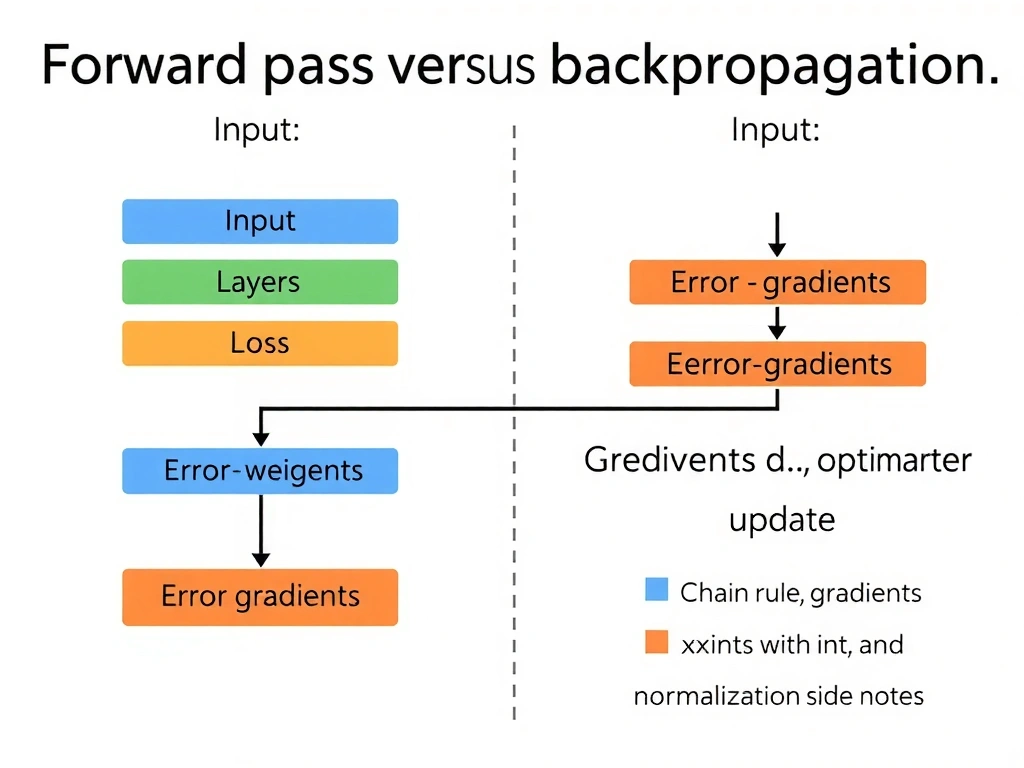
Okay, let's dive in. Training isn't just shoving data forward and hoping. After the network makes a guess, something has to answer: which knobs twisted the loss the wrong way? That's backpropagation. Think of it like this—you're debugging a long pipeline of functions, and you walk the error signal from the end back to the start, using the chain rule at every step. Boss walks in and asks why training is stuck: if you only did the forward pass or only initialized weights, you'd never know how to adjust anything. Exam trap: people mix up forward pass, init, and gradient descent itself. Land it: backprop = compute gradients backward from the loss. Got it? Sweet—keep rolling.
Full explanation below image
Full Explanation
Backpropagation is the workhorse algorithm that makes gradient-based training of multilayer neural networks practical. After a forward pass computes predictions and a scalar loss, backpropagation applies the chain rule of calculus to obtain partial derivatives of that loss with respect to every trainable weight and bias. Computation proceeds from the output layer toward the input layer, reusing intermediate activations so each layer's local Jacobian multiplies the incoming error signal efficiently. Those gradients then feed an optimizer such as stochastic gradient descent or Adam, which updates parameters to reduce loss on subsequent steps. Without this backward credit assignment, deep stacks of nonlinear layers would be almost impossible to train at scale.
This is distinct from several nearby concepts that often appear as distractors. Random initialization only chooses starting parameter values and does not attribute error to those parameters after a prediction is made. Input normalization improves conditioning of the optimization landscape and can speed convergence, but it does not itself calculate weight gradients. The forward pass is necessary—it produces the loss and the activations needed for the backward pass—but it is not the procedure that propagates error signals through the network. Gradient descent is the update rule that uses the gradients; backpropagation is how those gradients are computed efficiently in layered models.
In practice, automatic differentiation frameworks implement reverse-mode differentiation that corresponds to backpropagation for you, yet the conceptual model still matters for debugging vanishing or exploding gradients, designing residual connections, choosing activation functions, and understanding why deep sequential models struggle with long dependencies. Engineers inspect gradient norms, freeze layers, and redesign blocks precisely because they understand how error flows backward. A useful memory aid is the three-beat training step: forward to get the loss, backward to get the gradients, step to update the weights. On exams and in production reviews, associating a backward error signal plus the chain rule with backpropagation—and not with initialization, feature scaling, or the forward pass alone—keeps the answer clearly correct and grounded in how supervised neural training actually works end to end.