
In a multiclass neural classifier, what is the usual role of the softmax function in the final layer?
Select an answer to reveal the explanation.
Short Explanation and Infographic
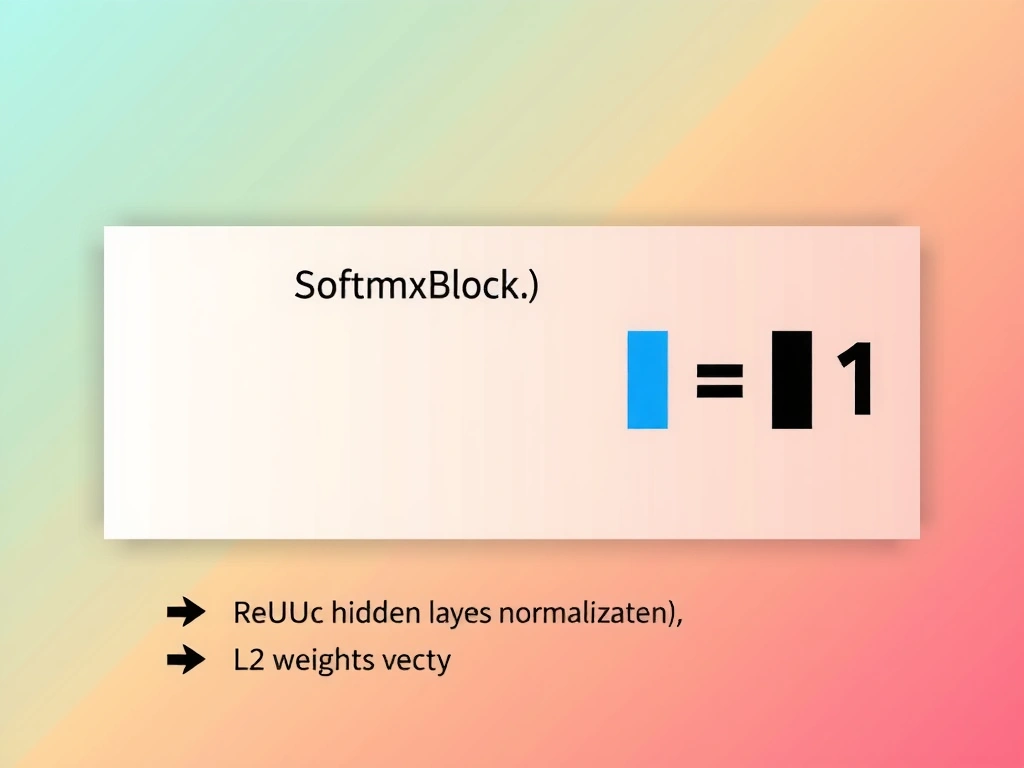
Check this out. After the network spits out a pile of raw scores—logits—you need something that says "class A is 70%, class B is 20%, class C is 10%." Softmax does that: exponentiate, divide by the sum, and boom—valid probabilities that add up to one. Think of it like splitting a whole pizza into slices for each class so nobody gets a negative slice. Boss wants a three-way product category model? Softmax on the last layer. Exam trap: people slap softmax on every hidden layer or confuse it with input normalization and weight decay. Land it: softmax = multiclass probability head. Pretty cool, and it shows up constantly on the exam.
Full explanation below image
Full Explanation
Softmax is the standard final activation for single-label multiclass classification in neural networks. Given a vector of logits from the last linear layer, softmax applies an exponential transform to each score and divides by the sum of those exponentials. The result is a vector of non-negative values that sum to one, which can be interpreted as a categorical probability distribution over mutually exclusive classes. Training often pairs softmax with categorical cross-entropy so that increasing the probability of the correct class decreases loss in a well-behaved way. Numerically stable implementations subtract the maximum logit before exponentiating to avoid overflow when scores are large in magnitude.
Softmax is not a general-purpose hidden-layer nonlinearity. Deep networks typically use rectified linear units, Gaussian error linear units, or similar activations in intermediate layers because they are cheaper to compute and avoid the saturation patterns that arise when softmax is applied indiscriminately across many hidden units. Softmax also is not input normalization: standardization or min-max scaling happens on features before or during batching, not as the classification head. Likewise, keeping weights small is the job of regularization techniques such as L2 penalties, dropout, early stopping, or explicit constraints—not the softmax transform itself.
Related distinctions help on exams and in design reviews. Sigmoid is common for binary classification or independent multi-label outputs where each label can be on or off without competing in a single simplex. Softmax assumes classes compete so that raising one class probability lowers others through the shared normalizer. Temperature scaling can soften or sharpen the distribution for calibration or sampling, but the core purpose remains turning scores into probabilities. A memory cue is that soft max softens a hard maximum by spreading probability mass while still favoring the largest logit. When a question asks why the final layer of a multiclass network uses softmax, answer in terms of a normalized probability distribution over classes—not hidden non-linearity, feature scaling, or weight shrinkage—and you will align with both theory and common deep-learning practice.