
What characterizes a generative AI model in neural network terms?
Select an answer to reveal the explanation.
Short Explanation and Infographic
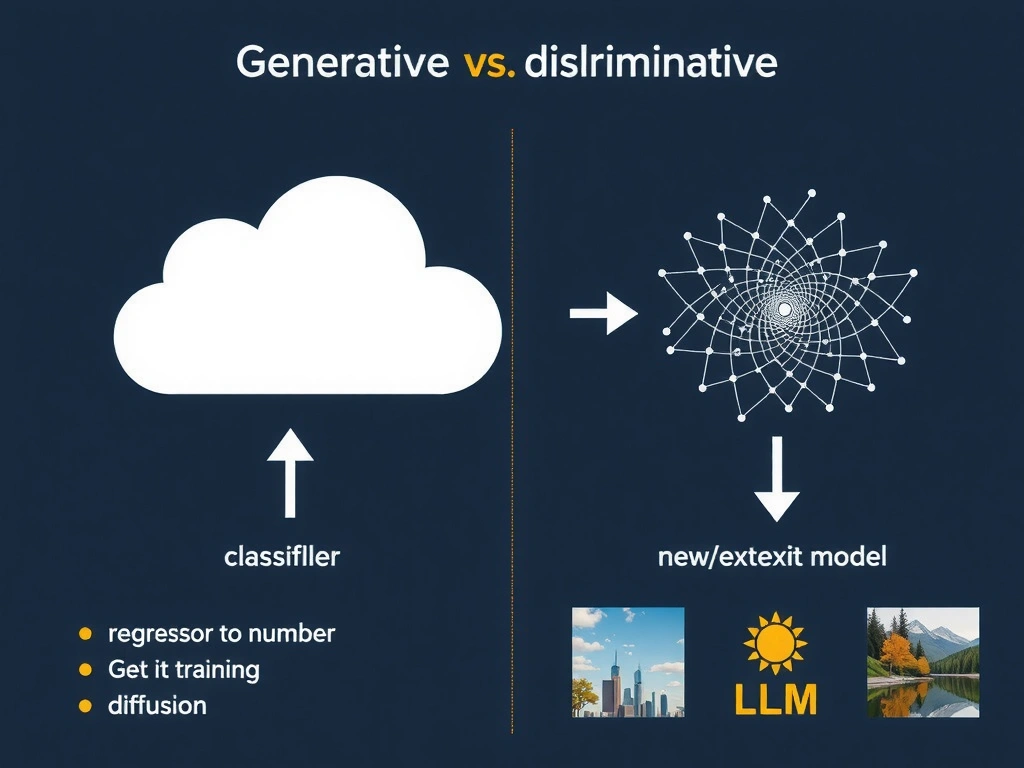
Generative AI is the "make something new" club. Train on lots of examples, then sample fresh text, images, code—stuff that looks like it could have come from the same world. Think of a chef who tasted a cuisine for years and can invent a new dish in that style—not someone who only stamps "soup" or "salad" on the menu. Classification labels categories. Regression spits a number. "Supervised" is how you train, not what generative means. Exam trap: people think generative equals any neural net—nope. Land it: generative = create new data similar to the training distribution. Pretty cool, right? Keep rolling.
Full explanation below image
Full Explanation
Generative models aim to capture the underlying probability distribution of data so that new samples can be drawn or constructed. In neural form this includes large language models predicting tokens, diffusion and flow models synthesizing images, variational autoencoders, and (in some domains) GANs. The hallmark is synthesis: outputs are newly formed instances—sentences never typed in the corpus, images never photographed, audio never recorded—yet statistically consistent with training patterns. Applications span content drafting, code assistants, design exploration, simulation, synthetic data for rare classes, and creative tools, always with caveats around factuality, copyright, bias amplification, and safety misuse.
Equating generative AI with "any supervised model" is incorrect. Supervised learning is a training paradigm using input–target pairs; a supervised image classifier is typically discriminative—it models p(y|x) to pick labels, not to invent new x samples. Some generative systems use supervised fine-tuning stages (instruction tuning, preference optimization), but that does not redefine the core generative capability of producing novel structured outputs. Models that only predict a single continuous value are regressors; models that only emit class labels are classifiers. Those discriminative systems are invaluable for decision-making and risk scoring but do not generate multi-dimensional samples from a data manifold by definition.
Practitioners distinguish generative from discriminative modeling in both theory and product design. They monitor sample quality with metrics such as FID for images, perplexity or win-rate for text, human preference studies, and toxicity or hallucination filters. Deployment often adds grounding, retrieval-augmented generation, watermarking, and policy layers. Memory aid: "Discriminative decides; generative invents." When an exam asks what a generative AI model is, choose the option about creating new data similar to the training distribution, not supervised-only training, not scalar regression, and not pure classification definitions.