
Why is the attention mechanism considered a breakthrough for many natural language processing models?
Select an answer to reveal the explanation.
Short Explanation and Infographic
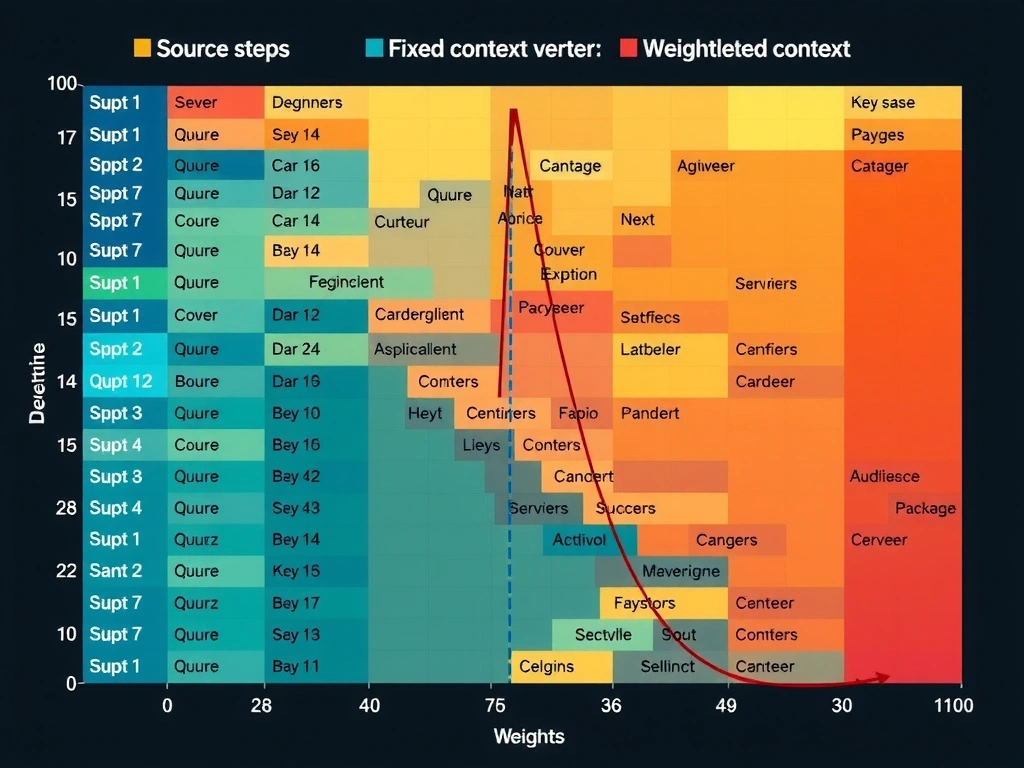
Here's where attention changed the game. Old seq2seq stuffed a whole sentence into one vector—like mailing a novel in a sticky note. Not very efficient! Attention says: at each step, look back and soft-focus on the words that matter. Think of a spotlight on a stage, not a single blurry photo of the cast. Trap: attention isn't a free lunch for tiny datasets, and it doesn't mean “ignore order.” Boss wants better long-document QA? Attention (and self-attention) is why modern NLP scales. Land the takeaway: attention = selective focus over the sequence so long-range context actually gets used.
Full explanation below image
Full Explanation
Before widespread attention, many encoder–decoder systems summarized an entire input sequence into one fixed-length context vector. That created an information bottleneck: early tokens could be forgotten, and the decoder had no flexible way to revisit source positions while generating. Attention mechanisms compute similarity scores between a query (for example, the current decoder state) and keys derived from encoder states, convert those scores into weights (typically via softmax), and form a weighted sum of values. The result is a context vector tailored to the current step rather than a single global summary. Soft alignments learned this way often match intuitive word correspondences in translation without hard-coded rules.
This dynamic focus is why attention is viewed as a major advance. It improves alignment in translation, strengthens long-sequence modeling, and underpins transformers, where self-attention lets every token attend to every other token (with positional information added separately). The same idea generalizes across modalities, but in NLP it unlocked dramatic quality gains on machine translation, summarization, question answering, and pretrained language models. Scaled dot-product attention and multi-head variants further stabilize training and let different heads specialize in different relational patterns such as syntax versus coreference cues.
Distractors overstate secondary points. Attention weights can be visualized and sometimes aid debugging, yet models remain hard to interpret overall; interpretability was not the primary breakthrough claim driving adoption. Attention does not magically enable training on tiny labeled sets—data efficiency still depends on pretraining, regularization, transfer learning, and task design. Finally, attention does not work by throwing away order; positional encodings or recurrent structure preserve sequence information while attention selects content. Ignoring order would destroy meaning in most languages.
Exam cue: if the stem stresses focusing on relevant parts of a long input and overcoming RNN fixed-context limits, choose attention’s selective weighting story—not interpretability marketing, small-data guarantees, or “ignore word order.” Remember the operational triple query–key–value: compare, normalize, and aggregate the parts that matter now.