
A product team is training a deep learning system to translate sentences between languages. Which architecture family is the standard choice for this sequence-to-sequence problem?
Select an answer to reveal the explanation.
Short Explanation and Infographic
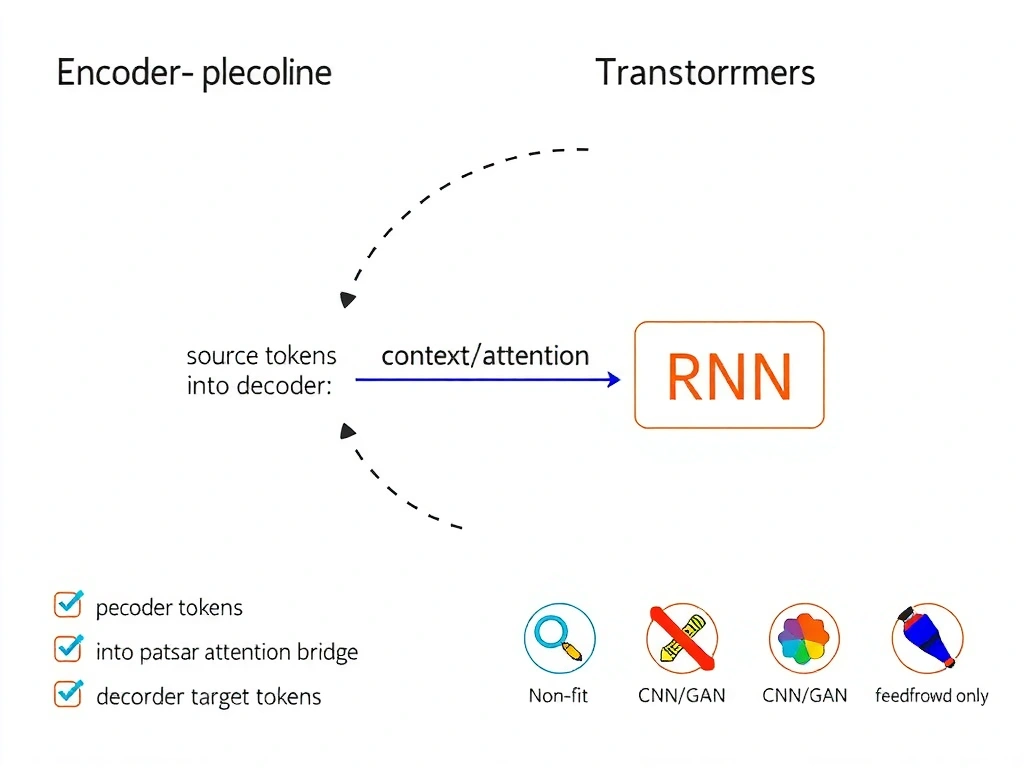
Let me show you how this works in the real world. Translation isn't one label—it's a whole output sentence conditioned on an input sentence. So you need sequence-to-sequence gear: encode the source, decode the target. Early systems used RNNs with encoder–decoder; today transformers own the leaderboard, same job with attention. If someone says “just slap a CNN or a GAN on it,” that's the exam trap—those shine elsewhere. Imagine your boss needs English→Spanish product docs by Monday; you reach for seq2seq MT, not image GANs. Takeaway: neural translation = encoder–decoder sequence models (RNN historically, transformer now).
Full explanation below image
Full Explanation
Neural machine translation (NMT) is a sequence-to-sequence problem: a variable-length source token sequence must be mapped to a variable-length target sequence, often of different length and order. The architectures that made NMT practical are encoder–decoder models. The encoder compresses or contextualizes the source; the decoder generates target tokens autoregressively, conditioned on encoder states and previously emitted tokens. Early breakthroughs used bidirectional RNNs or LSTMs with attention; contemporary systems predominantly use transformer encoder–decoder stacks (for example, the original “Attention Is All You Need” MT setup and its descendants). Both generations share the same high-level contract: read the whole source, then write the target one token at a time while consulting source context.
Attention (and self-attention) lets the decoder focus on relevant source positions at each generation step, which is critical for long sentences and reordering between languages. Training typically maximizes likelihood of reference translations on parallel corpora, with beam search or sampling used at inference. Quality depends on alignment learning, adequate bilingual data, subword tokenization for rare words, and careful decoding hyperparameters. Production MT systems may add terminology constraints, quality estimation, and domain adaptation on top of the same encoder–decoder core.
Why the distractors fail: a CNN specialized for spatial image features is the wrong primary family for general sentence translation, even though convolutional sequence models have been researched as historical alternatives. GANs are adversarial generative frameworks famous in image synthesis; they are not the industry-standard MT architecture and do not define the usual supervised translation training loop. A simple feedforward net without sequential machinery cannot gracefully handle alignment, variable length, and ordered dependencies across tokens, nor emit fluent multi-word outputs conditioned on an entire source sentence.
Practical memory aid: “MT = encode source, decode target.” Whether the backbone is recurrent or transformer-based, that encoder–decoder seq2seq pattern is the answer exam writers expect when a company “translates text from one language to another” with deep learning. If you see CNN, GAN, or shallow feedforward options, treat them as distractors that borrow fame from other AI domains without solving seq2seq translation.