
An operations team needs a deep learning model for live camera feeds that must detect vehicles and pedestrians frame by frame. Which network type is the best primary fit?
Select an answer to reveal the explanation.
Short Explanation and Infographic
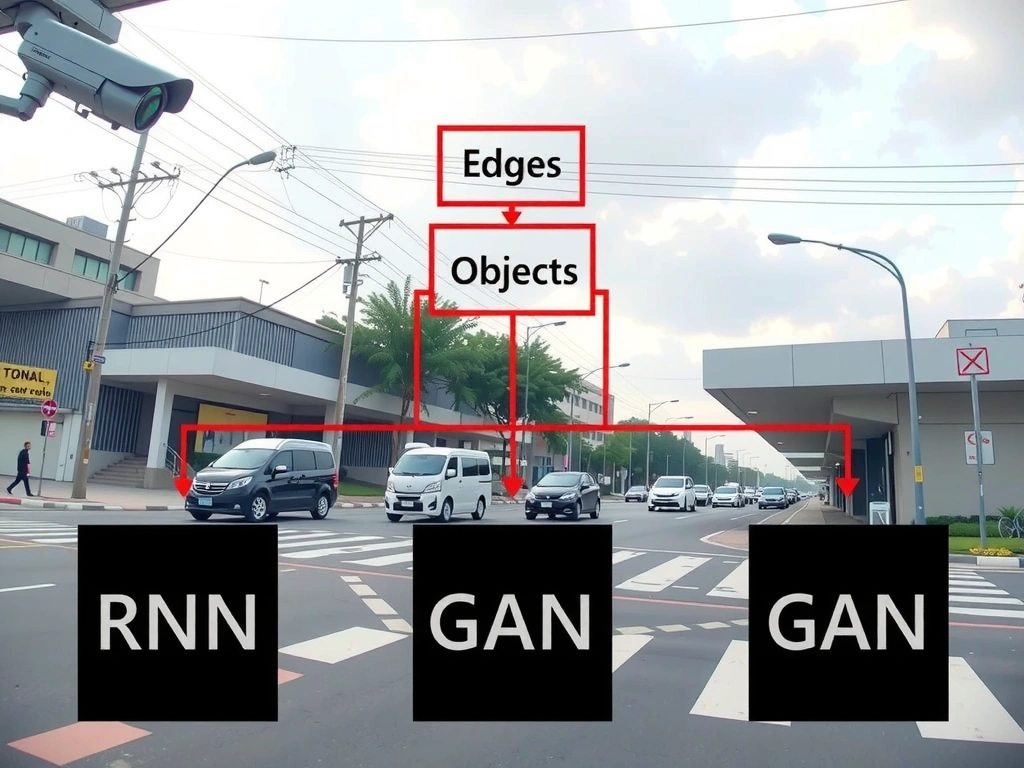
Boss walks in: “Spot cars and people on the cameras—now.” You don't start with a text RNN or a fancy image generator. You start with vision gear: CNNs. Convolutions slide little filters across pixels to find edges, shapes, then objects—perfect for detection. RNNs are sequence champs; GANs invent pictures; giant fully connected nets on raw pixels? Painful and weak for this. Video surveillance still processes visual structure per frame (often with tracking on top). Exam trap is picking RNN because “video is sequential.” Spatial detection first, CNN first. Got it? CNNs are your go-to for vehicles and pedestrians in frames.
Full explanation below image
Full Explanation
Detecting vehicles and pedestrians in video is fundamentally a computer-vision problem: each frame (or short clip) is a spatial grid of pixels in which objects appear with local structure, scale variation, and translation. Convolutional neural networks impose a strong inductive bias for this setting through local receptive fields, weight sharing, and hierarchical feature composition—from edges and textures to object parts and whole objects. Modern detectors (YOLO-style, SSD, Faster R-CNN family, and many transformer hybrids that still use convolutional stems) build on that CNN foundation to produce class labels and bounding boxes in real time or near real time. For live surveillance, that spatial recognition capability is the primary requirement before optional tracking links identities across frames.
Recurrent networks excel when the core signal is ordered tokens or time steps with long dependencies, such as language modeling. While temporal models can help tracking or action recognition after features exist, an RNN alone is a poor substitute for spatial feature extraction on raw frames and is not the best “type of neural network” answer for object detection in camera imagery. Generative adversarial networks learn to generate realistic samples via a generator–discriminator game; that objective is not object detection for safety monitoring and does not output calibrated boxes for vehicles and pedestrians. Fully connected networks that flatten images discard spatial locality, explode parameter counts, and generally fail to match CNN sample efficiency on vision benchmarks because every pixel connects densely without local sharing.
Deployment notes for surveillance: pair CNN detectors with multi-object tracking, camera calibration, and strict latency budgets; consider edge inference accelerators; evaluate false positives carefully to avoid alert fatigue; and retrain when lighting, angles, or camera models change. Privacy and retention policies also matter operationally but do not change the architectural choice. For the exam, map “detect objects in camera imagery” to CNN-centered vision architectures, not RNNs, GANs, or plain dense nets. A useful memory cue is “pixels with shapes → convolutions first.”