
What is the primary purpose of BERT (Bidirectional Encoder Representations from Transformers)?
Select an answer to reveal the explanation.
Short Explanation and Infographic
Here's the deal with BERT: it's a pretrained language brain you fine-tune. Bidirectional means it looks left and right in the sentence—super handy for understanding, not primarily for writing novels token-by-token. Think of it like studying with the whole paragraph visible, then later specializing for the quiz: sentiment, NER, question answering. Exam trap: they'll offer GPT-style next-word generation or image toys. BERT isn't a diffusion model and isn't ResNet for photos. Boss says, "We need solid text classification with limited labels"—pretrained BERT plus a small head is the classic play. Takeaway: pretrain bidirectional encoders, fine-tune widely. Stick that in your pocket for the test.
Full explanation below image
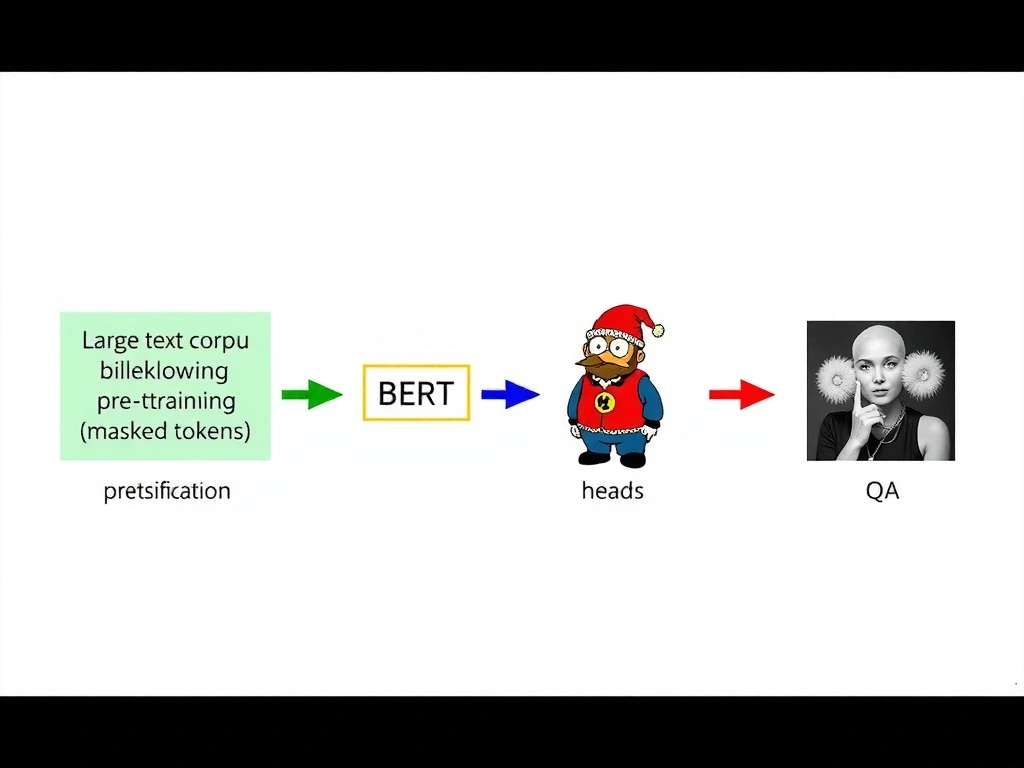
Full Explanation
BERT popularized large-scale pretraining of Transformer encoders for natural language understanding. During pretraining, objectives such as masked language modeling encourage the model to reconstruct hidden tokens using both left and right context, yielding deep bidirectional representations. Optional next-sentence-style objectives were used historically as well. After pretraining on large corpora, practitioners attach lightweight task heads and fine-tune on labeled data for sentence classification, token labeling, span-based question answering, and related NLP problems.
This purpose differs from autoregressive language models optimized to predict the next token left-to-right for open-ended generation. While both families use Transformers, BERT-style models shine at understanding and encoding text, whereas decoder-only LMs dominate free-form generation. Confusing BERT with computer-vision classifiers or generative image models misses the modality and objective entirely: BERT is about language representation learning, not ImageNet labels or pixel synthesis.
From an exam perspective, anchor three facts: (1) bidirectional encoder Transformer, (2) pretrain then fine-tune paradigm, (3) broad NLP transfer rather than a single narrow task. Related concepts worth linking—but not conflating—include WordPiece tokenization, [CLS]/[SEP] special tokens, and the later ecosystem of variants (RoBERTa, ALBERT, domain-specific BERTs). Modern LLM chat systems often use decoder architectures; that evolution does not rewrite BERT's original role in the curriculum.
Practically, BERT-style transfer learning reduced the need to train deep NLP models from scratch on every small dataset, a major MLOps and research shift. When a question asks for BERT's main purpose, answer with pretrained bidirectional representations for fine-tuning across NLP tasks—not next-word storytelling, not image labeling, not image generation. That precise scope is what most certification items test.