
Which description correctly defines a feedforward neural network?
Select an answer to reveal the explanation.
Short Explanation and Infographic
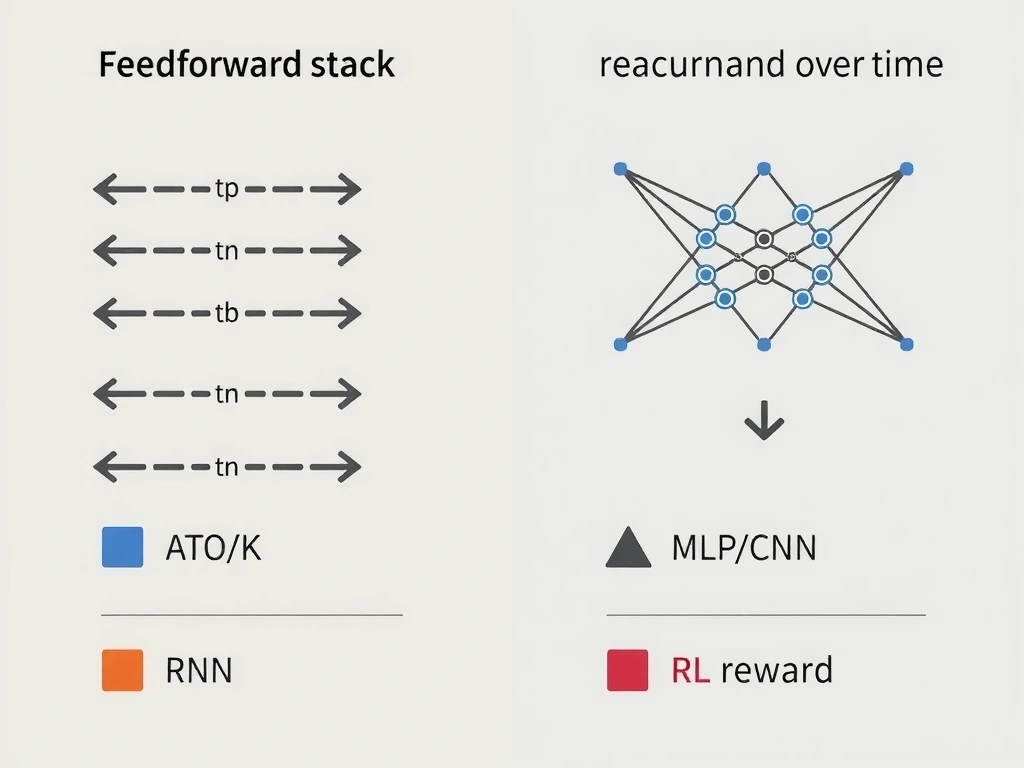
Okay, let's clear the naming fog. Feedforward means the signal goes in one way: input → hidden → output. No looping back on itself during the forward pass. Think of a one-way street—cars don't circle the block inside the same pass. RNNs do loop state through time; that's the contrast the exam loves. Trap options will wave "cycles," "images only," or "rewards." CNNs are feedforward too, by the way—they're just structured for grids. RL is about the learning signal, not this topology. If your boss sketches a plain MLP for tabular data, you're looking at feedforward. Remember: acyclic forward flow = feedforward; cycles over time = recurrent. Got it? Sweet.
Full explanation below image
Full Explanation
Feedforward neural networks compute a mapping from inputs to outputs by stacking layers such that, in the forward pass, information does not cycle back to earlier layers. The computation graph is directed and acyclic with respect to layer connectivity: each layer transforms its inputs and passes results onward until the output layer produces predictions. Multilayer perceptrons are the canonical example; convolutional networks and many Transformer blocks used in a single forward evaluation are also feedforward in this structural sense, even though training uses backpropagation (which is not a recurrent data cycle in the model topology).
This definition is often contrasted with recurrent neural networks, where hidden states feed into future time steps and connections form loops when time is considered. Recurrence is appropriate for sequential state, but it is the opposite of the feedforward constraint. Another confusion is task exclusivity: feedforward nets are not "vision only." They are used for tabular prediction, audio spectrograms, NLP (as non-recurrent stacks), and more. CNNs specialize feedforward computation with local connectivity and weight sharing; they remain feedforward architectures.
Reinforcement learning confuses learning paradigm with network topology. An RL agent may use a feedforward policy network, a recurrent policy, or both; receiving rewards does not define feedforward structure. On exams, match vocabulary carefully: feedforward = one-way layer flow without recurrent cycles; recurrent = temporal feedback; convolutional = spatial inductive bias inside (usually) feedforward stacks.
Why it matters operationally: feedforward models are simpler to parallelize across a batch, easier to reason about for latency, and avoid some temporal gradient issues of RNNs—though deep feedforward stacks have their own optimization challenges. Memory aid: draw arrows only to the right for feedforward; if you need an arrow looping to a past state, you have left the pure feedforward club. That simple diagram distinction answers most definition items cleanly and correctly.