
When training a neural network, what is the main role of the Adam optimizer regarding parameter updates?
Select an answer to reveal the explanation.
Short Explanation and Infographic
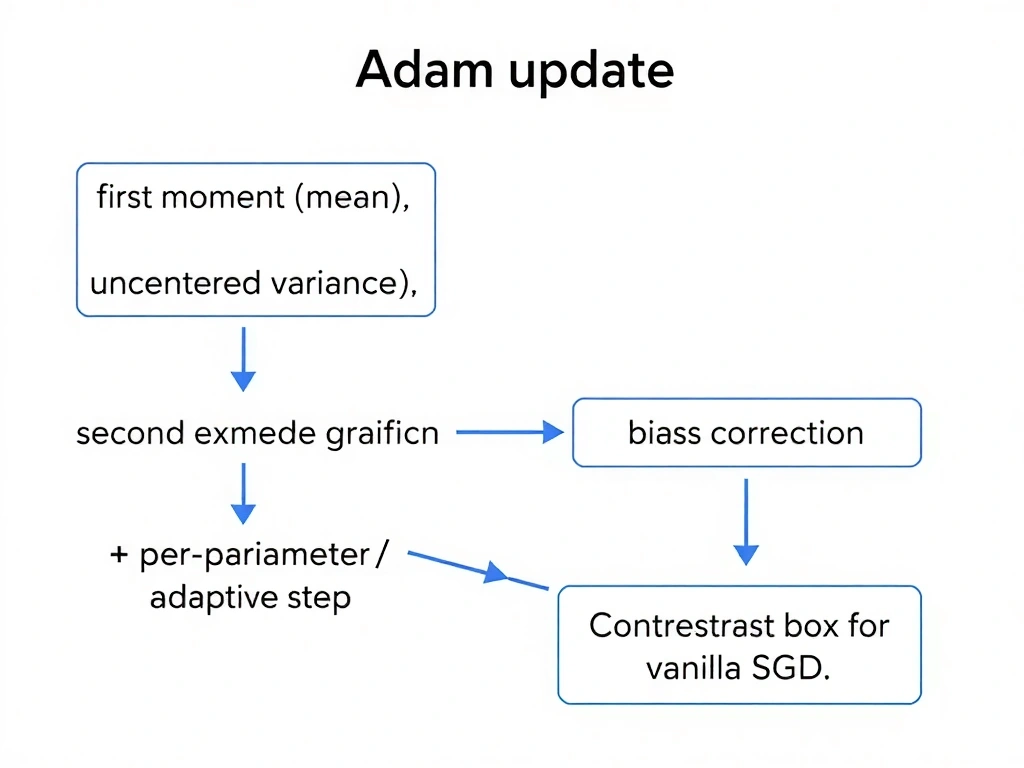
Let's talk Adam like you're about to train tonight. Adam doesn't just glance at today's gradient and shrug. It keeps a short memory of recent gradient directions and how wild the magnitudes have been, then scales each weight's step. That's the adaptive magic. Trap answers describe plain SGD (current gradient only, fixed rate) or weight decay/clamping. Different tools! Imagine driving with cruise control that eases up on bumpy roads per wheel—that's closer to per-parameter adaptation. Boss wants stable training without hand-holding every layer's learning rate—Adam's often the default. Remember: first moment + second moment → adaptive updates. You can still schedule a base learning rate, but adaptivity is the headline.
Full explanation below image
Full Explanation
Optimizers translate gradients into parameter updates. Vanilla SGD multiplies the current mini-batch gradient by a learning rate and subtracts that product from the weights. Adam instead maintains exponential moving averages of the gradients (first moment, related to momentum) and of the element-wise squared gradients (second moment, related to adaptive scaling). After bias correction early in training, the update divides a momentum-like term by a root-mean-square scale of recent gradients, yielding a distinct effective step size for each parameter.
That adaptive behavior is Adam's main role in training: stabilize and accelerate optimization when parameters receive gradients of very different scales, which is common in deep networks. Practitioners still choose a base learning rate, betas, epsilon, and often decoupled weight decay (AdamW), but those knobs refine a method whose core idea is moment-based adaptation—not a permanently frozen global rate.
Distractors target nearby ideas. A constant learning rate with no moment state is closer to basic SGD. Explicitly keeping weights small is regularization (L2/weight decay, max-norm constraints) rather than Adam's identity. Using only the instantaneous gradient without historical moments again describes SGD. Note that Adam can be combined with learning-rate schedules; schedules change the global scale over time, while Adam still adapts relatively across parameters.
For certification study, pair this item with the earlier "advantage versus SGD" question: one focuses on benefits (often faster/more robust convergence), the other on mechanism (first and second moments). Memory phrase: "Adam remembers direction and scale." In production, monitor training curves, try AdamW for generalization, and remember that optimizer choice interacts with batch size, normalization layers, and model architecture—but the exam answer for Adam's main role remains adaptive per-weight updates from gradient moment estimates.