
In a standard multilayer neural network, what is the role of a hidden layer?
Select an answer to reveal the explanation.
Short Explanation and Infographic
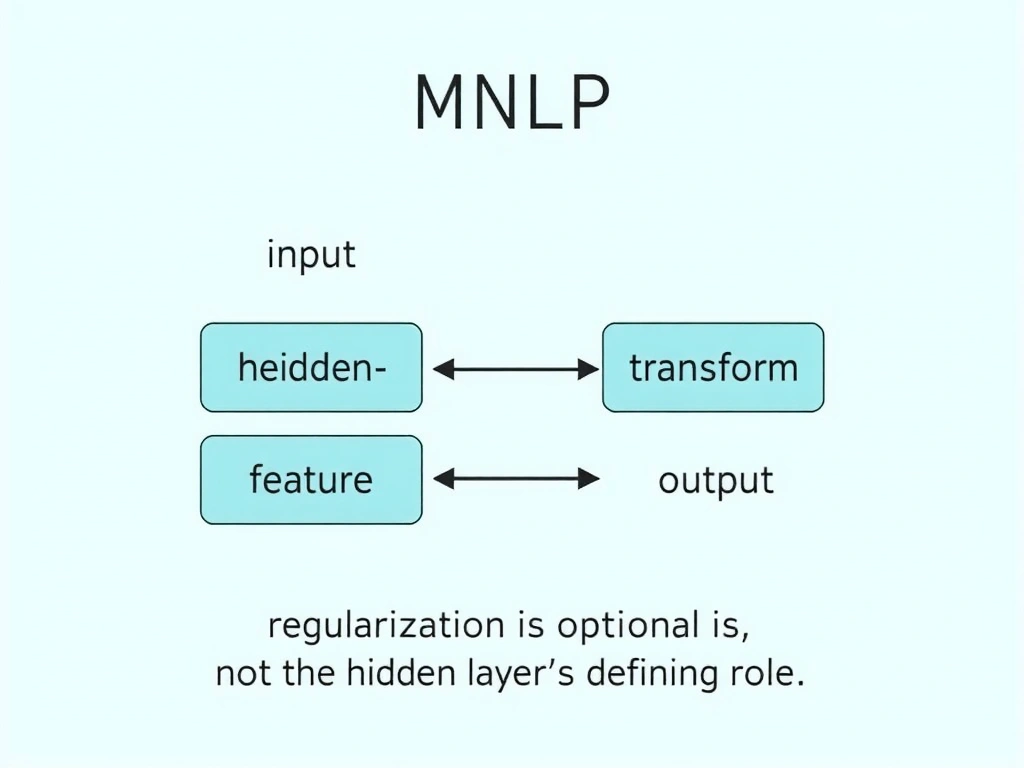
Here's where it gets interesting for you. Inputs come in, outputs go out—and everything cooking in the middle? Those are hidden layers. They mash and reshape the data into smarter representations: edges become shapes, tokens become meaning. Think of a restaurant kitchen between the order ticket and the plated dish—the cooking happens out of sight, but that's where the real work is. Exam trap: don't confuse hidden with input or output, and don't say hidden layers exist only to stop overfitting. Dropout might sit in hidden layers, but their job is transformation. Boss asks why deeper nets work? Stacked hidden layers build hierarchy. Takeaway: hidden = intermediate feature computation. Practice sketching a tiny MLP and label input, hidden, output.
Full explanation below image
Full Explanation
A feedforward neural network is typically described as an input layer, one or more hidden layers, and an output layer. The input layer presents features; the output layer produces task-specific predictions such as class logits or continuous estimates. Hidden layers occupy the middle: each unit computes a weighted combination of its inputs followed by a nonlinearity (ReLU, GELU, etc.), yielding a new representation that subsequent layers consume.
Those intermediate representations are where capacity and hierarchy live. Shallow hidden layers may capture simple interactions among features; deeper stacks compose them into increasingly abstract concepts—exactly the pattern exploited in deep learning. Width (units per layer) and depth (number of hidden layers) are primary capacity knobs. Training adjusts the hidden weights so that the final representation is linearly (or simply) separable for the output head when possible.
Common misconceptions map layer names incorrectly. The input layer is not "hidden"—its activations are the observed data (or embeddings of that data). The output layer is not hidden either; its neurons are tied to labels or reconstruction targets and are evaluated by the loss. Another trap is treating hidden layers as pure regularizers. While techniques like dropout are often applied to hidden units, the fundamental purpose of a hidden layer is computation and feature extraction. Regularization is an additional concern about generalization.
For exams, use a structural definition: if a layer is neither the raw input interface nor the final prediction interface, it is hidden. Relate this to universal approximation intuition—nonlinear hidden units enable networks to model complex functions that a single linear map cannot. In practice, also connect hidden depth to vanishing gradients, residual connections, and normalization, but keep the core definition crisp: hidden layers transform intermediate representations between input and output.