
Compared with classic stochastic gradient descent (SGD), what is the primary practical advantage of the Adam optimizer?
Select an answer to reveal the explanation.
Short Explanation and Infographic
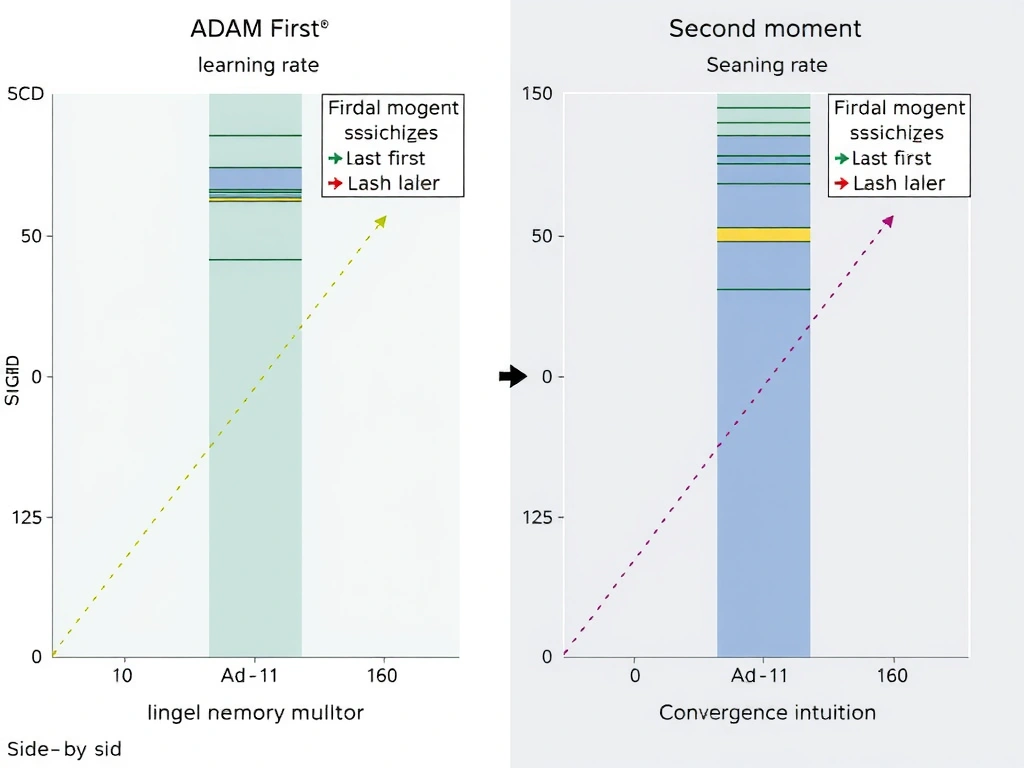
Here's the deal: plain SGD takes steps with a fixed learning rate (maybe with a schedule), same idea for every weight. Adam says, "I'll remember recent gradient directions and how noisy or large they've been," and it adapts the step size per parameter. That's why it often races to a good valley faster—especially early in training. Exam trap: don't pick "uses less memory" or "simpler." Adam keeps two moment buffers, so it's heavier and more complex than vanilla SGD. Think of it like a driver who both keeps momentum on the highway and eases off the gas on twisty roads—per parameter. Boss wants a model training by Monday? Adam is often your default. Just know the trade-off: more state, usually faster convergence.
Full explanation below image
Full Explanation
Stochastic gradient descent updates parameters using gradients computed on mini-batches, typically with a global learning rate that may be decayed over time. Momentum variants add a velocity term so updates keep moving in consistent directions. Adam (Adaptive Moment Estimation) goes further: it maintains exponential moving averages of both the gradients (first moment) and the squared gradients (second moment). After bias correction, those estimates produce an adaptive learning rate for each parameter. Parameters that receive large, noisy gradients get dampened steps; parameters with small, steady gradients can take relatively larger effective steps.
This combination—momentum-like first moments plus RMSProp-style second moments—is why Adam frequently converges faster or with less manual learning-rate fuss than plain SGD on many deep networks, including transformers and CNNs. Practitioners still tune beta hyperparameters and weight decay (e.g., AdamW), but the adaptive mechanism reduces the pain of a single global step size across layers with very different gradient scales.
Memory and simplicity myths are common distractors. Because Adam stores first and second moments for every trainable weight, its optimizer state is larger than SGD or SGD with only momentum. Implementation is also more involved than the one-line SGD update. Suitability is not limited to small datasets; Adam is a workhorse in large-scale training, though carefully tuned SGD with momentum and schedules can still win on some vision benchmarks for final generalization.
When studying for exams, map optimizers by what state they keep and what they adapt: SGD (gradient only), Momentum (velocity), RMSProp/AdaGrad-family (second-order scale), Adam (first + second moments). The key advantage versus SGD is not elegance or thrift—it is adaptive, momentum-aware updates that often reach low loss more quickly. In production, choose Adam for robust defaults; revisit SGD-style recipes when you need maximum final accuracy and have budget for careful tuning.