
In modern AI, what does LLM stand for, and which neural architecture do contemporary LLMs most commonly build on?
Select an answer to reveal the explanation.
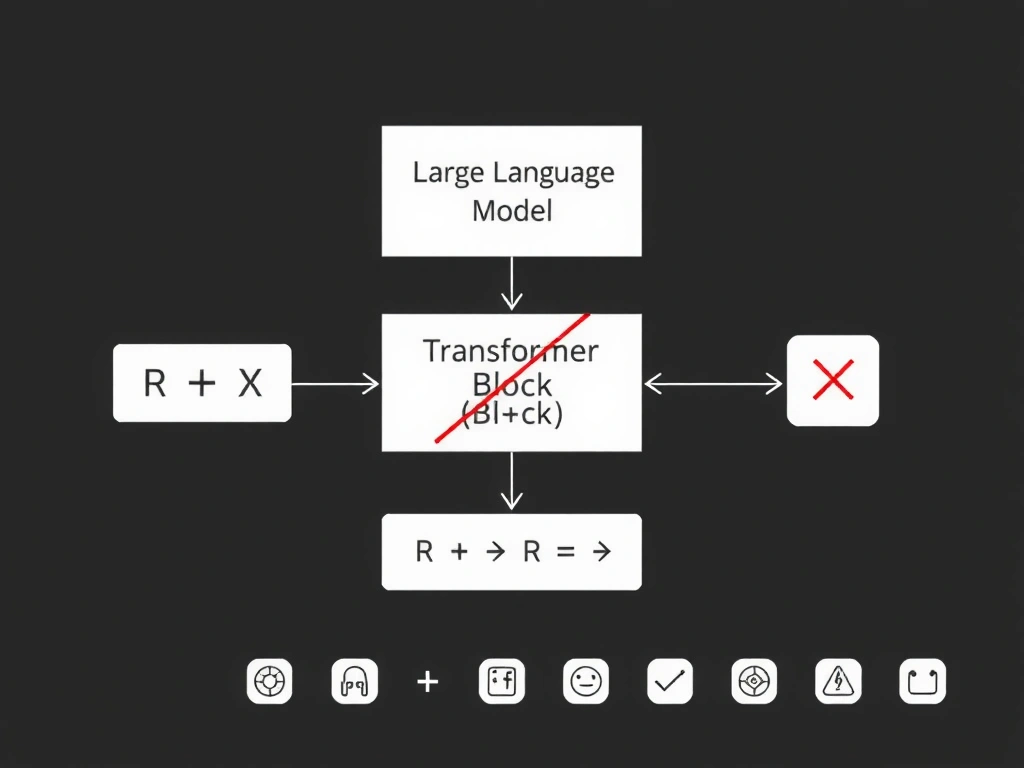
Short Explanation and Infographic
Check this out—LLM is Large Language Model, not some "long learning" mashup. And the stack under nearly every chat model you use today? Transformers with self-attention, not old-school RNNs marching token by token. Think of a Transformer like a meeting where every word can look at every other word in parallel—way better for long context than pure recurrence. Exam trap: they'll throw plausible expansions and older architectures at you. Don't bite. RNNs mattered historically; symbolic rules are a different world; linear regression is not an LLM. When the boss asks what powers that coding assistant, you say: large language model on Transformers. Land it: Large + Transformer. Got it? Let's keep rolling.
Full explanation below image
Full Explanation
An LLM, or Large Language Model, is a neural model trained on massive text (and often multimodal) corpora to predict or generate language at scale. The "large" refers to parameter count, data volume, and compute—typically billions of parameters—enabling emergent abilities such as in-context learning, instruction following, and code generation after appropriate training and alignment stages.
Architecturally, contemporary LLMs are overwhelmingly based on the Transformer family introduced by Vaswani et al. Transformers replace recurrence with self-attention (and feed-forward sublayers, residual connections, and normalization). Attention lets each token attend to others in the context window, capturing long-range dependencies more effectively than classic RNNs or LSTMs for many language tasks, and enabling highly parallel training on GPUs and TPUs. Decoder-only stacks (GPT-style), encoder-only stacks (BERT-style), and encoder–decoder stacks (T5-style) are all Transformer variants; generative chat and code assistants are usually decoder-only or closely related designs.
Incorrect expansions test whether candidates memorize marketing noise or real terminology. "Long Learning Model," "Linear Learning Machine," and "Logical Language Model" are not standard expansions. Pairing LLM with RNNs reflects an older sequence-modeling era; RNNs still appear in niches, but they are not the default backbone of modern foundation LLMs. Linear regression cannot express the hierarchical representations these models learn. Symbolic or logical systems encode explicit rules rather than distributed neural representations learned from data.
Exam and interview takeaway: define LLM correctly, then name Transformer/self-attention as the dominant architecture. Bonus depth: distinguish pretraining objectives (next-token prediction, masked language modeling), scaling laws, and post-training (instruction tuning, RLHF/RLAIF) without confusing those stages with the core architectural fact. That clean two-part answer—Large Language Model + Transformer—covers the overwhelming majority of certification-style items on this topic.