
During neural network training, which statement best describes the primary job of the loss function?
Select an answer to reveal the explanation.
Short Explanation and Infographic
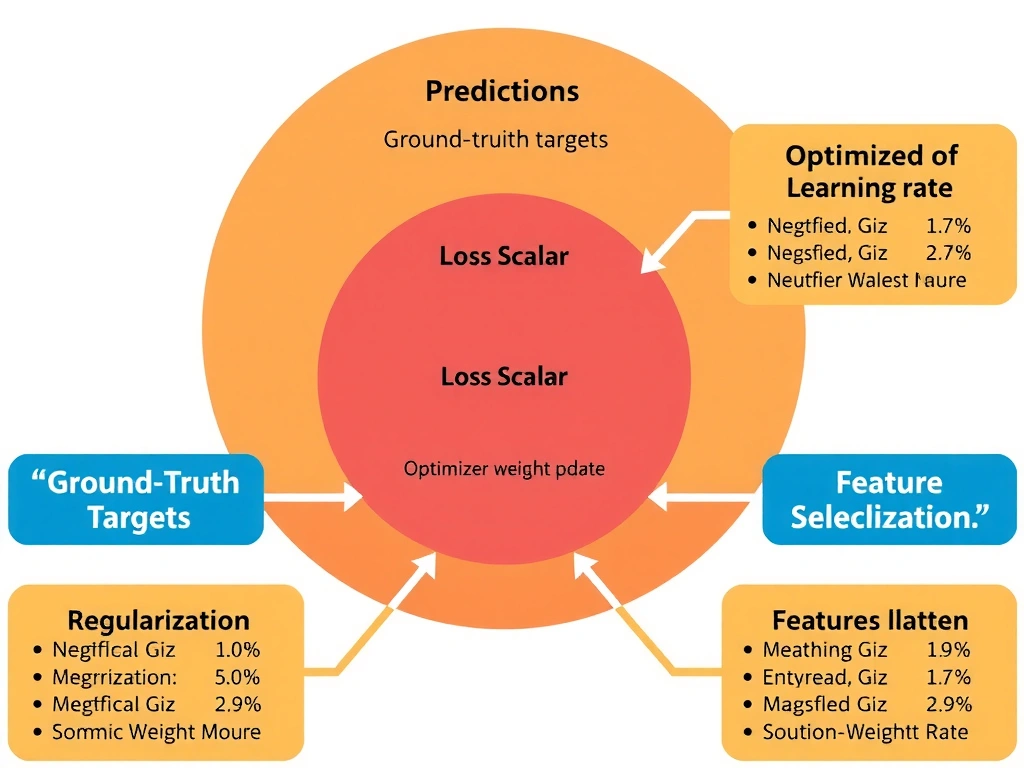
Okay, let's dive in. Think of training like tuning a radio until the song comes in clear. The loss function is the static meter—it tells you how bad the signal still is by comparing what your model guessed with what the label actually is. Your optimizer then uses that number to nudge the knobs (the weights). Here's the exam trap: people mix up the loss with regularization or with learning-rate tricks. Nope. Dropout fights overfitting; the learning rate is a separate dial. The loss is pure scorekeeping: prediction versus truth. Imagine your boss walks in mid-training and asks, "How wrong are we right now?"—you point at the loss. Got it? Sweet. Remember: loss measures error; optimizers act on that signal.
Full explanation below image
Full Explanation
In supervised deep learning, training is an iterative process of improving predictions by adjusting model parameters. The loss function (also called a cost or objective function) is the mathematical measure of how incorrect those predictions currently are relative to the ground-truth targets. For regression, mean squared error is common; for multi-class classification, categorical cross-entropy is typical. Whatever the form, the loss produces a scalar (or sometimes structured) signal that backpropagation can differentiate so gradients flow to every trainable weight.
This measurement role is foundational. Without a loss, there is no principled way to say one set of weights is better than another for the task. Optimizers such as SGD or Adam do not invent goals; they minimize the loss you defined. Changing the loss changes what the model optimizes for—class balance, robustness, ranking quality, and so on—so choosing an appropriate loss is part of problem design, not a minor implementation detail.
The distractors confuse the loss with neighboring concepts. Regularization (L2 penalties, dropout, early stopping) is often applied through or alongside the loss, but its purpose is to improve generalization, not to define raw prediction error. Feature selection chooses or ranks inputs before or outside the core training loop; the loss does not perform that ranking. Learning-rate selection and scheduling control step size for the optimizer; the loss value informs gradients but does not itself calculate the learning rate.
A practical memory aid: prediction pipeline → loss scores the mistake → gradients of the loss update parameters. On exams and in production debugging, when someone asks what the loss "does," answer first with error measurement. Only then discuss which loss family fits the task and how regularization or adaptive optimizers interact with it. Keeping that separation clear avoids common design mistakes, such as expecting the loss alone to prevent overfitting or to auto-tune hyperparameters without explicit mechanisms.