
While reviewing a binary classifier’s metrics, you observe a low F1 score. What does that primarily indicate?
Select an answer to reveal the explanation.
Short Explanation and Infographic
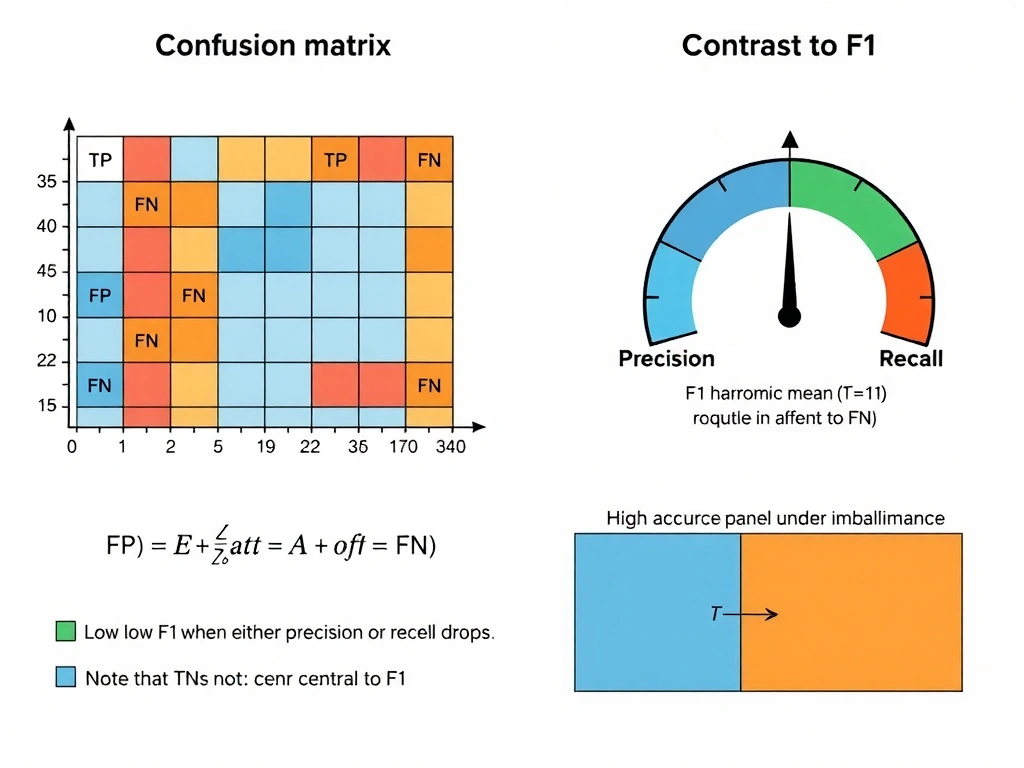
Let me show you how this works in the real world. Precision asks, "When I flag fraud, am I right?" Recall asks, "Of all real fraud, how much did I catch?" F1 smashes those two together with a harmonic mean—if either side is sad, F1 looks sad too. Low F1 means that balance is off; maybe you're missing cases, crying wolf, or both. Boss stares at a dashboard after a skewed dataset made accuracy look like a home run—F1 is the reality check. Exam trap: low F1 is not a death sentence for the algorithm forever, not a code for "accuracy is high," and not "lots of true negatives." Land it: low F1 = weak precision/recall combo. Run a tiny confusion matrix once by hand and you'll never forget.
Full explanation below image
Full Explanation
For binary classification, precision equals true positives divided by the sum of true positives and false positives, while recall equals true positives divided by the sum of true positives and false negatives. The F1 score is the harmonic mean of precision and recall: F1 equals two times precision times recall, divided by the sum of precision and recall. The harmonic mean penalizes imbalance harshly: if either precision or recall approaches zero, F1 collapses even when the other metric looks excellent. Therefore a low F1 primarily signals that the model is not achieving a healthy joint precision-recall trade-off on the positive class of interest under the chosen decision threshold and data distribution.
This interpretation is especially important under class imbalance. Accuracy can remain high when a model almost always predicts the majority class, while F1 on the minority class stays low and business outcomes suffer. Threshold choice, class weights, resampling strategies, and improved features can move precision and recall—and thus F1—without necessarily abandoning the entire algorithm family. Related tools include precision-recall curves, average precision, and F-beta scores that weight recall more or less heavily than precision when costs are asymmetric.
The distractors encode common misconceptions that appear on exams. Declaring the model type permanently unsuitable overreads a single scalar metric; diagnosis should include threshold sweeps, error analysis, data quality review, and comparison with alternative models when needed. Claiming that accuracy is necessarily very high contradicts how low F1 often appears precisely when accuracy is misleading. Emphasizing true negatives confuses F1 with specificity or overall correctness; F1’s ingredients are true positives, false positives, and false negatives through precision and recall, not a celebration of true negatives.
Memory aid: F1 is a both-doors-must-open score for the positive class. Exam tip: if the stem says low F1, look for language about poor precision-recall balance rather than accuracy, true-negative counts alone, or an automatic veto of the algorithm. Best practice is to report F1 with context including class prevalence, operating threshold, and the business cost of false positives versus false negatives so stakeholders interpret the number correctly.