
What is the main purpose of one-hot encoding in a machine learning pipeline?
Select an answer to reveal the explanation.
Short Explanation and Infographic
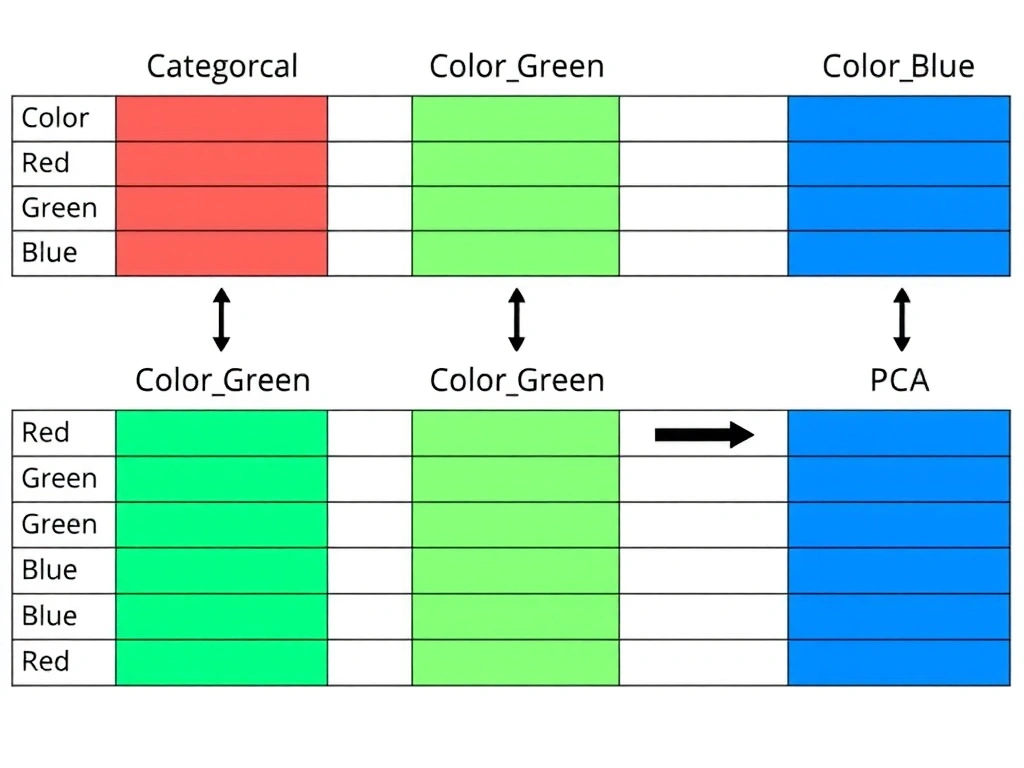
Okay, let's dive in. Models love numbers. Your "color = red/green/blue" column is words. One-hot encoding builds a little light switch for each category—red on, others off—so the algorithm sees clean 0s and 1s without pretending red is "greater than" green. Think of it like coat-check tickets: each color gets its own hook, not a ranking on a shelf. Boss brings a CRM export full of plan types and regions—encode those categoricals before the linear model or neural net chokes. Exam trap: don't confuse one-hot with min-max scaling, dropping nulls, or PCA. One-hot usually adds columns; it doesn't shrink the feature space. Land it: categories → binary indicators. Got it? Sweet.
Full explanation below image
Full Explanation
Many machine learning algorithms operate on numeric tensors and cannot consume raw string categories directly. Nominal categorical variables such as product type, country, or device operating system have no intrinsic numeric order. Assigning arbitrary integers like zero, one, and two can mislead linear models and distance metrics into treating categories as ordinal quantities with meaningful magnitude. One-hot encoding addresses this by expanding a categorical column into multiple binary features, each indicating membership in one category. For a feature with k levels, practitioners typically create k columns, or k minus one columns if a reference level is dropped to avoid perfect multicollinearity in unregularized linear models.
That is the purpose stated in the correct option: make categoricals numeric and usable without imposing false ordinal structure. Related encodings include ordinal encoding when a true order exists, target or mean encoding with careful leakage controls, frequency encoding, and learned embeddings for high-cardinality categories. Robust pipelines fit category vocabularies on training data only, persist those mappings, and define an explicit policy for unseen levels at inference time so production scoring does not fail silently.
Scaling continuous features into an interval such as zero to one is normalization or min-max scaling, which is a different preprocessing step aimed at numeric magnitude. Removing or imputing missing values is data cleaning and completeness handling. Dimensionality reduction seeks fewer derived variables; one-hot encoding generally increases dimensionality, which can worsen the curse of dimensionality for very high-cardinality fields and motivates alternatives such as hashing tricks or embeddings in those cases.
Best practices include monitoring cardinality before encoding, aligning encoding choice with model family—tree models sometimes tolerate integer codes more safely than linear models do—and preventing target leakage in any supervised encoding scheme. Exam memory aid: one-hot means category light switches, not scale, not impute, and not principal component analysis. If an option talks about ranges of continuous variables or fewer latent axes, it describes a different tool in the preprocessing toolkit. Connecting encoding decisions to model assumptions is a core skill for both production pipelines and certification questions.