
What is a primary practical advantage of support vector machines (SVMs) compared with simpler linear classifiers such as logistic regression?
Select an answer to reveal the explanation.
Short Explanation and Infographic
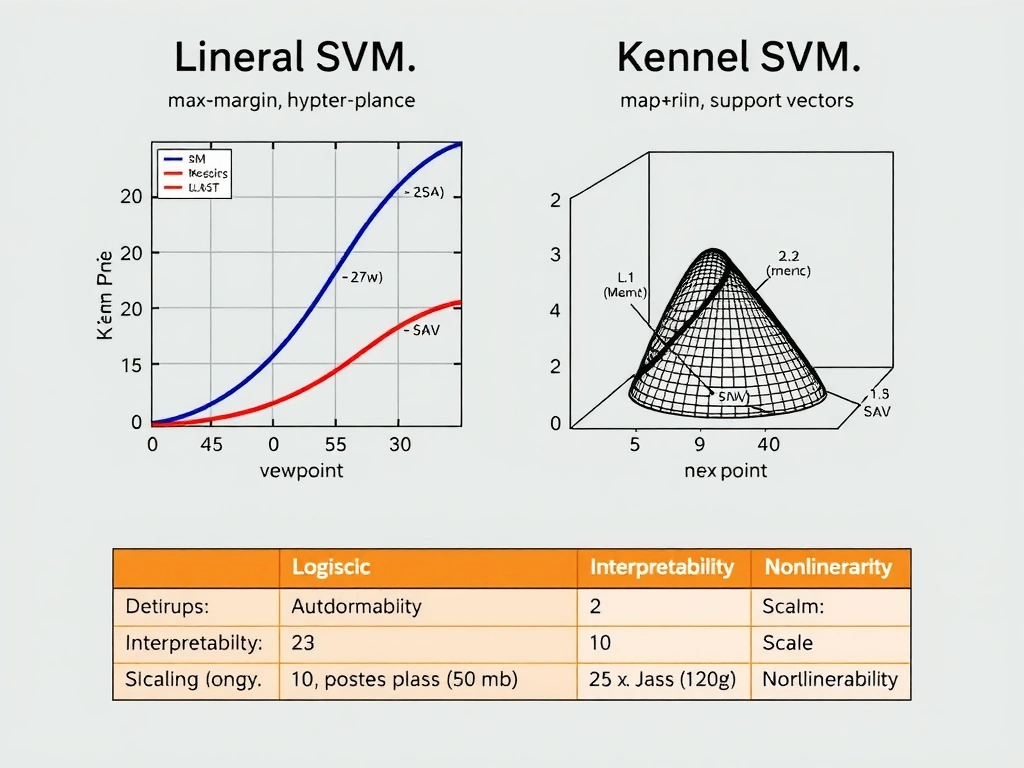
Pay close attention here, because this one bites people on the exam. Logistic regression draws a clean linear (in feature space) probability boundary—nice and readable. SVMs chase a maximum-margin separator and, with kernels, can bend that boundary around messy blobs without you hand-crafting every interaction term. High-dimensional text or bio features? SVMs often feel right at home. Think of it like stretching a rubber sheet until two classes have the widest safe hallway between them—and kernels are the magic that lets the hallway curve. Trap: SVMs aren't automatically more interpretable, aren't always faster on big data, and they can still overfit. Land it: SVM strength = high-D + kernels for nonlinearity. Trust me on this—when you see “kernel” and “margin,” think SVM advantages.
Full explanation below image
Full Explanation
Support vector machines find a decision boundary that maximizes the margin between classes, focusing learning on critical support vectors near the boundary rather than on every training point equally. In the linear case this yields a hyperplane with strong theoretical grounding and good behavior in high-dimensional spaces. The kernel trick allows inner products to be computed as if data were mapped into an implicit higher-dimensional feature space, so nonlinear patterns can become linearly separable there without explicitly materializing huge feature maps. Common kernels include linear, polynomial, and radial basis function kernels. This combination of margin maximization and kernels made SVMs historically strong on high-dimensional problems such as text classification with bag-of-words features and on moderate-sized nonlinear datasets where a flexible boundary helps.
That advantage contrasts with plain logistic regression, which models log-odds as a linear function of the original features unless you manually engineer nonlinear terms or switch to a different architecture. Logistic regression shines when calibrated class probabilities and coefficient-level interpretability matter to stakeholders. SVMs historically emphasize geometric separation, dual formulations, and support vectors; soft-margin formulations and the regularization parameter C still control the trade-off between margin width and training errors.
Distractors reverse real trade-offs that certification items frequently test. Interpretability usually favors linear logistic models over kernel SVMs, whose decision surfaces can be difficult to explain. Training time on very large sample sizes can favor linear models, stochastic gradient methods, or approximate solvers; classical quadratic-programming style SVM training is not universally the fastest option. Overfitting remains possible: a highly flexible kernel with poorly chosen C or gamma settings can memorize noise, so validation and regularization remain mandatory.
Exam and practice cues: associate SVM with margins, support vectors, and kernels; associate logistic regression with probabilities and coefficients. Modern practice may prefer tree ensembles or neural networks for many tabular tasks, but certification questions still test classic SVM strengths. Memory aid: high dimensions plus nonlinear modeling via kernels is the SVM advantage line, while claims that SVMs are always more interpretable, always fastest, or immune to overfitting are almost always false. Choose the model that matches data size, need for probabilities, and deployment constraints rather than treating any one classifier as universally superior.