
When is unsupervised learning typically the most appropriate modeling approach?
Select an answer to reveal the explanation.
Short Explanation and Infographic
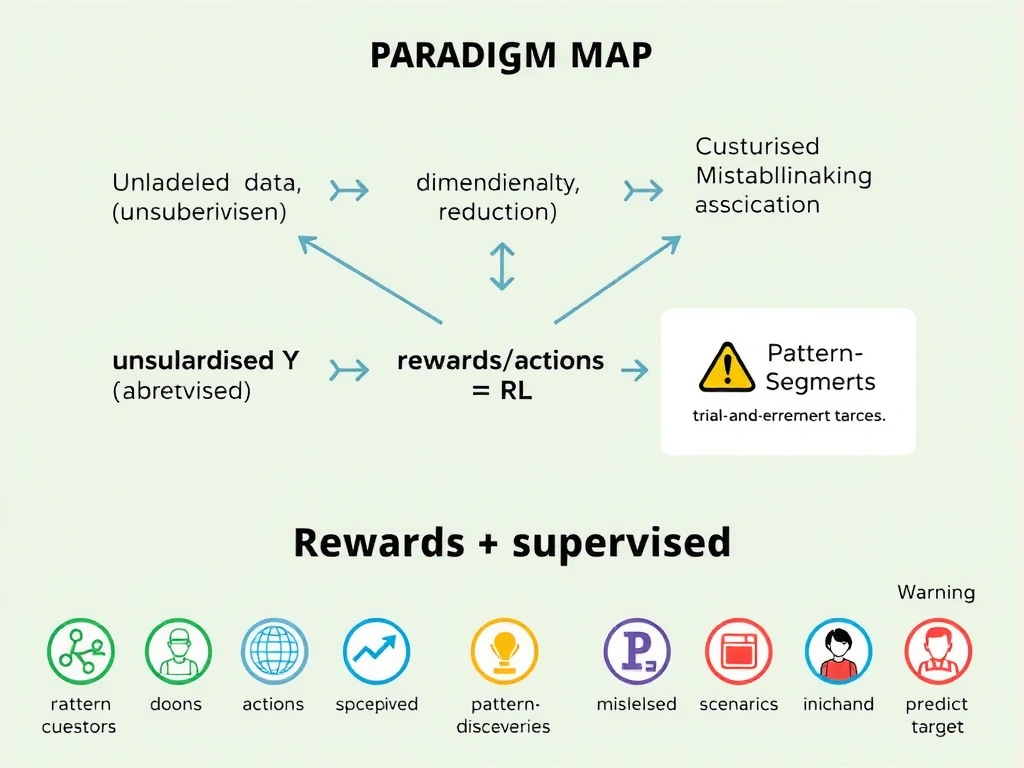
Here's where it gets interesting for you. Sometimes you don't have answers in the spreadsheet—just raw behavior, clickstreams, sensor dumps. Unsupervised learning says, "Fine—let's find the natural clumps and patterns anyway." Think of sorting a messy junk drawer without labels on the boxes: you group by shape and use, not by a grade someone's already written down. Boss walks in with a warehouse of unlabeled events and asks what segments exist—that's unsupervised. Exam trap: trial-and-error with rewards is RL; predicting a known column is supervised no matter how many features you have. Land the takeaway: no targets + structure discovery = unsupervised. When the exam hands you "unlabeled" and "hidden patterns," that's your cue. Keep rolling.
Full explanation below image
Full Explanation
Machine learning paradigms are chosen by what supervision signal exists and what the business question asks. Supervised learning requires labeled targets and optimizes prediction of those targets on new examples. Unsupervised learning receives features without paired outcomes and seeks internal structure: grouping similar items through clustering, finding frequent co-occurrence through association analysis, estimating density, detecting anomalies as low-density regions, or compressing representation with methods such as principal component analysis and autoencoders. Semi-supervised learning mixes scarce labels with abundant unlabeled data, while reinforcement learning optimizes sequential decisions via rewards rather than a fixed labeled column.
Unsupervised learning is therefore most appropriate when labels are absent or when the explicit goal is exploration of structure rather than prediction of a predefined target Y. Customer segmentation without a churn flag, topic discovery in document collections, market-basket analysis, and exploratory compression of high-dimensional telemetry are standard examples. Teams often use unsupervised results as inputs to later supervised models or as decision-support tools for human experts who assign business meaning to clusters and components.
Trial-and-error policy learning is reinforcement learning: the feedback is reward over time in an interactive environment, not merely the absence of a class column. Having a small but labeled high-dimensional dataset still points to supervised methods, possibly with regularization or dimensionality reduction as helpers; width of the feature table does not convert a labeled prediction task into unsupervised learning. Any project brief that says success means accurately predicting a known outcome column on new rows is supervised by definition, whether the outcome is categorical or continuous.
Best practices for unsupervised work include validating outputs with domain experts, checking cluster stability across seeds and samples, and measuring downstream utility such as whether segments improve campaign performance, because there is no single universal accuracy label. Exam memory aid: unsupervised answers “what structure is in X,” supervised answers “what is Y given X,” and reinforcement learning answers “what action maximizes reward.” Match the paradigm to the available signal first, then select algorithms and evaluation protocols that fit that paradigm rather than forcing every problem into a labeled classification template.