
What is the principal distinction between a single decision tree classifier and a random forest classifier?
Select an answer to reveal the explanation.
Short Explanation and Infographic
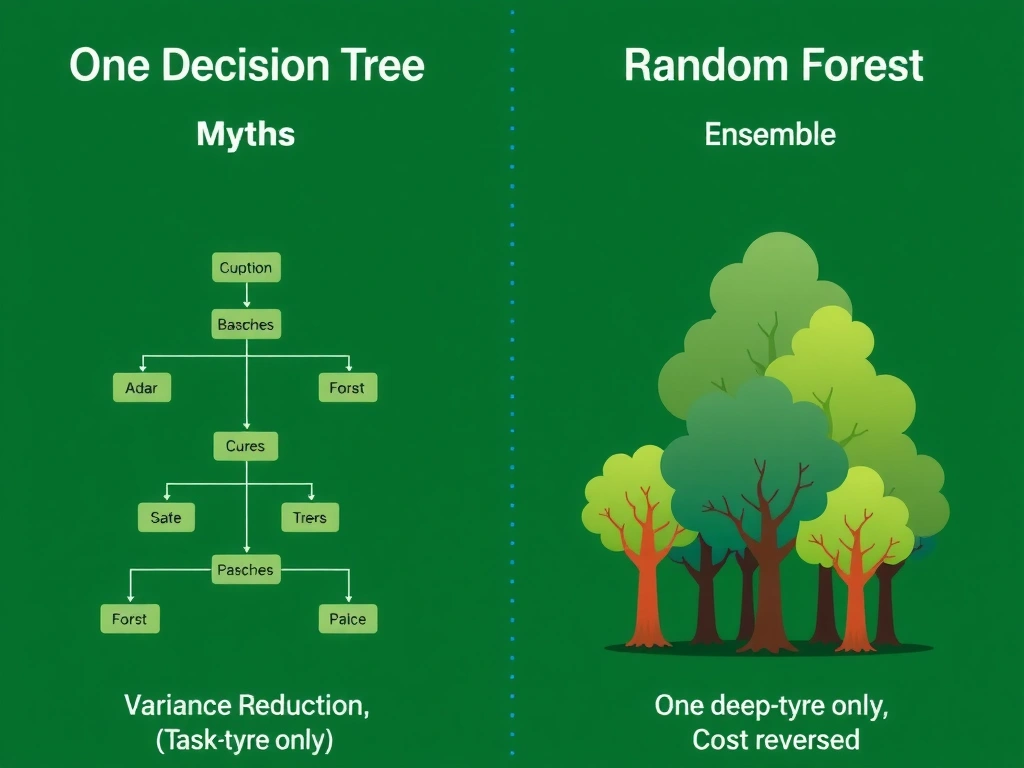
Check this out. A decision tree is one flowchart of splits—great story, but it can be jumpy and overfit. A random forest is a whole committee of trees: each one sees a slightly different slice of rows and features, then they vote. Think of it like asking one expert versus polling a diverse panel. Boss wants a stabler churn model by Friday? Forest usually beats the lonely tree on accuracy and variance. Exam trap: don't invent that forests are “one deep tree,” that trees are slower than forests, or that one is only for regression. Land it: tree = single model; forest = ensemble of trees with bagging and feature randomness. Pretty cool, right? Practice sketching one stump versus a vote of stumps and it'll stick.
Full explanation below image
Full Explanation
A decision tree recursively partitions the feature space using axis-aligned or similar splits chosen to improve purity or reduce prediction error. Predictions at leaves are class majorities, probability estimates, or local averages of the target. Individual trees are highly interpretable because each path is a conjunction of human-readable conditions, but they are also high-variance learners: small changes in the training data can produce very different structures, and deep trees easily overfit noisy patterns. That variance is exactly why ensemble methods built on trees became so popular for tabular data.
A random forest addresses variance through ensemble learning. It trains many trees on bootstrap samples of the training data, a technique known as bagging, and at each candidate split it considers only a random subset of features. Final classification is typically a majority vote across trees, while regression forests average the numeric outputs. Diversity among trees makes their individual errors less correlated, so aggregation often improves generalization relative to a single unpruned tree. Feature randomness is as important as row bootstrapping because it prevents every tree from repeatedly choosing the same dominant predictors at the top of the structure.
The correct option captures that ensemble definition with bootstrap sampling and feature randomness. Computational cost usually rises with the number of trees, so claiming a single tree is more expensive than a full forest reverses the typical comparison. Calling a random forest “one deep tree” confuses depth with ensemble size and misses the variance-reduction story. Restricting trees to regression and forests to classification is false: both families have regression and classification forms; the distinction is single model versus a bagged, feature-randomized ensemble of trees.
Principles and exam cues: bagging reduces variance; feature randomness further decorrelates base learners; forests trade some interpretability for accuracy and robustness. Related methods include gradient boosting, which fits trees sequentially on residuals, and extremely randomized trees, which inject even more split randomness. Memory aid: forest equals many trees plus bootstrap plus random features plus aggregation. If an option forgets “many trees,” it is not defining random forest. In practice, tune tree count, maximum depth or leaf size, and feature subsample rate with validation rather than assuming defaults always win.