
A team trains a model to estimate each customer’s expected monetary lifetime value as a continuous dollar amount. Which type of machine learning problem is this?
Select an answer to reveal the explanation.
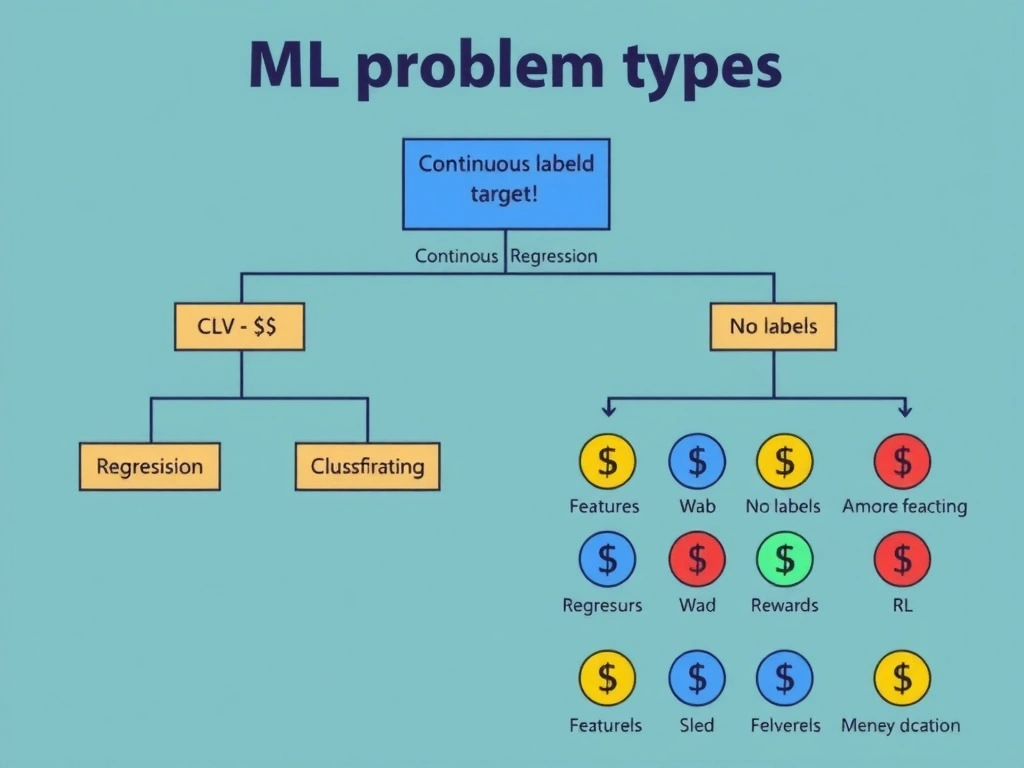
Short Explanation and Infographic
Here's the deal: if the answer is a number on a sliding scale—dollars, temperature, risk score—you're usually in regression land. Customer lifetime value? That's money, continuous, labeled from past customers. Think of it like predicting next month's electric bill, not sorting mail into pass/fail bins. Boss walks in: "Tell me what each account is worth over the next three years." You don't answer with a cluster id or a reinforcement policy—you fit a supervised model to a continuous target. Exam trap: people see "customers" and jump to clustering, or they mix up classification because marketing loves segments. Segments can come later; the problem as stated is predict a continuous value. Land the takeaway: continuous labeled target → regression. You've got this.
Full explanation below image
Full Explanation
Supervised learning maps input features to known targets drawn from historical labeled data. When the target is continuous—revenue, temperature, demand, expected lifetime value—the problem class is regression. When the target is categorical, the problem is classification. Unsupervised methods such as clustering operate without a target column and seek structure among inputs alone. Reinforcement learning frames interaction with an environment through actions, states, and rewards over time, not a single static prediction of a historical label. Choosing the wrong paradigm early leads teams to pick unsuitable metrics, architectures, and evaluation designs.
Predicting customer lifetime value as a monetary amount is the textbook regression setting. Historical customers supply features such as tenure, purchase frequency, average order size, and channel, together with a continuous outcome measuring realized or carefully estimated value. Algorithms may include ordinary linear regression, regularized linear models, gradient-boosted trees, neural networks, or other regressors; the problem type does not change merely because the algorithm family changes. What matters for the exam definition is that a numeric Y is being predicted from X under supervision.
Clustering might later group customers for marketing campaigns, but grouping without predicting the dollar target is not the same task as estimating lifetime value. Reinforcement learning could appear in sequential marketing or dynamic pricing policies, yet that formulation requires an agent-environment loop and a reward signal, not a one-shot continuous forecast from a static feature table. Classification would apply if the team instead predicted discrete buckets such as high, medium, or low value, or binary churn flags; the stem specifies a continuous dollar amount, so classification is incorrect.
Principle: read the target type first. Continuous targets imply regression; discrete labels imply classification; no labels with structure discovery imply unsupervised learning; sequential decisions with rewards imply reinforcement learning. Exam memory aid: “how many dollars?” is regression language, while “which bin?” is classification language. Best practice still includes proper holdout evaluation, leakage checks that avoid using future spend features unavailable at prediction time, and a clear business definition of lifetime value so the continuous label is computed consistently across training and production scoring.