
In machine learning, what does the curse of dimensionality primarily describe?
Select an answer to reveal the explanation.
Short Explanation and Infographic
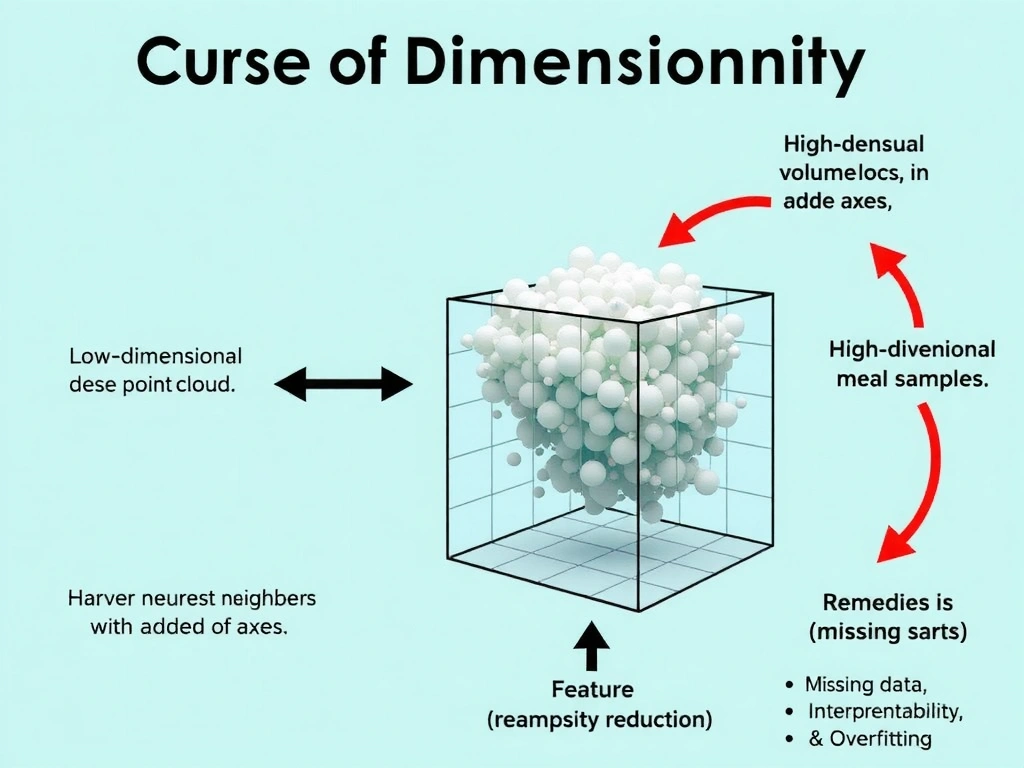
Okay, let's dive in. Imagine you scatter a few marbles on a table—easy to see neighbors. Now stretch that table into a hundred-dimensional warehouse. Same marbles, huge empty space. That's the curse of dimensionality: more features blow up the volume of the space so your data looks thin and lonely. Distance metrics get weird, density estimates go flaky, and models need way more samples to learn solid patterns. Exam trap: folks pick “missing values,” “hard to interpret,” or “overfitting” because those also hurt models—but the curse is specifically about sparsity as dimensions explode. Think of it like this: more knobs on the dashboard doesn't automatically mean more signal if you don't have enough data to cover the dials. Land it: high dimensions → sparse data → harder training. Got it? Sweet.
Full explanation below image
Full Explanation
The curse of dimensionality refers to a family of problems that appear when the number of features (dimensions) grows large relative to the amount of data. In a fixed sample size, adding dimensions expands the volume of the input space exponentially. Points that were relatively dense in a few dimensions become sparse; nearest neighbors move farther apart on average; and many classical assumptions—local smoothness, reliable density estimation, and stable distance comparisons—break down. As a result, supervised models may need far more examples to cover the space, distance-based methods such as k-nearest neighbors and some kernel methods can degrade, and noise dimensions can dominate true signal. Practitioners often first notice the issue when validation error plateaus or distances between points become nearly uniform, which robs algorithms of meaningful neighborhood structure.
The correct answer states this core idea: more features sparsify the data and make training and generalization harder. Practical mitigations include collecting more representative data when feasible, careful feature selection guided by domain knowledge, regularization that shrinks weak coefficients, and dimensionality reduction techniques such as principal component analysis, learned embeddings, or domain-driven feature pruning. Dropping irrelevant sensors or engineered columns can restore workable density without discarding the business signal you care about.
The distractors mix nearby pain points that exams love to confuse with the curse. Missing values create incomplete observations and require imputation or deletion strategies; they do not define the curse of dimensionality. Difficulty interpreting a high-parameter model is an explainability and governance issue—important ethically and operationally, but orthogonal to geometric sparsity in feature space. Overfitting from excessive model capacity is a related training risk: high-dimensional feature spaces can encourage overfitting, yet the curse itself is about the geometry and statistics of the data manifold, not solely “too complex a hypothesis class.”
Memory aid: curse means too much empty space for the samples you have. Exam questions often tempt you with any high-dimension headache; pick the option that names sparsity of data in an expanding feature space. Best practice is to ask whether each new feature pays for the volume it adds—if not, shrink the space before you scale model complexity. Connecting feature engineering choices to sample size is one of the most reliable ways to keep high-dimensional projects trainable and trustworthy.