
Which description best characterizes the Bayesian approach to machine learning?
Select an answer to reveal the explanation.
Short Explanation and Infographic
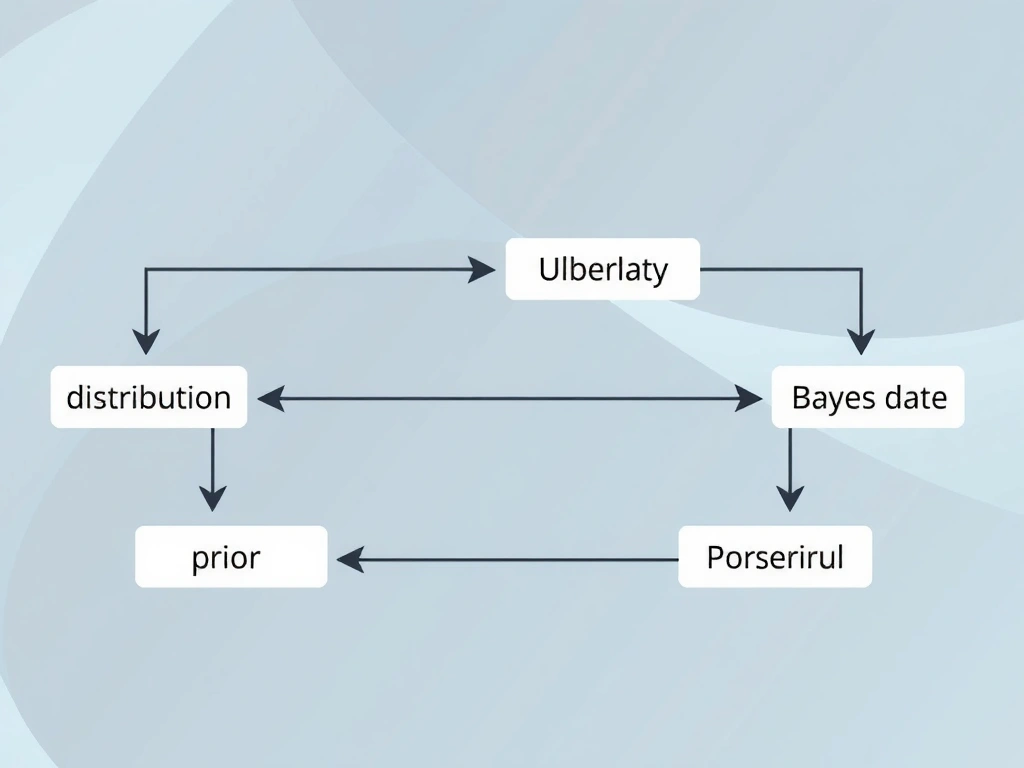
Okay, let's dive in. Bayesian learning is "start with a prior belief, see the data, update." Think of a doctor who has a hunch about a diagnosis, then revises odds after lab results. That's prior → posterior. It's not "unsupervised only," not "just pick one best point and forget uncertainty," and not "a type of neural net." Exam trap: treating Bayesian as a model architecture checkbox. It's a way of reasoning with probability. When you hear prior, likelihood, posterior—that's the Bayesian story. Sweet—remember: update beliefs with data under probability rules.
Full explanation below image
Full Explanation
The Bayesian approach treats unknown quantities—parameters, latent variables, even model indices—as random variables with probability distributions. A prior encodes beliefs before seeing the current dataset. The likelihood links parameters to observations. Bayes rule yields the posterior proportional to likelihood times prior, which becomes the new belief after observing the data. Predictions often integrate over the posterior, a practice known as Bayesian model averaging, rather than plugging in a single parameter vector, which naturally expresses uncertainty about what the right parameters are.
This framework is orthogonal to the supervised versus unsupervised split: you can have Bayesian linear regression, Bayesian mixture models, Bayesian optimization, and Bayesian neural networks. Computation may use conjugate closed forms when available, or Markov chain Monte Carlo, variational inference, or Laplace approximations when posteriors are intractable. Priors act as regularizers; strong priors shrink estimates toward theoretically or historically plausible values, while vague priors let the data dominate. Hierarchical priors share strength across groups, which is useful when each group has limited samples.
Distractors fail for clear reasons. Labeling Bayesian learning as purely unsupervised confuses a probabilistic philosophy with a data-labeling regime. Claiming it only seeks a single best model without uncertainty opposes the posterior-centric worldview, even when maximum a posteriori point estimates are used for convenience in deployment. Calling it a neural network type confuses methodology with architecture; a network can be trained with Bayesian or non-Bayesian procedures.
Compared with pure maximum-likelihood training, Bayesian methods emphasize coherent updating and calibrated uncertainty—valuable for small data, risk-sensitive decisions, sequential learning, and experimental design. Predictive intervals can reflect parameter uncertainty, not only residual noise. For exams, associate Bayesian machine learning with priors, likelihoods, posteriors, and belief updating under probability rules, not with a single algorithm brand name or a claim that it is only clustering. When a stem mentions prior belief updated with new evidence, the Bayesian approach is the intended concept.